
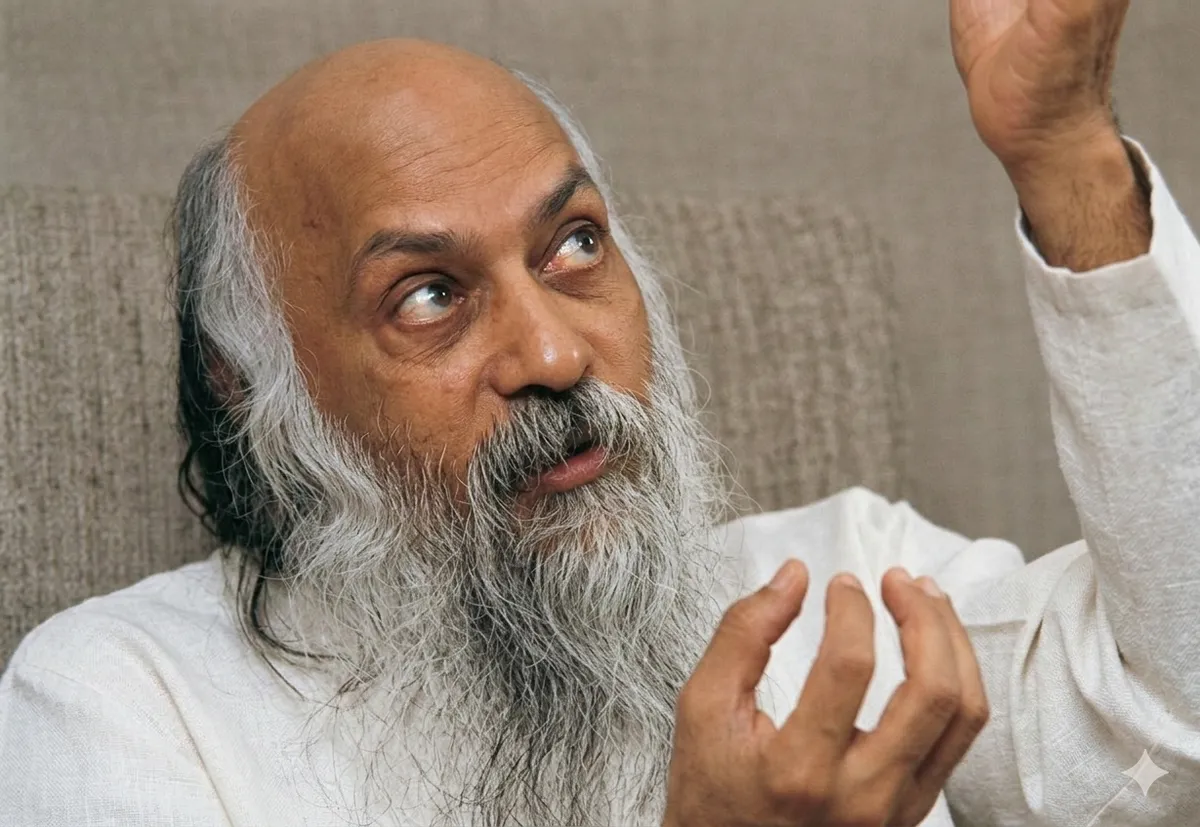
Osho's perspective on Abraham
When Osho Spoke About Abraham
Passages from the discourses where this theme comes alive.
Osho, I heard you say that jesus' finger pointing to the moon is not a very good one. Is there a better one?
God is somewhere far away in space -- how far none of them have said. Although this Maria goes four times a month, I don't think she can say the exact distance from the earth to heaven. She meets Jesus once a week, has a direct contact with God. Certainly these entities are outside you; the God is outside. You can have a direct contact, you are not it. You can meet Jesus once a month; certainly you are not Jesus. Jesus is separate from you, then only is meeting possible. And the woman goes to heaven -- of course there is a distance that has to be traveled. So there is a distance in space, and there is a distance in time, because Jesus continuously talks about the kingdom of God -- but that is going to happen after this life. Everything of Jesus' religion is after death. So…
Osho, before Mahavira there were twenty-three Tirthankaras. Then Mahavira’s family members must have been followers of someone—Mahavira himself was not a follower of anyone—so were they followers of Parshvanath or of someone else? How did it happen that Mahavira, who forged his own path and was not anyone’s disciple, ended up with a path that coincided with Parshvanath’s path, or with that tradition? Because that path already existed! And the name “Jain” for the sect is associated with Mahavira; before him, what were those people called?
There are two or three things to understand here. First, only with Mahavira did a stream of thought become a sect. Before Mahavira there was indeed a current of thought, but it had no separate existence from the Aryan tradition. It was a current that arose within the Aryan tradition. Its name was Shramana. It was not called “Jain” yet. And there was a reason for calling it “Shramana,” as I have said earlier. I have told you that the Brahmin current does not put faith in attaining the ultimate through effort, through sadhana, through tapas. The ultimate is to be attained in an attitude of extreme humility, in prayer, in utter meekness—where we are completely helpless, where we can do nothing; the doer is That alone. In this perfect poverty—what Jesus called “poverty of the spirit”—one who is so humble and indigent in spirit that he says, “What can…
प्रश्न: ओशो, महावीर के पहले जो तेईस तीर्थंकर रहे तो महावीर के फेमिली वाले या तो किसी के अनुयायी रहे होंगे--महावीर तो किसी के अनुयायी थे नहीं--तो वे पार्श्वनाथ के अनुयायी थे या किसी के थे, तो यह कैसे हुआ कि महावीर ने जो अपना पथ स्वतः निर्माण किया, जो किसी के अनुयायी नहीं रहे, उनका पथ पार्श्वनाथ के पथ से या उस परंपरा के पथ से मेल खा गया? क्योंकि उनका पथ तो पहले से ही था! और जैन नाम जो है संप्रदाय का, वह महावीर के साथ ही साथ जुड़ा है, उसके पहले वे जो लोग थे, वे क्या कहलाते थे?
इसमें दो-तीन बातें समझने जैसी हैं। पहली बात तो यह कि महावीर के साथ ही पहली बार विचार की एक धारा संप्रदाय बनी। महावीर के पहले विचार की एक धारा थी। उस विचार की धारा का आर्य परंपरा से कोई पृथक अस्तित्व न था। वह आर्य परंपरा के भीतर पैदा हुई एक धारा थी। उसका नाम श्रमण था। जैन वह नहीं कहला रही थी तब तक। और श्रमण कहलाने का कारण था। वह कारण यह था, जैसा मैंने पीछे कहा आपको। मैंने पीछे आपको कहा कि ब्राह्मण-धारा इस बात पर श्रद्धा नहीं रखती है कि श्रम के माध्यम से, साधना के माध्यम से, तप के माध्यम से परमात्मा को पाया जा सकता है। …
The buddha said: "there was once a man who, being in despair over his inability to control his passions, wished to mutilate himself. The buddha said to him, 'better destroy your own evil thoughts than do harm to your own person. The mind is lord. When the lord himself is calmed, the servants will of themselves be yielding. If your mind is not cleansed of evil passions, what avails it to mutilate yourself?' " thereupon, the buddha recited the gatha: "passions grow from the will, the will grows from thought and imagination: when both are calmed, there is neither sensualism nor transmigration."
THE BUDDHA SAID, "THIS GATHA WAS TAUGHT BEFORE BY KASHYAPABUDDHA. THE BUDDHA SAID: "FROM THE PASSIONS ARISES WORRY, AND FROM WORRY ARISES FEAR. AWAY WITH THE PASSIONS, AND NO FEAR, NO WORRY. ... Go deeper and catch hold of anything arising in the first step. And then it is so easy -- just like you can destroy a seed very easily, but to destroy a tree will be difficult. And when the tree has sent its millions of seeds into the air, then it is almost beyond your control. The winds have taken the seeds to faraway fields; now it is impossible to find out where they have fallen. Now the tree is not one; it has created many possibilities of its own being. It will be imitated in many fields. BUDDHA SAYS THAT DESTROYING THE BODY IS NOT GOING TO HELP. If your eyes make you desirous of beautiful women
Osho, “Shrutih vividhāh, smritayash cha bhinnāh; na eko munir yasya vachah pramāṇam. Dharmasya tattvam nihitam guhāyām; mahājano yena gatah sa panthāh.” “That is to say, the revealed scriptures (shruti) are various, the remembered traditions (smriti) are also different, and not even the word of a single sage is final authority. The essence of dharma is subtle and hidden; therefore, to know it, only the path trodden by the great ones is the path.”
Osho, what is the mark of a mahājan (a great one)? What does it mean to walk on their path? Please be gracious and explain. ... Just yesterday I received a long letter from a Jain lady, evidently very learned; she has extracted the essence of Jain scriptures. She writes: “Your words seem very lovely, but why do you take the names of Krishna, Christ, Mohammed, Buddha along with a vitarag like Mahavira? Only the passionless one is God. Vitaragata is the sole criterion. On that touchstone, Ram and Krishna fail; even Buddha fails, for he at least uses clothing and a begging bowl—so much attachment, so much possession! Mahavira is sky-clad, bowl-less—hand-to-mouth; even a loincloth not retained. Digambar-hood is proof of vitaragata. So she is troubled that I name Mohammed—who carries a sword—or Krishna, entangled in political strategies—or Ram, who goes to war—alongside Mahavira. To her this is all mere
पहला प्रश्न: ओशो, श्रुतिः विभिन्ना स्मृतयश्च भिन्ना, न एको मुनिर्यस्य वचः प्रमाणम्। धर्मस्य तत्वं निहितं गुहायाम् महाजनो येन गतः स पंथाः।। ‘अर्थात श्रुतियां विभिन्न हैं, स्मृतियां भी भिन्न हैं और एक भी मुनि के वचन प्रमाण नहीं हैं। धर्म का तत्व तो गहन है। इसलिए उसे जानने के लिए तो महाजन जिस मार्ग पर चलते हैं, वही केवल मार्ग है।’ ओशो, महाजन की पहचान क्या है? उनके मार्ग पर चलने का अर्थ क्या है? समझाने की अनुकंपा करें।
कल ही मुझे एक जैन महिला का बड़ा लंबा पत्र मिला है। बड़ी ज्ञानी महिला होगी। सारे जैन शास्त्रों का सार निचोड़ कर रख दिया है। लिखा है कि आपकी बातें बहुत प्यारी लगती हैं, लेकिन आप महावीर जैसे वीतराग पुरुष के साथ कृष्ण का, क्राइस्ट का, मोहम्मद का, बुद्ध का, इनका नाम क्यों ले देते हैं। वीतराग ही केवल भगवान है। वीतरागता ही एकमात्र कसौटी है। वीतरागता की कसौटी पर राम तो न उतरेंगे, कृष्ण तो न उतरेंगे। कृष्ण और राम की तो बात ही छोड़ दो, बुद्ध भी नहीं उतरते, क्योंकि बुद्ध भी कम से कम वस्त्रों का तो उपयोग करते हैं, भिक्षापात्र तो रखते हैं--इतना राग तो है, इतना परिग्रह तो है। महावीर दिगंबर हैं, करपात्री हैं, हाथ से ही भोजन लेते हैं; लंगोटी भी नहीं। दिगंबरत्व वीतरागता का प्रमाण है।
What is the significance of Abraham?
definitionProfound Quotes on Abraham
Explore our structured collection of meaning-mapped quotes regarding Abraham.