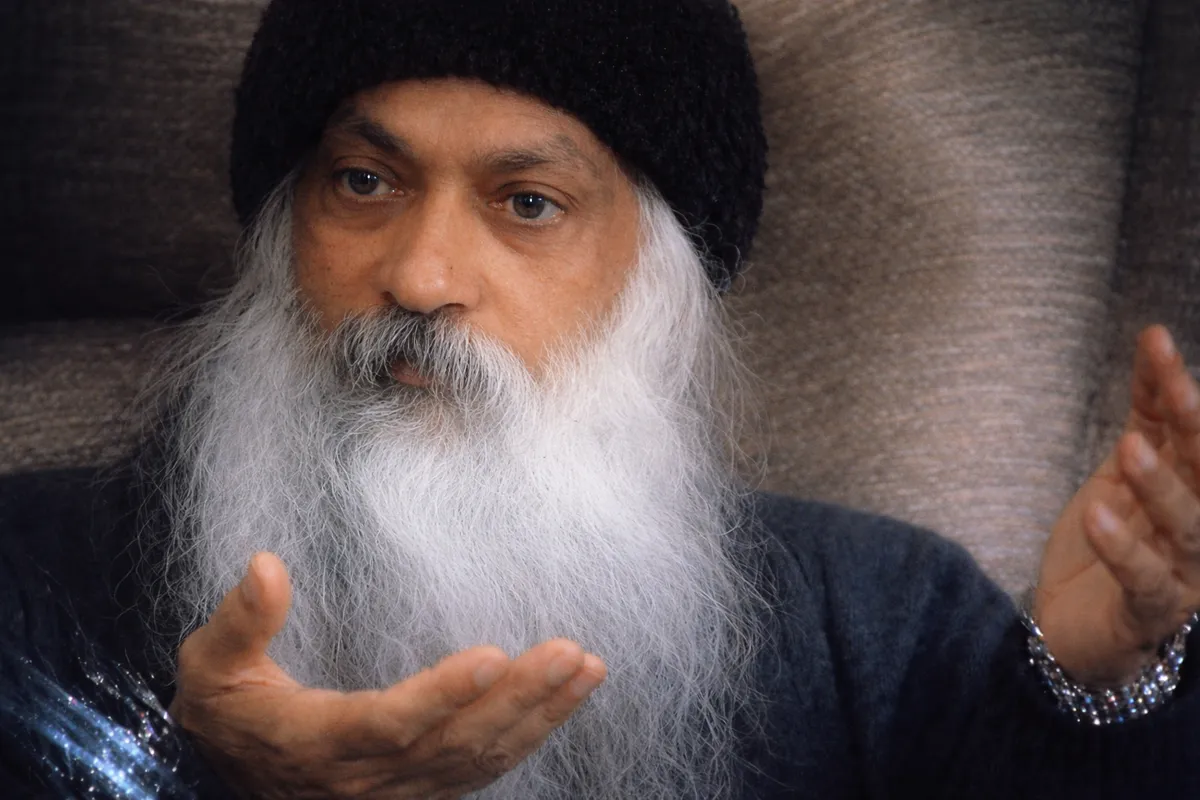
Browse an extensive collection of Osho's most profound quotes, curated semantically by topic and discourse source. Uncover transformative wisdom organized dynamically for deep contemplation.
Osho embraces the left-hand path, revealing that anger, desire, and sexuality, when skillfully transformed, can lead to divine insight; he advocates for the conscious alchemy of all energies, turning even 'poison' into nectar through awareness, rather than mere indulgence.
In the essence of Osho's teachings, the true trinity for meditators transcends the patriarchal confines of Christian doctrine, revealing a harmonious relationship among body, mind, and the genderless witness, where awakening liberates us from earthly identifications and reconnects us to our divine nature.
Ahmak Ahmadabadi, on the brink of sorrowful renunciation in Kashi, found liberation in laughter, returning to Osho, whose vision of sannyas transcends grim religiosity, embracing joy through celebration, dance, and ecstatic living—a transformation reflected in Ahmak’s new identity.
In the stillness where the egoic 'decider' dissolves, true action emerges effortlessly, unburdened by choice; here, contentment blossoms in the present moment, allowing life to flow through us in harmonious spontaneity.
True goodness flourishes from a deep awareness rather than mechanical compliance, revealing itself in the conscious acts of those who, like Jesus, Buddha, and Lao Tzu, transform darkness into light, transcending mere conditioned responses.
To transcend the gunas, one must disidentify from the body-mind, embracing each guna with honesty—transforming tamas' heaviness into a drive to elevate, rajas' vigor into mindful service, and sattva's joy into a freedom from attachment, ultimately revealing the ever-free witness within.
Embracing the path of a bodhisattva requires profound inner renunciation, for deciding to serve others while still clinging to the self transforms noble intent into mere excuse; true compassion flourishes only through egolessness, guiding one to share wisdom briefly before transcending to Buddhahood.
Delving deep into your inner self reveals a unified core where all distinctions dissolve, welcoming you into the vibrant presence of Osho and the awakened, guiding you toward a profound connection with existence that transcends isolation.
In the embrace of a true commune, individual identities dissolve into a shared essence, where disciples harmonize with a master, experiencing a collective rhythm that amplifies mood, creativity, and spiritual growth, transcending the limits of solitary existence.
Gorakh Nath, much like Osho, unveils the folly of scholars who regurgitate scripture without true understanding, emphasizing that genuine enlightenment arises not from ornate words or intellectual posturing, but from the simplicity of direct experience that ignites the inner light.
The transformative leap transcends causality, emerging as an unconditioned discontinuity that defies the chains of cause and effect; it is a profound shift that cannot be manufactured or justified, revealing that seeking reasons only perpetuates the illusion of continuity.
In the spirit of Osho, astrology transcends mere belief or disbelief; it invites us to embrace the mystery of existence, urging seekers to cultivate direct experience and awareness, free from the constraints of dogma and preconceived notions.
In the shadows of Mahavira, Buddha, and Christ, rival claims arose, yet Osho reminds us that true avatars need not self-proclaim; their authentic essence radiates truth, revealing the genuine through quiet presence rather than loud assertions.
In the art of sustained, unblinking observation, the boundary between seer and seen dissolves, inviting the sky to enter you and transforming you into the very essence of nature, while even a simple image can awaken a profound connection to the master’s presence, revealing the oneness that binds all.
The moment a sannyasin truly perceives life's promises as mere mirages, the weight of expectation evaporates, revealing the Divine presence that has always enveloped us, free from the illusions of distant goals.
In the essence of Osho's teachings, immediate divine realization unfolds not as a challenge or a journey but as a revelation of your true nature; it invites you to drop all seeking and simply recognize that you are, inherently, what you seek.
In the vision of Osho, varna emerges not from birth but from one's actions; thus, engineers and doctors embody the shudra spirit through their crafts, while the theoretical and the abstract ascend as brahmins, illustrating the fluidity of purpose over mere classification.
Osho reminds us that the notion of soulmates, much like marriage, offers no true transformation; instead, it is our own capacity to love—free and unpossessive—that shapes meaningful connections, for love flourishes only through inner change and genuine freedom.
A true iconoclast, as Osho suggests, dismantles the impulse to idolize, including his own image, fostering a consciousness unbound by forms; for when one critiques others' idols while craving their own, they unwittingly become a creator of worship, veiling the essence of truth.
Transpersonal psychology, while rooted in objective analysis and the study of behavior, inevitably falls short of grasping the essence of Buddhahood; true understanding lies beyond the mind, in the profound inner yoga that Osho illuminates through pure awareness and subjective experience.
In the spirit of Osho's teachings, the poison of self-doubt arises from societal conditioning that equates worth with success, yet true liberation lies in embracing our unique essence, celebrating our gifts for the joy they bring rather than for external validation.
Repetition in life emerges from our failure to fully experience love and existence, as unfulfilled desires tether us to the past; yet, when we embrace ourselves wholly and authentically, the cycle dissolves, leaving nothing unfinished.
Embracing Osho's wisdom, one realizes that the quest for aspiration isn’t about chasing distant stars, but rather an inward journey that transforms consciousness, unveiling the fulfillment and cosmic belonging already within.
In the spirit of Osho's teachings, Meera emerges as a radiant embodiment of love’s essence, pouring forth her devotion in a world gripped by fear and materialism, celebrating the miracle of divine intoxication that transcends the confines of life and death.
In the quest for Divine Union, samadhi stands as the sole gateway, demanding a profound commitment that transcends the mind's desire for shortcuts; true value awakens within us, compelling us to risk everything for even the briefest glimpse of the sacred.
Destruction, with its alluring ease, beckons even the uninitiated, while creation, a profound act of love and intelligence, reveals our true essence, drawing us closer to bliss and the divine, as Osho might illuminate in his reflections on existence.
When total effort marks the initial stages of your journey, fleeting moments of effortless flow arise, where laughter and catharsis dance freely; in these instances, you are merely the observer, empowered by your own initiation to embrace the unfolding without fear.
The essence of the Satguru transcends mere words, revealing itself in the living presence that captivates the soul; through this profound connection, one sheds defenses and encounters the unspoken truth, where the pearl of existence awaits.
Worry dissipates not through struggle but through the art of indifference; by observing our thoughts like fleeting clouds, we create a sacred space within, revealing the essence of our Buddha nature and transforming life into a profound blessing.
In the spirit of Osho, bhog embodies the joyful celebration of life's essence, serving not as a mere distraction but as the driving force that propels us forward; through embracing abundance rather than renunciation, we effortlessly release what no longer serves us, revealing the diamonds within.
In the dance of life, where childhood conditioning often chains us to the need for external approval, true freedom blossoms when we embrace our authentic selves, trust our inner wisdom, and courageously accept the consequences of our choices, liberated from the strings of societal expectations.
In the realm of cosmic consciousness, true joy unfolds as the enlightened embrace the divine essence within, transcending the illusion of fleeting pleasures and awakening to the profound bliss that exists beyond worldly distractions.
Osho perceives the New Age movement as a fleeting allure, enchanting yet superficial, while he champions a timeless quest for truth, emphasizing the profound impact of subtle contributions to humanity's awakening over transient trends.
The spiritual journey unfolds as the recognition of the futility of worldly desires clears the way for a profound inner space; in this emptiness, a singular longing for the Vast emerges, guiding one to the ultimate liberation of desirelessness and oneness.
Embracing the essence of true hollowness, one discovers that the absence of desire and expectation opens the heart like a bamboo, allowing fullness to flow in effortlessly and revealing the radiant purity of emptiness itself.
Timing transcends mere moments; it is the inner thirst for truth that ignites enlightenment, as Osho reminds us that we are the light waiting to be recognized, urging us to leap into our own awakening without hesitation or delay.
In the spirit of Osho’s teachings, the blooming lotus transcends mere floral imagery, embodying the awakening of our inner essence, where its vibrant colors reflect the profound shifts in consciousness and the rich tapestry of our emotional landscape.
Confessing a past offense honors the present's call for truth, allowing acceptance to transform guilt into liberation; as Osho suggests, in this sincere admission, even our mistakes become pathways to growth, healing, and profound inner peace.
In the vision of Osho, true democracy flourishes not through the mere selection of party lines, but by nurturing an enlightened citizenry that chooses individuals of integrity, transcending divisive labels and liberating society from the toxic grip of political machinery.
In the spirit of Osho's teachings, the name 'Ram' transcends mere words; true spirituality blossoms when we embrace the essence of Ram within our hearts, where silent love and presence flourish, rendering even the simplest utterance a profound liberation.
Individuation, as envisioned by Osho, transcends Jung's mental constructs of conscious and unconscious divisions, revealing a profound oneness where the multiplicity of the mind dissolves into pure, timeless consciousness, experienced through meditation rather than mere theory.
Willpower flourishes through the gentle practice of small commitments, as each vow upheld nurtures self-trust, while broken promises erode our resolve; thus, embracing simple, consistent disciplines—like focusing your gaze—becomes the true path to inner strength.
Embracing the essence of Osho's teachings, one finds that true transformation arises not from suppressing or projecting hatred onto others, but from acknowledging it within oneself, ultimately turning that energy into compassion and understanding.
In the East, as Osho might suggest, eroticism in art serves as a tantric invitation to transcendence, where sculptures envelop temples, guiding one from repressed desires to inner silence; while in the modern West, it often devolves into mere pornography, ensnaring the senses without offering a path to liberation.
In the spirit of Osho's philosophy, true charity transcends guilt-driven acts; it flourishes as joyful sharing, where giving—be it love, knowledge, or resources—nurtures our own consciousness and spreads like a fragrant essence to those around us.
In the embrace of viraha, love manifests as a fervent yearning for the hidden Beloved, a transformative fire that purifies the ego through trials and tears, ultimately leading the seeker to the profound union where the heart's ache reveals divine oneness.
When natural sexual energy is stifled by shame and societal condemnation, it transforms into perversion—a by-product of repression rather than an inherent flaw; liberated from guilt, this energy can flow freely, nurturing creativity and authenticity.
Persecuted for his truths, he believes that ideas, more powerful than actions, flow from mind to mind, unsettling those in power who lack the means to counter them; while authorities may silence his presence, they cannot extinguish the light of his thoughts.
In the dance of management, where ego seeks power and positions, true wisdom lies in recognizing that our roles are not about dominance but service; by surrendering the ego and embracing humility, we shift from competition to a meditative harmony.
Osho illuminates how a direct, unwavering gaze—akin to the Divine's—pierces through the heart’s illusions, shattering old comforts and ego, transforming this dissolution into a sweet rebirth that ignites a silent revolution in those open to its power.
Sangha emerges not as an institution but as a vibrant communion of kindred spirits, where the resonance of one meditator's depth ignites the inner journeys of others, nurturing a joyful collective that accelerates spiritual growth through shared love and presence.
In the spirit of Osho, Zorba the Greek emerges as a vibrant testament to living joyfully and fully in the present, inviting us to shed seriousness and embrace each moment with passionate presence, for in that celebration lies the essence of eternity.
The essence of our greatest dilemma lies within ourselves, as we often forsake our authentic existence in favor of abstract ideals like humanity or destiny; true liberation emerges when we embrace our individuality and craft our path in solitude, allowing the root of our problems to dissolve.
Osho suggests that excess weight transcends mere dietary concerns, revealing a deeper longing for love and connection; as we learn to nurture intimacy and trust, the void within us heals, allowing our true selves to emerge and our bodies to find balance.
Osho’s earlier works serve as the living roots of a vibrant tree, grounding us in a rich foundation that nourishes his evolving expression of truth, reminding us that while the past informs our understanding, we must remain open to the deeper insights unfolding in the present.
Sin and virtue emerge not from actions but from the depths of consciousness; when awareness illuminates our being, every moment reflects virtue, while in its absence, even noble deeds can be tainted by ego and desire, revealing that true morality thrives in the light of awakened presence.
In the vibrant tapestry of sannyas, colors bloom as the sannyasin embraces the emptiness of existence, transforming into a radiant rainbow; orange and red symbolize a joyous celebration of life, embodying playful sincerity and the beauty of thriving like a lotus in the world.
Introspection, often a tangled web of judgment and analysis, transforms into pure self-awareness when we embrace the present moment without thought; through this choiceless observation, emotions dissolve, and our consciousness evolves, revealing the profound beauty of simply being.
Human rights, as Osho might suggest, transcend mere legalities; they embody our inherent rights to life, dignity, and growth, flourishing only in a world where nonviolence and respect for all beings prevail, free from the shackles of ideology or war.
In the dance of enlightenment, Jesus embodies the fiery spirit of rebellion, cut short before his transformative journey into serene compassion, while Buddha, nurtured by the cultural soil of India, gracefully matured into a voice of tranquil wisdom.
Healthy journalism, akin to Osho's vision of enlightenment, transcends mere event transmission to nourish the body, mind, and soul, fostering a better humanity through timeless insights, art, and the elevation of spirit, while urging both leaders and readers toward wisdom and growth.
In the emergence of a new radiance, a delicate tremor of bliss, the mind often questions its authenticity, trapped in a reverence for sorrow; yet, as Osho suggests, by embracing this light with unwavering faith, we empower it to blossom, awakening our true witnessing consciousness through love, dance, and awareness.
Insecurity, when embraced as an undeniable truth rather than a fleeting mood, liberates us from the illusion of safety, allowing us to engage fully with life—building relationships, pursuing dreams, and acting wisely in the present without clinging or fear.
In the spirit of Osho's teachings, while inequalities have long marked the human experience, true equality emerges as a profound awakening, unfolding gradually through collective consciousness, guiding us from the duality of childhood towards the harmony of equanimity.
In the dance of existence, the enlightened emerge not from personal desire but in response to the world's collective suffering, their unconditional love flowing like a gentle river, nourishing receptive hearts that yearn for bliss amid turmoil.
Children, with their pure and untainted intelligence, exist in a state of open curiosity, yet society swiftly imposes conditioning that stifles this innate awareness; true trust emerges from embracing doubt, allowing their freedom to flourish in authentic growth.
In the spirit of Osho's teachings, the tale of Indra and Mahavira transcends mere dialogue, serving as a profound parable that invites listeners to delve into its symbolic depths, fostering spiritual insight that resonates far beyond the confines of literal truth.
In the spirit of Osho's teachings, true inwardness blossoms when love and meditation intertwine, as perfected love transcends ego, guiding us from the worship of the external guru to the profound awakening of our inner essence.
In the spirit of Osho's teachings, truth and rightness emerge not from external doctrines but from the depths of one's lived experience, where the immediacy of inner awareness becomes the only true touchstone, inviting each individual to explore and trust their own journey.
In the unfolding crisis of humanity’s cyclical evolution, as East and West exchange roles and old structures crumble, Osho's wisdom reveals that embracing meditation and awareness can transform chaos into profound insight, while rigid attachments only deepen suffering.
In the spirit of Osho's teachings, true calmness amid life's extremes—be it a flood or searing heat—emerges from embracing the present with playful adaptability, where awareness and humor transform challenges into opportunities for growth.
In the essence of Osho’s thought, man embodies the Divine seed, a living prayer that invites us to dissolve the ego and transcend limits, embracing the courage to walk alone, inquire deeply, and flow like a river into the vast ocean of the Infinite. True humanity lies in this self-transcendence, where glory and agony converge on the path to Buddhahood.
In the spirit of Osho's insights, modern civilization stifles our innate capacity for sublimation by repressing vital energies, particularly sexuality, which, instead of flowing freely as in Patanjali's time, now twists into anger and violence, hindering our ascent to higher creativity and compassion.
In the stillness of a mind surrendered to silence, contemplation fades into insignificance, allowing laughter to free us from the weight of thought, where the essence of truth unfolds beyond words in a boundless ecstasy.
Switzerland, a 'little piece of the Himalayas,' embodies both serene beauty and psychological health, thriving as a peaceful refuge where, much like Osho's vision, the pursuit of inner paradise through meditation could elevate its people to unparalleled joy.
Passion flourishes when we release our grip on outdated beliefs and inner divides, transforming into a divine surrender where the ego yields to a greater essence, dissolving conflict and allowing us to embrace the sacredness in all things.
The ultimate experience reveals itself in profound simplicity, often obscured by the ego's resistance to relinquish its hold on challenge and prestige; true liberation awaits those willing to embrace the dissolution of self, transforming the daunting into the instantaneous.
In the dance of motherhood, the true essence transcends mere biology and possession; it blossoms into a spiritual bond where love nurtures individuality, guiding the soul's discovery, much like Osho's playful embrace of the disciple's journey toward enlightenment.
In the essence of Osho's wisdom, the relentless pursuit of running reflects the mind's deceptive race, where shifting goals only deepen our suffering; true liberation arises in the profound act of stopping, resting, and embracing the stillness of non-doing.
Indulgence, when its fleeting pleasures dissolve into sorrow, paves the way for dispassion, opening the door to awakening; in this ascent, craving fades, awareness blossoms, and one glimpses the profound unity that lies beyond mere enjoyment.
To navigate the cacophony of societal voices and inherited teachings, one must first confront them with the wisdom of a master, yet ultimately shed all such guidance; true freedom arises in the silence of no-mind, where the courage to 'kill the Buddha' honors the essence of self-liberation.
In the spirit of Osho's teachings, one might see the Vatican's authority as a distortion of living truth, where dogma replaces divine connection, and the true essence of spirituality flourishes beyond institutional confines, embracing life, peace, and direct communion with the divine.
The Vedas, embodying saguna knowledge shaped by the three gunas, serve as valuable pointers to the boundless truth of nirguna, reminding us that while scriptures illuminate, only direct, unexpressed realization can transcend their limitations.
AIDS emerges not as a divine punishment for sexual freedom, but as a consequence of religious dogmas that suppress natural love, fostering guilt and secrecy; true healing lies in embracing a conscious, liberated sexuality that celebrates connection without fear.
In the dance of existence, where the brilliance of intelligence grapples with the monotony of life, the quest for meaning can lead to shadows of despair; in our modern solitude, the burden of self-authorship may provoke an identity crisis, urging the mind to contemplate the finality of existence.
Awakened souls, like Osho, see autobiographies as mere ego constructs, for in the light of self-knowledge, the person fades and life’s events become dreamlike, rendering the profound truth ineffable and beyond the grasp of words, inviting us instead to embrace the essence of living wisdom.
Embodying the essence of Osho, Zorba the Buddha represents the revolutionary spirit of a new man who harmonizes the earthy vitality of Zorba with the profound awareness of Buddha, transcending the divide between materialism and spiritualism to celebrate the wholeness of existence.
In the dance of existence, apparent contradictions reveal themselves as the heart’s unique responses to each questioner, where logic may seek uniformity but love unveils the myriad perspectives that converge into a singular, profound truth.
Moses’ Ten Commandments, while born from the urgency of a charismatic leader to guide a traumatized people, pale in comparison to the vibrant essence of living religion, where true awakening replaces rigid laws, allowing consciousness to illuminate our actions in the present moment.
Embracing the essence of Osho, the Here and Now transcends thought, revealing a silent awareness where true experience unfolds—sounds, sights, and breath intertwining in a dance of presence, inviting us to use the mind as a tool while remaining anchored in the richness of the moment.
In the eyes of Osho, the true essence of spirituality is found not in the imitation of religious figures who merely echo dogma, but in the authenticity of being oneself; true masters like Buddha and Lao Tzu embody a living religion, inviting us to walk alongside them as equals on the path of self-conquest.
Nostalgia, as Osho might suggest, emerges from our inability to embrace the vibrant present, leading us to cling to memories or future fantasies, revealing a deep inner emptiness and a yearning for awareness that ultimately nourishes no one.
Disillusionment arises when we project our fantasies onto another, mistaking their emptiness for fulfillment; yet, through the nurturing of a meditative awareness that sheds labels and expectations, we can embrace their true essence, allowing the pain of shattered illusions to transform into clarity.
Samsara unfolds as the mind's dreamlike narrative woven from desire, fantasy, and fear, ensnaring us in a hypnotic spell; yet, through awakening and awareness, we can transcend this illusion, liberating ourselves from the burdens of suffering.
Discipline flourishes not through obedience to external authority, which binds us in compromise and hidden resistance, but through the joyous surrender that reveals our true selves, where individuality and clarity coexist, free from the shackles of ego.
In the spirit of Osho's teachings, social justice often entangles itself in cycles of sanctioned violence, as courts and movements justify retaliatory force, revealing that true liberation from violence emerges not from institutional frameworks but from profound inner transformation.
True religiousness, as Osho suggests, embodies a vibrant, individual experience of truth that transcends dogmas and institutions, flourishing in the freedom of direct awareness and authenticity, like a boundless sky embracing the essence of love and presence.
Conflict between the world and God is merely an illusion, crafted by ignorance and centuries of conditioning, for in truth, the world pulses with divine energy, inviting us to awaken to the sacred thread that weaves through all existence.
In the spirit of Osho's philosophy, one discovers that true understanding transcends lectures; it blossoms in the stillness of silence and the depth of personal experience, where the essence of awakening is found not in words, but in the quiet presence of one's own being.
Osho invites us to recognize that while goals can serve as practical tools, true wisdom lies in embracing a goal-less awareness that savors the richness of the present, allowing us to dance fluidly between planning and presence, doubt and trust, as we celebrate life’s unfolding.
One tap — creates your free account, or signs you back in.
Already have an account? Login here
New here? Create a free account
Enter your account email and we'll send you a link to choose a new password.
Remembered it? Back to login