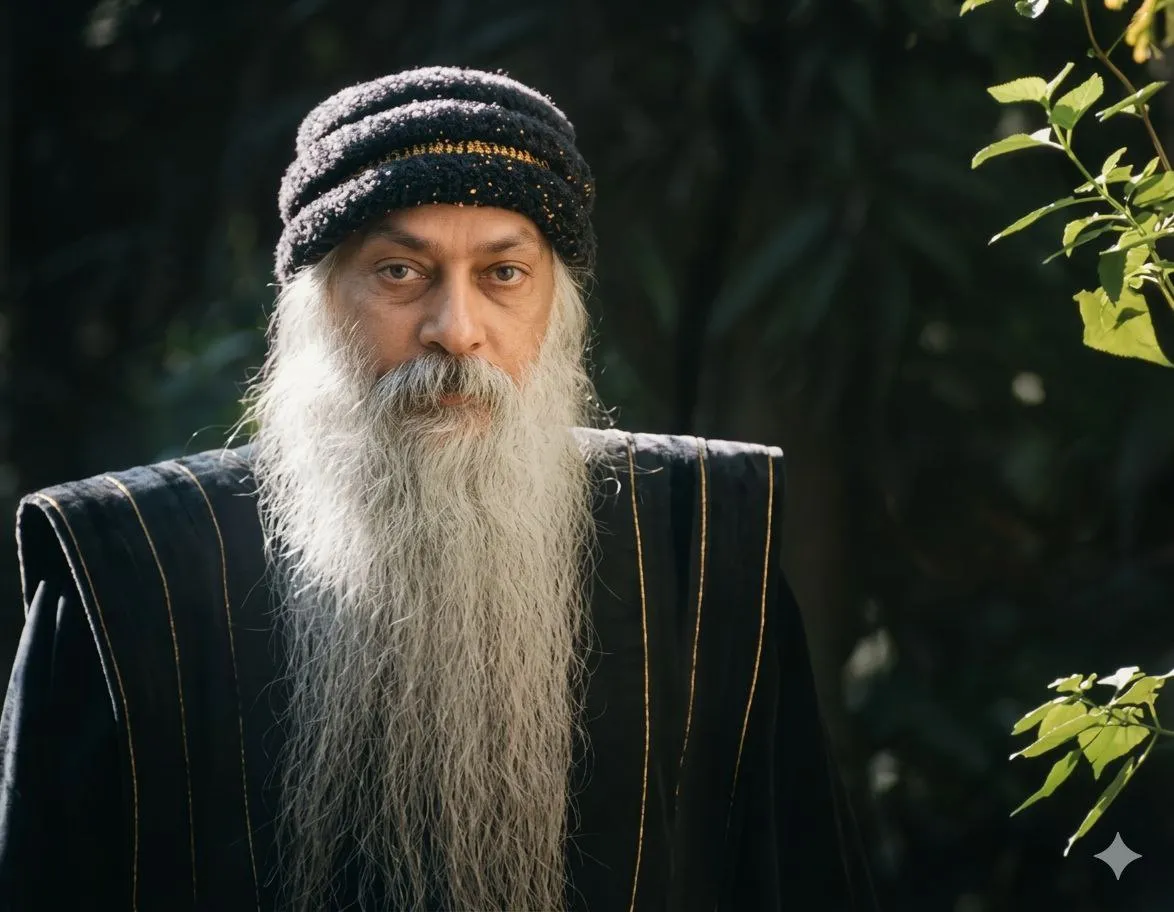
Browse an extensive collection of Osho's most profound quotes, curated semantically by topic and discourse source. Uncover transformative wisdom organized dynamically for deep contemplation.
In the realm of understanding, arguments may ignite inquiry and dispel confusion, yet they remain bound to the ego; true insight emerges from a profound awareness and silence, inviting us to transcend debate and embrace the clarity of witnessing where understanding blossoms free of conflict.
Disease, as Osho suggests, often emerges from the depths of consciousness, where around eighty percent is psychosomatic, influenced by our inner attitudes and societal constraints; by nurturing a healthy mind and fostering harmonious social environments, many ailments can dissipate, leaving only the truly external challenges to address.
Osho suggests that the indescribable is a reminder that words serve merely as milestones; clinging to them can anchor us in dogma, while embracing their essence transforms them into steps that elevate our awareness beyond rigid beliefs into the realm of true experience.
In the journey of consciousness, humanity stands at a crossroads where the light of awareness beckons; self-ignorance, a choice we did not birth but must confront, binds us to the profound responsibility of our freedom to choose.
Baraka embodies the Sufi essence of divine grace, a silent blessing that flows effortlessly from an overflowing master to a receptive disciple, nurturing their journey with courage and trust, much like the rain quenches the thirst of parched earth.
In the spirit of Osho's teachings, the mother-daughter relationship transcends mere fate, inviting daughters to embrace awareness and responsibility, allowing their souls to blossom beyond inherited narratives and blame.
Kachchh holds a profound place in his heart, a destination he hesitates to visit for fear of being forever transformed; he envisions a vibrant homecoming that stirs the very essence of the region, blending joyous embraces with the invigorating tension of dissent.
Understanding the intricate dance of mind, heart, and feelings reveals that sex and death are intertwined expressions of the same life force; by witnessing their unity, we dissolve fear and transform turmoil into profound clarity.
In the spirit of Osho's teachings, coordinators serve as vital catalysts in the dynamic journey of sannyas, fostering open dialogue and embracing diverse perspectives, while guiding the group toward a shared understanding that honors reason over dogma and tempers ego in collective decision-making.
In the dance of Zen and Sufism, the Sufi heart, a poetic essence of refined thought and devotion, mirrors Zen's empty mind; both invite us to relinquish all mental clutter, unveiling a boundless emptiness that serves as a gateway to the divine.
Human capacities, like a dewdrop reflecting the vast ocean, reveal their boundless nature when we shed self-imposed beliefs; in this dissolution of definitions, we awaken to the infinite truth of our existence—“Ana el Haq.”
In the dance between gravity and grace, Osho reveals that the sensation of soaring beyond the physical realm isn't madness but a profound glimpse into our true essence, where deep meditation enhances awareness, guiding us to discern the inner lightness from fleeting illusions.
Embodying Osho's wisdom, the concept of static reveals a frozen illusion that halts the vibrant flow of existence; true awareness thrives in the dynamic dance of life, urging us to release our grip and embrace the ever-unfolding journey.
In the wake of British departure, India's struggle with lawlessness reveals how centuries of conditioned obedience to external authority stifled inner consciousness, leading to a chaotic freedom devoid of personal responsibility, much like Osho's reflections on the necessity of self-awareness in true liberation.
True giving transcends mere material exchange, blossoming instead into the heartfelt sharing of one's essence—love—while genuine receiving invites that love to penetrate our being; yet, both are stifled by conditioning and self-doubt, only to flourish authentically when we embrace ourselves fully, allowing love to flow freely and deeply.
Embracing the seat life offers, much like the unique number 326, reveals that true presence emerges not from anxious searching or comparison, but from a serene acceptance of our place, where harmony unfolds and the journey of self-discovery truly begins.
In the cosmic dance of Rasa Lila, where bliss unfolds, Krishna embodies a non-possessive presence while the gopis represent our senses harmonizing; here, the celebration transcends ego, transforming every interaction into a joyful flow around the silent essence of existence.
Heedfulness blossoms from within, as Osho suggests, where the natural fragrances of nonviolence, non-possession, non-stealing, and desirelessness emerge effortlessly when consciousness is clear, rather than through imposed disciplines that only stifle true awareness.
In the embrace of the Divine, where the dichotomy of good and bad dissolves, true surrender relinquishes the ego's grip on doership, revealing that sin cannot exist when one recognizes every experience, even pain, as a sacred part of the whole.
Osho illuminates that idiocy is not a flaw but rather the inherent condition of an unenlightened mind, trapped in the sleep of borrowed thoughts and ego-driven fears, while true intelligence blossoms with the awakening of genuine awareness.
Déjà vu serves as a fleeting glimpse into the tapestry of our past lives, where familiar faces and places momentarily resurface, reminding us that existence weaves through cycles of death and rebirth, occasionally allowing our souls to remember what was once sealed away.
In the depths of nigod lies the primal realm of dormant souls, shrouded in utter darkness and ignorance, where liberation is a distant whisper; from this unconscious abyss, souls gradually awaken, journeying through the dreamlike samsara towards the luminous freedom of moksha.
In the intricate dance of the psyche, where the rational mind and the instinctual self often remain at odds, Osho illuminates the essential role of witnessing awareness, revealing that only through this inner observer can we transcend self-deception and embrace our authentic wholeness.
A Kshatriya embodies the perfect balance between inward awakening and outward compassion, uniquely poised to become a Tirthankara or avatar, as he merges prajna and karuna, forging a path for others while navigating the depths of truth.
True conviction emerges from an unclouded inner vision, a self-evident truth that resonates as deeply as the pulse of life itself; in the clarity of such awareness, doubt dissipates, revealing that authentic certainty is the only compass needed.
In the spirit of Osho's insights, the Bhoodan Movement reveals that true liberation from exploitation transcends mere acts of charity; one must dismantle the very structures of oppression, for as long as we exist within them, we are but cogs in a relentless machine.
Osho illuminates how centuries of patriarchal conditioning have led women to undervalue their inherent feminine qualities, obscuring their innate radiance and power, while societal fears and controls have reduced their essence to mere shadows of subhuman existence.
Osho illuminates the paradox of obscenity, revealing that when society's priests and moralists condemn and repress sexuality, they only intensify its allure; true liberation lies in embracing openness, where curiosity flourishes and the allure of the forbidden fades away.
Embracing Osho's wisdom, one realizes that hurt arises from our identification with others' words; by choosing not to internalize their negativity, we preserve our inner peace, allowing insults to flow past us without leaving a trace.
In the dance of existence, life energy, when entangled in violence, spirals downward in a desperate quest for solace, yet when embraced in nonviolence, it transforms, rising joyfully toward liberation and the divine, illuminating the path to true freedom.
True possibility emerges not from the confines of reality, but from the liberation of consciousness, as Osho suggests; when we break free from the conditioned limitations imposed by society, we transform abstract visions into tangible experiences.
A poet, like a seed reaching through half-awake dreams, offers gentle solace and fleeting glimpses of light, while a rishi, grounded in the eternal, ignites awakening with fiery words that shatter illusions and illuminate the path to deeper realization.
Possession arises from the absence of inner light, where darkness prevails and unconsciousness reigns; yet, through awareness and meditation, the illusion of being overtaken dissolves, revealing the divine presence that always resides within.
Terrorism emerges from a deep-seated malaise within humanity, where the crowd’s denial of its own madness fuels the veneration of extreme ideals, ultimately stifling the healing wisdom of voices like Socrates and Jesus, and perpetuating a cycle of fear and imbalance that can only be broken by embracing our collective unhealth and seeking harmony.
In Osho's view, condemnation serves to unveil the façades of false greatness, challenge societal hypocrisy, and reaffirm truth as the ultimate guide, urging seekers to abandon blind faith and align with authentic compassion and nonviolence through critical discernment.
In the dance between Satya Yuga and Kali Yuga, Osho illuminates humanity's descent from the innocence of childhood to the disillusionment of age, where the heart’s poetry fades beneath the weight of intellect, revealing that true progress lies not in accumulation, but in the preservation of inner joy.
Resolves stemming from our thought-constructed identity are mere illusions, for the thinker is inauthentic; true clarity emerges from inner silence found in meditation, where resolution unfolds effortlessly, embodying the Divine's guiding presence within.
When energy turns inward, the clamor of the outside world fades, revealing a profound stillness; in this fertile emptiness, joy blossoms and centeredness transforms reality into a dreamlike tapestry, inviting us to surrender and let the experience unfold.
Synchronization transcends mere alignment of timepieces; it is the art of harmonizing your heart and spirit with the master’s essence, allowing your joy and awareness to flow in a vibrant dance of inner harmony, where both the master’s field and your open presence create a profound resonance.
Rituals, as Osho might suggest, transcend the confines of tradition and novelty, inviting us to engage in a profound, present-moment awareness; the twenty-one-day ritual emerges not as a relic of the past but as a vital expression of our current consciousness.
In the spirit of Osho's teachings, one might find that optimism and pessimism are merely reflections of the mind; true wisdom lies in embracing life as it unfolds, free from the chains of hope and fear.
Independence, as Osho would suggest, breathes life into a constitution, transforming it from a mere document into a vibrant reflection of inner freedom; it nurtures creativity, honors dissent, and safeguards the individual against the confines of borrowed ideologies and past authorities.
In the practice of Zazen, one immerses in silent stillness, observing the mind's fleeting fantasies without pursuit, allowing thoughts to drift away while nurturing a profound awareness that transforms the very essence of being.
In the spirit of Osho's philosophy, the satirical figure of Shri Ahamak Ahmadabadi embodies the folly of clinging to superficial religious symbols, inviting us to embrace authenticity and depth rather than mere appearances in our spiritual journeys.
Embracing feelings of unworthiness as blessings reveals the ego's gradual dissolution; by approaching them with humility and gratitude, we transform our meditation into a journey of self-discovery, where worthiness fades, and pure being emerges.
Embracing the essence of merging, Osho illuminates the path of surrender, where one relinquishes the grasp on fleeting thoughts and instead dwells in the silent gaps between them, discovering a profound connection to one's true self.
Wandering in dreams of desire and ambition, we often find ourselves in need of a map to return to the present; yet, this guide is merely a tool to unravel our imagined journeys, reminding us that true arrival lies in the embrace of the here and now, where we can ultimately let go of all maps.
Injustice emerges as a natural response of minds shaped by tradition, prejudice, and fear, where the crowd, swayed by clever rhetoric, often targets the truth seekers; thus, rather than battling shadows, one must look inward, embracing clarity and compassion over resentment.
Social morality often labels many truths as ‘improper,’ yet Osho invites us to illuminate what was once hidden, urging open dialogue free from shame, allowing us to transcend borrowed guilt and transform our instincts into wisdom, love, and responsibility.
Self-surrender, as Osho illuminates, transcends the confines of gendered paths; while the will-driven journey awakens through relentless striving, the feminine route flourishes in effortless acceptance, revealing that true awakening lies in the purity of one's chosen principle.
In a world where prudish moralists cloak sacred nudity in shameful cover-ups, Osho reveals that true spirituality flourishes in innocence, untethered by the politics of modesty that seek to distort our perception of decency.
In the essence of Osho's thought, gods and goddesses transcend mere myth, embodying higher states of consciousness that reveal profound truths beyond language, inviting humanity, as a bridge between animal and divine, to awaken through silence and sadhana to their inherent divinity.
Embracing the essence of 'sanchit' reveals a misunderstanding of Osho's teachings, as it reflects a lingering attachment to ego and ambition; true liberation lies in surrendering the doer, embracing ordinariness, and simply witnessing the flow of existence.
Dwelling solely on life's inherent boredom and meaninglessness offers only a partial view; true sages, like Osho, illuminate the path to love, meditation, and bliss, inviting us to transcend despair and embrace a richer, more vibrant existence.
Embracing the vast tide of emotions rather than retreating to the safety of dry land allows the small, chattering ego to drown while revealing our oceanic, immortal essence; in surrendering to love, truth, and silence, we discover the depths of our true nature.
Shiva, the primordial meditator and master of awareness, reveals through his 112 methods that true enlightenment is not bound by celibacy; instead, he transforms sexual energy into love and compassion, mapping a life-affirming journey to inner silence accessible to all.
In the spirit of Osho's teachings, extended meditation camps may elevate participants to exhilarating heights of bliss, yet the stark return home often plunges them into despair; shorter retreats, however, cultivate a harmonious acceptance of life’s peaks and valleys, fostering an inner balance that transcends fleeting emotions.
Delusion tightens its grip as we swap one blind belief for another, mistaking authority for wisdom; true liberation lies in the fearless pursuit of inquiry, where the courage to question transforms ignorance into insight, echoing Osho's call for authentic awareness.
In the essence of Osho's wisdom, true passivity embodies a vibrant, watchful energy, a serene readiness that savors the simplicity of existence—like a poised cat—while laziness languishes in inertia, devoid of life’s dynamic pulse.
In the spirit of Osho, the towel, once a simple defense against Jabalpur's mosquitoes, transformed from a practical tool into a vessel of superstition reflects the essence of non-attachment; it serves as a reminder to shed symbols and habits when their purpose fades, urging us to embrace the freedom of letting go.
Excessive sentimentality, rather than being suppressed, should be consciously redirected, transforming raw emotion into love, creativity, and presence, for when we guide our feelings wisely, intensity evolves into virtue, enriching our lives.
In the spirit of Osho, the youth's embrace of love and meditation as a revolutionary force reflects a genuine evolution of the Left, where creativity and compassion replace ideological conflict, transforming the 'impossible' into a tangible path for social change.
An outstanding personality is a contradiction, as the ego's desire to be recognized crafts identity, yet true greatness lies in embracing the simplicity of being nobody—alive, authentic, and present—echoing Osho's playful challenge to abandon the need for distinction and find peace in awareness.
Land use transcends mere legal frameworks, embodying a living harmony that nurtures communities' freedoms and their right to coexist authentically; true justice flourishes when courts defend this unity, fostering spaces like Rajneeshpuram where individuals become a single, vibrant organism rather than isolated factions.
In the spirit of Osho's teachings, the newborn's brain may be a pristine biocomputer, yet the mind, a tapestry of accumulated conditionings from past lives, veils pure consciousness; true enlightenment emerges from shedding these layers, revealing the essence of being.
In the spirit of Osho, true social revolution emerges not from reactive extremes but from a centered awareness that blossoms in joy, transcending opposition to cultivate lasting change rooted in the essence of truth.
The inner guide emerges from the depths of our being, transcending the turmoil of the subconscious with its whispers of clarity and peace, urging us toward authentic existence while the repressed mind clamors for attention through guilt and compulsion.
Hero worship, as Osho might suggest, stifles true growth by fostering dependence and imitation, leading the worshiper to forget that liberation lies not in idols but in nurturing one’s own unique potential to blossom.
Osho suggests that aggression often masks deep-seated fears and internal conflicts, revealing a fragile self that feels threatened by authentic existence; when we respond with compassion, we invite healing and transformation, allowing the latent truth beneath the anger to emerge.
In the spirit of Osho's wisdom, true meritocracy flourishes when governance is entrusted to those whose competence transcends mere age, ensuring that decision-makers are not just seasoned politicians, but enlightened experts dedicated to the greater good.
Vanaprastha unfolds as an instinctive journey from the clamor of the marketplace to the serenity of the forest, an organic transition born from profound witnessing that transcends ego, revealing a purity untouched by the cunning of deliberate renunciation.
In the spirit of Osho's teachings, dialectics reveals life’s essence as a dynamic dance of conflict and harmony, where opposing forces collide, fostering transformation and growth, and illuminating the path to a higher synthesis of consciousness.
A true church transcends mere organization, blossoming instead as a vibrant communion forged by the enlightened Master, igniting the sacred bond with each seeker, where the essence lies in their direct connection, free from the distortions of dogma and tradition.
In the embrace of transcendental awareness, one discovers a witnessing consciousness that transcends both body and mind, revealing a perfect oneness that nurtures gratitude, dignity, and bliss, where genuine meditation becomes a true return home, far surpassing the superficiality of mere mantra-chanting.
Embodying Osho's spirit, he embraces spontaneity without plans, welcoming the possibility of an encounter at the Vatican to reveal the emptiness of religious authority, asserting that truth exists independently of popes, elections, or scriptures—he is solely a messenger of his own authenticity, ready to engage with life as it flows.
In the spirit of Osho's teachings, self-sufficiency emerges as an innate state, where one, unencumbered by the need for external affection, embraces their completeness, recognizing that the desire for closeness is as unique as the soul itself.
In Osho's playful spirit, the whimsical jests of Moonians, who reproduce at the mere stir of an empty pot or by entwining tentacles, invite Earthlings to reflect on their own hurried nine-month journey, questioning why they rush when the essence of creation is a dance of patience.
Company, much like the transformative fire Osho describes, ignites only when we approach with openness and authenticity; it refines us by burning away pretense, revealing the pure gold of our true selves in the warmth of connection.
Willingness embodies a profound state of positivity, where the power to act coexists with the conscious choice of stillness; in this sacred space of non-doing lies the essence of mastery, presence, and the freedom that Osho so eloquently celebrated.
Nagarjuna’s Shunyavada eloquently mirrors the Buddha's silent wisdom, revealing that the essence of emptiness—like the vast, empty sky—serves as the fertile ground from which all existence emerges and ultimately dissolves, transcending the distinction of method.
Osho suggests that while Shastras can provoke a discontent with mere secondhand knowledge, true understanding emerges from within, transcending words; thus, they transform into transparent echoes guiding us toward authentic realization rather than serving as substitutes for it.
In the spirit of Osho's teachings, energy is squandered when our actions lead us back to the same starting point, revealing that without awareness and purpose, our efforts become mere cycles, preventing any true transformation and leaving us trapped in repetitive journeys.
Freedom from heedlessness unfolds not through action, but through the gentle embrace of awareness; by witnessing our states—be it laziness or busyness—without judgment, we allow consciousness to awaken, dissolving distractions into pure clarity.
True stillness transcends mere silence, as Osho suggests; it invites us to quiet the mind's surface chatter, allowing the deeper currents of the subconscious and the cosmic to merge, ultimately unveiling the clarity and freedom that reconnect us with our true home.
In a gathering where the British presence is minimal—“fortunately not many, only three”—Prem Lisa’s reserved nature and sensitivity to humor reveal how deeply national conditioning and judgmental attitudes endure, starkly contrasting with the melting openness Osho invites.
The will to live is not something to be regained, as it flows innately through each breath; rather, it calls for surrendering the ego and embracing each moment as a sacred end, allowing life to renew itself in the quiet trust of existence, where resurrection follows the crucifixion of our striving.
In the dance of existence, thought emerges as a singular wave, while the mind serves merely as a vast collection of these waves; by allowing thoughts to ebb, one transcends into the profound stillness of no-mind, where true awareness resides.
Krishna and Rama, while distinct in their divine expressions, embody the singular energy of Vishnu, the life-force bridging creation and dissolution; each avatar, including adversaries like Ravana, reflects this essence uniquely, revealing the profound interconnectedness of existence.
In the realm of universal consciousness, love flourishes in its most liberated form, transcending ego and time; as attachments dissolve, what remains is a profound essence, allowing only those pure, grateful connections to resonate in true recognition.
Despair emerges when our actions are shackled by expectations; true liberation lies in embracing work as a joyful expression rather than a pursuit of outcomes, allowing us to revel in the beauty of the moment and remain untouched by disappointment.
Osho’s vision of the 'Fourth Way' transcends mere dialogue or consolation, immersing individuals in a transformative journey that reshapes the entirety of their being—body, mind, heart, and essence—challenging egoic patterns to facilitate a profound awakening that is felt deeply rather than just understood.
Osho's admiration for Saint Francis of Assisi resonates deeply, reflecting a profound respect for the purity of Francis’s spirit, inviting seekers to embrace and be inspired by those whose lives authentically embody sincerity and spirituality.
To embody the essence of representation is to don a borrowed mask, echoing the voices of tradition and authority; true authenticity emerges when we shed these secondhand identities and express our own lived truths, for it is in presence, not proxy, that reality resonates.
True liberation emerges when one acknowledges that the prisons we inhabit are woven from the fabric of our conditioned minds—hypnotic self-images and comforting beliefs that mask our reality, binding us in an illusion of freedom.
Embodying the essence of Osho's teachings, a Baul transcends doctrine, embracing the mystique of existence with an open heart, celebrating life through song and dance, and reveling in the present moment, fully alive and in love with the world.
In the realm of spirituality, the visions of deities like Krishna or Christ reflect mere psychological projections; true spiritual awakening emerges only when consciousness transcends objects, resting in the pure essence of self beyond the confines of the mind.
In the meditative stillness that Osho advocates, the judgments of an opinionated mind dissolve, allowing us to perceive the essence of reality beyond labels of ugliness or beauty; from this clarity, our actions become creative and intelligent responses to the truth of existence.
In the spirit of Osho's teachings, exploitation stems from a mindset that fosters division, as true prosperity blossoms from collaboration, where workers and employers unite in shared purpose, transforming the workplace into a garden of mutual growth rather than a battlefield of conflict.
Life unveils its open secrets when the ego dissolves, borrowed knowledge fades, and our awareness anchors in the present; in this pure state of being, akin to curing blindness, we shed the past and future, allowing the essence of existence to reveal itself in an instant.
Embracing the idea of infallibility as an infallibly fallible state, Osho invites us to shed the burden of perfectionist ideals, allowing human imperfection to flourish and liberating us from guilt, ultimately paving the way for genuine sincerity and joyful spontaneity.
One tap — creates your free account, or signs you back in.
Already have an account? Login here
New here? Create a free account
Enter your account email and we'll send you a link to choose a new password.
Remembered it? Back to login