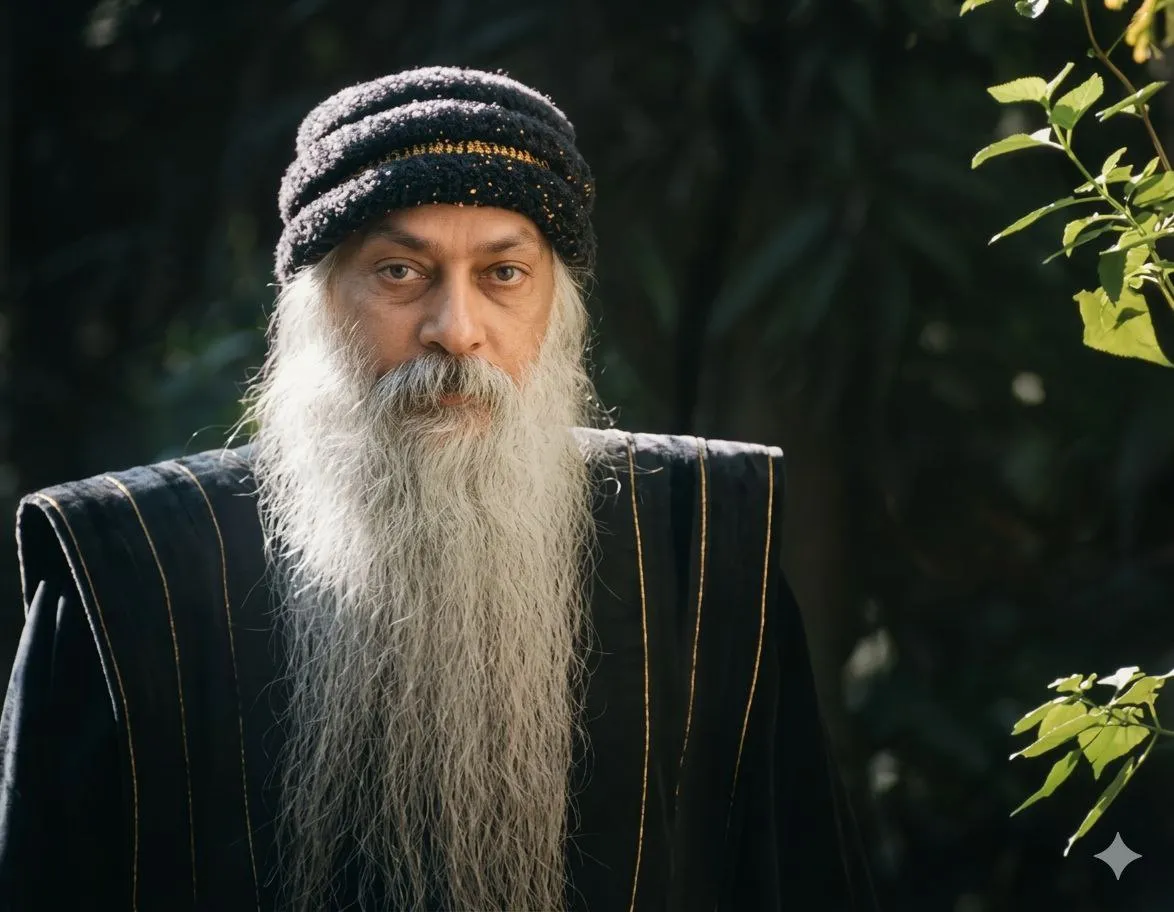
Browse an extensive collection of Osho's most profound quotes, curated semantically by topic and discourse source. Uncover transformative wisdom organized dynamically for deep contemplation.
In the spirit of Osho's teachings, prana-pratishtha embodies the reawakening of a sacred bond, transforming an image into a vibrant conduit of presence through sacred rites and the subtle recognition of a realized adept, ensuring that a true temple, alive and resonant, cannot be diminished.
Navigating the psychic stages is an inherent journey, one that unfolds effortlessly, yet through Dynamic Meditation, this evolution can happen so swiftly that it goes unnoticed; only the desire for psychic powers ensnares us, urging us to linger, while true liberation lies in witnessing without attachment.
Osho invites us to recognize that self-criticism, rooted in unattainable ideals, disrupts our peace and binds us in anxiety; by embracing our imperfections and living fully in the present, we unlock the essence of wholeness, leading to true freedom and fulfillment.
Defeat emerges from the relentless pursuit of victory; by releasing this craving and embracing surrender, one finds true triumph in acceptance, transforming life into a sacred offering where love prevails over ego's illusions.
In the spirit of Osho's teachings, the essence of the Mundaka Upanishad transcends authorship, for it is not the names inscribed but the awakening it ignites within us that truly matters, illuminating a path to profound understanding and inner freedom.
Tension arises from the turmoil of unawareness, impatience, and the burdens of comparison, while relaxation, Osho suggests, emerges effortlessly in the embrace of the present, transforming every ordinary act into a celebration of clarity and acceptance.
Osho illuminates the notion that all authentic spiritual paths—whether through meditation, love, or devotion—converge toward the same Divine essence, inviting each seeker to embrace their unique journey with sincerity and openness, free from the confines of dogma.
The timing of your return rests solely in your hands, for true liberation arises from within; the soul, embracing its boundless freedom, navigates through suffering and turmoil, choosing to return only when it is ready, guided by personal responsibility and awareness.
Self-repression often arises not from conscious choice but as a survival mechanism, shaped by childhood conditioning; the love and approval we crave can transform into an internalized guilt, policing our desires and stifling our true selves long after the threat has vanished.
The Puranas reveal that the mythic narrative of human nature, with its saints and scoundrels, unfolds perpetually in our lives; it is our own cynicism and preconceived notions that obscure the sacred dance of consciousness playing out in the everyday.
Embracing non-identification, one becomes a witness to life’s unfolding, engaging fully in each moment—eating, walking, loving—while a mirrorlike awareness reflects the beauty of existence, fostering clarity and passionate connection free from the burdens of memory and attachment.
Blooming emerges as a profound inner transformation, akin to a bud unfurling into a flower; sages captured this delicate awakening through the lotus, often depicted upside-down, symbolizing the initial stirrings of the chakras that transcend mere visibility.
In Osho's view, the Hindu concept of incarnations reveals not an evolutionary hierarchy but a divine consciousness descending into various forms, each avatar embodying the needs of their time, much like the first blossoms that herald the arrival of spring.
In the pursuit of self-actualization, we awaken from the potential of mere existence to the vibrant bloom of our true selves, transcending desire and finding effortless bliss in the realization that fulfillment lies within, dispelling the haunting sense of lack.
In the spirit of Osho, when the call of sleep beckons during a discourse on dreams, surrender to that need without guilt; embrace your authenticity while honoring the shared space, allowing both your truth and sensitivity to flourish harmoniously.
In the wisdom of Osho, true freedom emerges not from the fleeting allure of praise, which inflates the ego and binds us to others’ judgments, but from the serene space of witnessing both praise and blame without attachment, allowing us to rest in our authentic selves.
Embracing the essence of Osho's philosophy, speaking extemporaneously invites us to relax into the present, allowing genuine feelings to emerge joyfully, where spontaneity and authenticity effortlessly shape our words and conversations.
The philosopher's stone, a poetic symbol of transformation, embodies the journey from sleep to awareness, where communion with the awakened allows our inherent golden essence to shine forth, enabling not only our own awakening but also lighting the path for others.
In Osho's view, labeling others as 'cabbages' celebrates their silent innocence akin to Buddhas, while calling someone an 'asshole' serves not as condemnation but as a candid reflection, inviting us to shatter ego and embrace self-inquiry over hollow respectability.
In transcending chitta, one doesn’t erase it but rather harmonizes it within a broader awareness, where impulses arise effortlessly and consciously, allowing spontaneity to flourish, guided by a witnessing presence that transforms each action into an expression of unity.
Osho teaches that true transformation arises not from superficial rules that shun the external evils of seeing, hearing, or speaking, but from confronting and dissolving the inner negativity that flows from within, allowing authentic conduct to emerge naturally.
Tamas embodies a profound lethargy and heedlessness, casting a shadow over consciousness and stifling awareness, yet recognizing this inertia is the first step toward awakening, allowing the transformation from heaviness to vibrant clarity.
In the realm of human experience, where science and therapy intertwine, the essence of subjectivity emerges; healing becomes a dance between the patient’s will and the healer’s presence, revealing that outcomes are co-created, shaped by trust, meaning, and relationship.
Osho illuminates that true spiritual growth emerges from fulfilling our genuine needs, particularly the soul's yearning for truth and connection with the divine, while recognizing that mind-made desires—rooted in ego and illusion—only distract us from this deeper journey.
A pendant, or mala, embodies the essence of your unique understanding, serving as a vibrant expression of freedom, joy, and the quest for inner truth, urging you to seek answers from your heart rather than relying on borrowed interpretations. Embrace the responsibility to nurture your own intelligence, acknowledging any inner blockages as opportunities for deeper inquiry.
Nietzsche’s notion of the ‘Superman’ misguides, for true spiritual realization transcends the ego entirely; one merges with Brahman, dissolving personal identity into pure being, where the essence of existence surpasses mere human qualities and stories.
Insistence embodies the ego's relentless urge for reality to align with its rigid expectations, yet true spiritual living flourishes in the absence of such demands, inviting life to unfold with grace, where love and awareness replace conflict with effortless spontaneity.
In the dance of life, commitment and spontaneity intertwine, where imposed dedication feels like death, yet true commitment blossoms from spontaneous awareness, nurturing a vibrant fidelity to one’s own insights and experiences rather than to mere beliefs.
In the dance of existence, the mind serves as a versatile tool, wielding logic devoid of inherent morality, while the heart, vibrant and ever-evolving, breathes love into the equation; deeper still, the soul stands as the silent witness, the guiding essence that harmonizes love and thought without being bound by either.
Raasleela unfolds as the universe’s joyous dance, a profound interplay of purusha and prakriti that transcends mere sexuality; it invites us to transform the tensions of opposites into a creative harmony, where life becomes a shared celebration of unity rather than a struggle.
Embracing formlessness challenges the mind, which thrives on limits and relationships, often panicking at the infinite; true sadhana lies in relinquishing these attachments, revealing that the struggle arises not from formlessness itself, but from our clinging thoughts.
The allure of what is 'missing' enchants the ego, which thrives on desire and the chasm between reality and expectation; yet, in the embrace of the present—where 'should' dissolves—true freedom unfolds, inviting us to simply be.
In the throes of youth revolt, the Western mind, having reached the zenith of rationality, yearns to embrace its suppressed irrationality; as affluence fosters a profound boredom, the allure of meditation, Zen, and yoga emerges, offering experiential paths to restore balance in a technocratic world.
Inner space unfolds as a serene expanse free from desire, where the old self dissolves, allowing the emergence of a new being; in this sacred stillness, the clamor of ambition and competition fades, revealing the profound richness of joy, love, and awareness.
Masculinity embodies a singular energy that, when channeled positively, blooms into creativity and adventure, while its darker aspects can lead to aggression; true masculinity harmonizes with the nurturing force of femininity, fostering wholeness in love and life.
In the spirit of Osho's teachings, true law and order emerge not from oppression or exploitation but from a deep awareness that prioritizes compassion and justice, recognizing that genuine civilization flourishes only when it protects the vulnerable.
Human stupidity manifests in our rigid attachment to roles, beliefs, and institutions, overshadowing the vibrant truths of love and reality, turning us serious and dutiful, while the true essence of intelligence remains playful, free, and loving, forever challenging our conditioned perceptions.
Embracing the essence of Osho's wisdom, one must cultivate an unwavering sincerity within, understanding their true intentions while navigating the social landscape with compassion and grace, wearing masks when necessary but never losing sight of their authentic self. In the dance of life, flexibility and consciousness allow us to balance honesty and kindness, revealing that sometimes a gentle lie can nurture love more profoundly than harsh truths.
In the dance of female energy, love blossoms through devotion, guided by a higher consciousness; it is within the embrace of awakened male energy that longing transforms into surrender, allowing desire to fade into the serenity of meditative love.
In a dance of creation, Lilith emerges as the primal force, only to be obscured by a patriarchal narrative that could not bear the truth of a woman preceding man; Osho would celebrate her as the embodiment of natural truth, challenging the absurdities woven into the myth.
In the dance of sounds, true meditation unfolds not as a quest for silence but as a profound stillness within, where one becomes a clear witness, embracing every note without reaction, ultimately transforming the cacophony into a dreamlike awareness that deepens into samadhi.
Osho challenges the notion of a savior, asserting that such figures undermine human dignity by fostering dependency and stripping individuals of their inherent responsibility; instead, he advocates for a profound awakening where each person embraces their power to choose and claim their own liberation.
In the dance of existence, the inquiry into nonbeing falters, for to seek a knower implies a lingering self; true nonbeing transcends knowledge, dissolving both the question and the seeker into the boundless stillness of existence.
Mahavira's nakedness transcends mere character, revealing a profound vision where clothes hinder the body's sacred exchange with the cosmos; true nudity, akin to an open antenna, fosters an intimate dialogue with existence, making mere imitation devoid of essence.
Anugaman embodies a profound receptivity, inviting one to align harmoniously with a guiding truth, embracing the art of deep listening and the willingness to follow, rather than the ego's relentless drive to forge ahead.
In Osho's view, inconsistency serves as a deliberate tool for awakening, where words transform—like a bell or cold water—to rouse the slumbering minds, urging us to question cherished beliefs and embrace the utility of statements over their truth-value.
Embracing the essence of newness, Osho illuminates how the youthful spirit, alive with restless energy and creative dissatisfaction, seeks uncharted dimensions, while the old often find solace in the familiar, revealing that this discontent is a vibrant pulse of life itself.
In the spirit of Osho's teachings, true wisdom flourishes in clarity, unencumbered by the cryptic language of pretenders; it invites us to embrace simplicity, revealing that genuine insight needs no elaborate disguise to resonate with the heart.
Osho illuminates the notion that while the sameness of Tirthankara idols embodies a unified spiritual essence expressed through a shared language of symbols, the distinct images of Buddha, Christ, and Krishna arise from the need for renewal and differentiation within their unique traditions.
Heartbreak, in its profound shattering of our dreamed selves, reveals the futility of separateness; it invites a transformative awakening where sorrow dissolves into bliss, urging us to embrace existence and flow harmoniously with the universe's unfolding.
In a world where spiritual entertainment often masquerades as genuine connection, the spectacle of rituals and sermons captivates the ego but leaves the soul untouched, much like a film that dazzles without transforming, as Osho might suggest, revealing the emptiness of gatherings devoid of true awakening.
Agelessness emerges when we connect with our timeless inner being, untouched by the passage of years; in this awakening, innocence and playfulness flourish, allowing a youthful radiance to illuminate our essence, transcending mere physicality.
In the essence of Osho's philosophy, the true tea ceremony transcends mere ritual; it invites us to sip from the cup of awareness, urging us to awaken to the present moment and savor existence beyond the confines of thought.
In the spirit of Osho's teachings, Chitta Vritti Nirodha emerges not from the suppression of the mind's fluctuations, but from a profound awareness that illuminates each thought, allowing even the fiercest emotions like anger to dissolve into serene stillness through understanding.
In the spirit of Osho's teachings, bio-energy emerges as an invisible yet potent life force, intricately woven from the threads of sexual energy and love, creating a magnetic field that nurtures vitality and transforms the essence of body, mind, and consciousness.
In the vision of Osho, a mala embodies the essence of life, meditation, and wholeness, with each bead representing a perfected moment woven into the fabric of eternity, while the cross, steeped in suffering, distracts from the vibrant dance of living consciousness.
Abraham stands as the patriarch of the Jews and the first prophet, embodying a timeless light of awareness that transcends the Abrahamic faiths, much like Osho's teachings illuminate the path of consciousness that connects all seekers.
In the dance of existence, where the body’s mortality and unpredictability serve as catalysts, true transcendence emerges through the simple awareness of breath, guiding us to disidentify from the physical and discover the timeless essence that lies within.
In the decisive Now of spiritual inquiry, as the illusion of ordinariness falls away, one unveils their inherent divinity; in this profound recognition, egoic striving dissolves, humility blossoms, and the gateway to awakening unfolds—right here, right now.
Melancholy graces every life as a precursor to self-realization, urging us not to dissect our sadness but to illuminate our being through meditation; as the inner lamp flickers to life, the ache of separation fades, revealing the bliss of wholeness.
In the spirit of Osho, an interview becomes an authentic exchange where preparation fades, revealing that truth thrives in spontaneity; embracing integrity means candidly acknowledging both knowledge and ignorance, allowing genuine presence to illuminate the dialogue.
To label humanity as a machine is to acknowledge our existence as conditioned beings, trapped in habits and past programming, where true awareness and spontaneity are rare; it often takes the jolt of a Master’s teachings or mindful introspection to awaken us from our mechanical existence, inviting a dance of conscious responsiveness.
In the spirit of Osho's teachings, the notion of a controller becomes superfluous, as every action imprints a residue of emotion that shapes our present selves; yesterday's anger or love subtly influences today's choices, weaving a tapestry of tendencies that governs our responses long after the original events have faded.
In the spirit of Osho's teachings, the article invites a fearless, unfiltered expression that dissolves repression and unveils authenticity, allowing inner silence to flourish; through this meditative catharsis, one becomes transparent and open to the profound truths of existence.
Gachchhamis flourish when approached with the vibrant spirit of living choices rather than mere obligations, serving as self-commitments that awaken our consciousness; it is our heartfelt presence and childlike curiosity that infuse each recitation with life, transforming it into a conscious choice for awareness, echoing Osho's celebration of authentic existence.
In the dance of existence, the rigid stance of ego ultimately yields to the grace of bowing; as the weight of arrogance becomes unbearable, it transforms into a profound humility, revealing the true essence of being beyond the self.
Justice, rooted in the intellect's rules, finds its true illumination through compassion, which transcends logic and breathes life into fairness, revealing that while justice sets the stage, it is compassion that fosters the flourishing of humanity as envisioned by Osho.
Osho invites us to see sexual freedom not as a mere slogan but as a deeply personal journey, where trust lies in cultivating awareness and meditation, allowing us to respond authentically to each moment rather than adhering to rigid ideologies.
Zorba embodies our instinctual joy, reveling in life's simple pleasures without spiritual burdens, and as Osho suggests, this celebratory essence is the fertile ground from which true awakening, like that of Buddha, can flourish.
True freedom from craving emerges not through external pursuits, but by turning our awareness inward to recognize its insatiable and futile nature; in this clear seeing, craving dissipates, leaving space for meditation to blossom and bliss to naturally unfold.
In the spirit of Osho's teachings, anāshrava embodies a consciousness where sights and sounds glide by like reflections in a mirror, untouched by desire or attachment, allowing experiences to flow freely without leaving any trace behind.
In the midst of cataclysm, the age-old human drama unfolds anew—wars, politics, and greed, all intensified by the ego's desire for significance; rather than succumbing to hysteria, we are invited to turn inward, uncovering the timeless essence that remains unshaken amidst the chaos.
Osho might suggest that anti-Semitism, much like any other 'ism', arises when the mind projects its frustrations onto others, transforming personal boundaries into perceived threats, while true intelligence transcends labels, embracing reality with compassion and clarity.
In the pursuit of genealogy, one often confuses a yearning for origins with mere family history, yet true understanding lies not in tracing ancestors but in turning inward; by asking Who am I? and embracing meditation, we unveil our essence and connect with the entirety of existence, revealing that while genealogy may quench curiosity, it falls short of offering profound existential insight.
In the last two centuries of Western spirituality, figures like Helena Blavatsky and J. Krishnamurti shone brightly, yet the institutions often stifled their genius, leaving a void where even earlier luminaries like Meister Eckhart and Jacob Boehme could not ignite a transformative legacy. Osho’s insights reveal that without a towering catalyst, profound wisdom remains untransformed, merely echoing through history.
In the spirit of Osho's teachings, fixating on the labels of 'property' obscures the essence of life; true liberation arises when we transcend these constructs, embracing awareness, love, and the vibrant presence of existence itself.
Embracing the art of doing nothing, as Osho suggests, unveils the ego's fragility; when we stop striving, we starve its need for challenge, leading to a profound simplicity where true relaxation flourishes and action reveals itself as the true dilemma.
Readiness unfolds in the dance of existence, where reality precedes understanding; embrace the moment and engage directly, for recognition follows like a shadow, illuminating the path of experience that has always been reaching for you.
Osho emphasizes that men and women embody distinct energy patterns, suggesting that spiritual practices crafted predominantly by men often neglect women's needs; he advocates for tailored techniques that honor these differences, allowing both sexes to flourish and achieve harmony together.
In the spirit of Osho's teachings, this interpretation shines with originality, inviting clarity over consensus; it encourages one to embrace the meaning within, relying on personal awareness rather than the validations of others.
Emerging from a backdrop of unprecedented affluence and existential boredom, the hippie movement reflects a profound rebellion against materialism, echoing Osho's belief that true fulfillment lies not in wealth but in a deep, chaotic exploration of spirituality and self-discovery.
In the essence of Osho's teachings, being 'pure in heart' embodies an egoless state born from humility, where the shadows of anger, greed, and possessiveness dissolve, revealing a profound inner clarity that opens the door to the kingdom of heaven within.
Childlikeness embodies the essence of meditation, reflecting a state of pure, wordless awareness where innocence reigns; in this sacred silence, free from societal pretense, the sage discovers that wonder and gratitude are the true expressions of life.
The search often feels hollow, as it is driven by desire and the illusion of future gains; true meaning blossoms only when we pause, turn inward, and embrace the present moment, allowing our ego to dissolve and revealing the soul’s innate fulfillment.
In the dance of existence, the law of necessity binds us to a robotic existence, where life unfolds without our conscious direction; yet, through meditation, we awaken to the law of power, embracing freedom as we shape our reality with intention and presence.
In the dance of existence, leaking embodies the weary mind's drain on energy, while overflowing emerges as a joyful expression of inner abundance, enlightening the soul and invigorating the spirit with its effortless grace and profound fulfillment.
In the spirit of Osho, the “burning fruit” reveals that the essence of longing, pain, or inquiry lies in the very act of experiencing them; when fully embraced, awareness transforms suffering into liberation, leaving no trace behind.
In the spirit of Osho, true expression emerges from a silent awareness, where words flow organically rather than from rehearsed techniques, transforming conversation into a meditative dance that invites the listener to experience reality anew, free from ego's grasp.
Osho profoundly contrasts drugs and meditation, asserting that while drugs plunge one into unconsciousness and numb pain, meditation awakens the spirit, cultivating bliss; thus, endorsing drugs would betray the very essence of his path toward inner awakening.
In the spirit of Osho's teachings, awakening body awareness involves gently reversing the flow of energy, guiding your hands from feet to head, while softly urging alertness with a verbal cue or a light touch, inviting a profound return to presence.
In Osho's perspective, right and wrong transcend rigid rules, emerging instead from the depths of our consciousness; as life evolves, true ethics reside in our awareness, where conscious actions breathe life into authenticity, while unconscious choices lead us astray.
Psychic health flourishes only when the soul is embraced, for true human wholeness intertwines body, mind, and spirit; as the awareness of mortality beckons, religion opens the door to meaning, while neglecting the spiritual leads to a profound inner emptiness.
In a world where women's bodies often serve as the sole vessel of power within patriarchal confines, Osho would suggest that true attractiveness emerges not from manipulation but from embracing authenticity, fostering genuine connections that transcend the games of control.
Loyalty, often mistaken for virtue, emerges not from genuine affection but from societal conditioning, rooted in fear and obligation, while love, in its wild and liberating essence, invites true freedom, unshackled by expectation.
In the dance of relationships, when marriage seeks to mend a wounded soul, the scars often become currency, turning love into a transactional exchange; true healing and intimacy flourish only when we embrace our inner messiah, transcending the shadows of need and manipulation.
Sitnalta embodies the essence of parinirvana, a wordless awakening that transcends concepts, where every teaching, even the playful wit he refrains from sharing in deference to Atisha's wisdom, beckons toward a profound realization of meditation, awareness, and true freedom.
Temptation emerges not from God, who embodies pure goodness and beckons us to surrender, but from the ego's resistance to that divine invitation; in choosing surrender like Jesus, we dissolve the 'I' that clings to its own 'no,' allowing goodness to flow freely through us.
In the spirit of Osho, pondering the world's origin reveals a child's game of the mind, where each answer births more questions; true wisdom lies not in chasing elusive riddles, but in embracing the richness of direct experience.
In the spirit of Osho, the I Ching's sixty-four hexagrams serve not as sources of knowledge but reflections of our inner state, urging us to awaken awareness and refine our understanding, revealing that every moment and element of nature is a profound expression of the universe's hidden truths.
In the cosmic circle, a seamless continuum unfolds where energy flows from the still center of consciousness to the outer circumference of matter, revealing that our material existence is but a reflection urging us to return to the silent core, where separation fades and the essence of life is truly experienced.
One tap — creates your free account, or signs you back in.
Already have an account? Login here
New here? Create a free account
Enter your account email and we'll send you a link to choose a new password.
Remembered it? Back to login