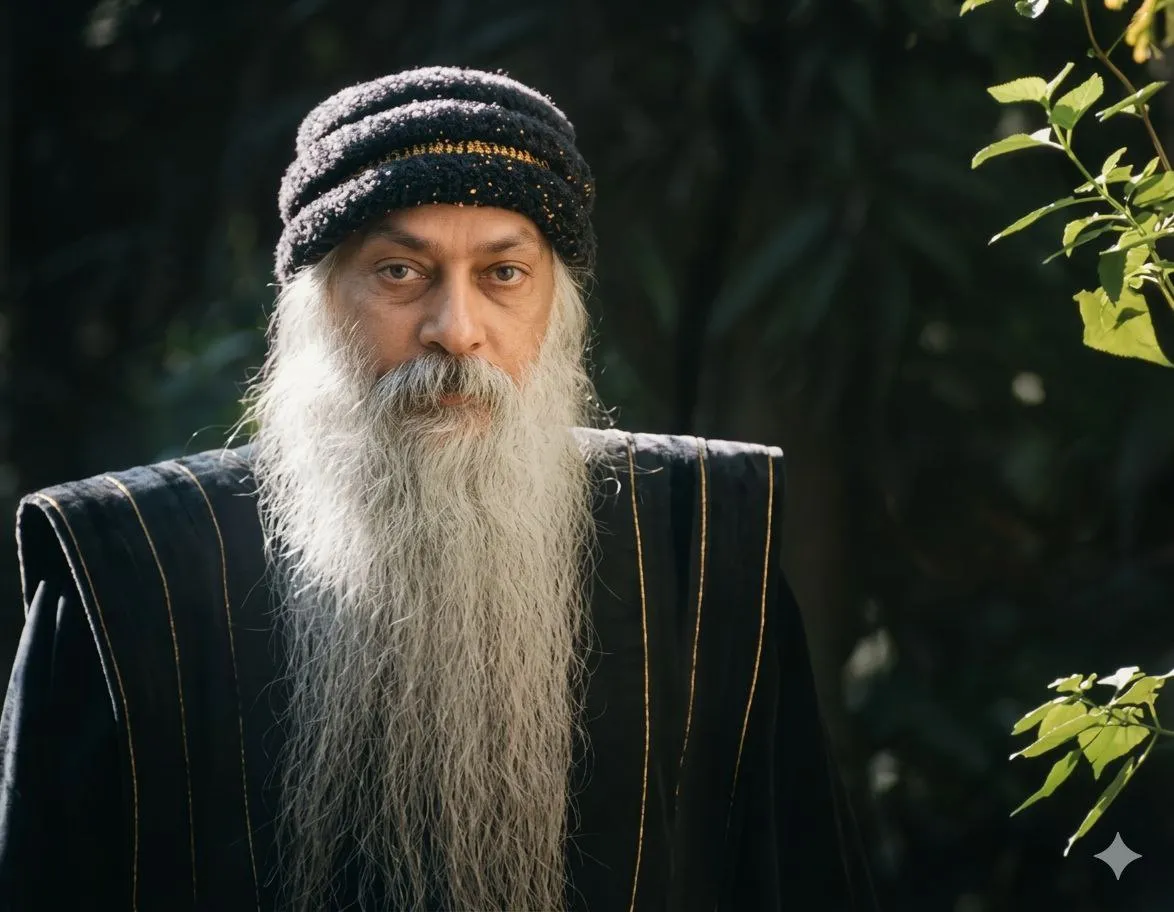
Browse an extensive collection of Osho's most profound quotes, curated semantically by topic and discourse source. Uncover transformative wisdom organized dynamically for deep contemplation.
Superior souls transcend mere physical refinement, realizing that true enlightenment springs from inner awakening; as science nurtures the body through genetics and health, it creates a fertile ground for higher consciousness to flourish, harmonizing body and soul in the process.
Deep hollowness resembles a black hole, where external events may shatter our foundations, yet only lead us deeper into the void; when that emptiness vanishes, it reveals the Master’s touch, as true healing emerges from awakened presence, not mere circumstance.
Embracing monk-like robes as the epitome of scientific attire, Osho illustrates that true freedom and ease arise not from external labels, but from a conscious choice of garments that reflect the inner essence of spirituality and identity.
In the pursuit of spiritual awakening, one must recognize that the journey is not a gradual ascent through stages crafted by the mind, but rather a profound leap from ignorance to illumination, where genuine wisdom dispels darkness in an instant, revealing the futility of borrowed knowledge and the necessity for uncompromising honesty about one’s own limitations.
In the spirit of Osho's insights, preaching often arises from a deep-seated fear of one's own ignorance, as individuals cling to borrowed wisdom, seeking the comfort of false certainty while masking their true journey toward self-discovery. This performative display serves to bolster the ego, leading to unsolicited advice that disregards the unique context of each listener.
In the spirit of Osho, the most profound transformation we witness today is the emergence of a new consciousness, a shift from mind to soul that transcends our primal origins, nurturing a life-affirming love for existence and calling forth individuals to cultivate this essential evolution.
In the spirit of Osho's teachings, a balanced social life involves engaging with others like a fine art, savoring only the interactions that enhance your joy and peace, while setting clear boundaries to ensure your inner ease remains undisturbed.
In the spirit of Osho, true religion harmonizes with science's quest for objective reality while art breathes life into form and meaning; together, they transcend mere invention, revealing the profound inner truths that unite the cosmos and the self.
Thought waves, like the winds and oceans, are natural expressions of life energy, arising without sin or flaw; by observing them in relaxed awareness, we allow identification to fade, revealing clarity and a spontaneous, quiet intelligence.
The concept of a prophet, rooted in ego, inevitably gives rise to false prophets who, in their quest for validation, create illusions of truth by projecting their flaws onto others; true spirituality, as Osho suggests, flourishes in the uncharted territory of personal exploration, free from dogma and authority.
In the spirit of Osho, true admiration blossoms not from distant ideals but from the vibrant, transformative connections within one’s own community of seekers, where the shared journey and commitment of those around us illuminate the path of self-discovery.
In the stillness of meditation, perceiving a satanic image reveals the mind's tendency to project its own shadowy aspects onto the canvas of awareness; every master and object merely reflects our inner landscape, inviting us to embrace and transcend these traits rather than cast blame outward.
In the dance of mediumship, one embraces a gentle receptivity, inviting disembodied spirits to resonate within, contrasting sharply with the aggressive act of forcefully vacating one’s own essence to occupy another, as Osho might suggest in exploring the subtleties of existence.
In the spirit of Osho's teachings, the sword should never be drawn, for true strength lies not in violence, but in the profound power of love and forgiveness, which alone can shatter the chains of madness and illuminate the path to peace.
In the dance of futility, spiritual practices serve to wear down the relentless urge to act, revealing that true transformation arises not from doing but from the dissolution of the ego, where failure becomes a gateway to the Divine's embrace.
Osho suggests that private interviews often stem from fear and ego, as our shared human struggles—anger, desire, and restlessness—are best addressed collectively; in openly sharing our truths, we not only lighten our burdens but also cultivate compassion and solidarity among us all.
In the harmonious union of love and revolution, akin to the balance of heart and head or woman and man, lies the true transformative power; only when these opposites embrace without resistance can action blossom into a compassionate and sacred force for change.
Inequality persists not through the lens of spirituality, but as a consequence of poverty, where the cycle of corruption and injustice thrives; true transformation emerges only when we address the root causes, fostering affluence and dignity rather than mere rhetoric.
In the spirit of Osho, Lao Tzu's concept of 'non-journeying' reveals that true practice, rather than a contradiction, serves merely to dissolve illusions, allowing us to awaken effortlessly to the center that has always been within us.
In the realm of spiritual awakening, the 'door' symbolizes the transformative passage of awareness, where the seed of human potential blossoms from a state of homelessness into the conscious celebration of existence, guided by the harmonizing forces of religion and meditation.
Being the last Rajneeshee signifies that the essence begins and concludes with the original; Osho teaches that true disciples should embrace their unique selves, allowing his presence to inspire their own blossoming rather than imitating a borrowed identity.
The opening of the Sahasrar transcends all religious visions and symbols, marking the mind's culmination where metaphors fade and duality dissolves, revealing an indescribable state of non-dual suchness, where both experiencer and experience vanish into pure totality.
In the spirit of Osho’s teachings, modern physics reveals a creative chaos that transcends the confines of intellect, inviting us to dissolve into the profound silence of existence where mystery is not explained but embraced, urging us to love and immerse ourselves in the chaos of life.
Embodying Osho's wisdom, the 'will to power' emerges not as a quest for dominance, but as a vibrant life-force yearning for self-realization; it transcends fleeting desires, focusing instead on the singular pursuit of becoming your authentic self, allowing your inner Buddha to flourish.
Bulls embody the mind’s grand illusions, much like Osho might suggest, where the marvels of conditioning and suggestion create a façade of intelligence, revealing our own credulity and the layers of belief that shape our perception of reality.
The Blessed One resides within as your intrinsic, dormant consciousness, a universal birthright waiting to awaken; when you consciously choose to rise from sleepwalking, bliss unfolds, the ego dissolves, and you join the eternal essence shared by all Buddhas.
Theater and literature serve as mere reflections of life’s grand stage, where the apparent dualities of existence—like day and night—dance in harmony; to truly live is to embrace this unity, allowing poetry and love to flow through our very being.
Walking becomes a dance of awareness, where each step, though grounded, transcends the weight of ego and drama, allowing one to navigate life with a serene presence, untouched by the chaos that surrounds.
Eyes serve as a delicate gateway to our experiences, revealing different worlds brimming with life; through genuine eye contact, we can heal the wounds of modern living, restoring sensitivity, compassion, and a profound presence that transcends mere vision, much like Osho's teachings on connection and awareness.
Within the essence of Osho's teachings lies the understanding that the magic rose symbolizes the inner awakening of consciousness; as we nurture the seed of our true selves with love and awareness, we blossom into our fullest potential, transcending mere existence.
In the dance of existence, raga embodies attachment and clinging, while viraga represents the paradox of renunciation tinged with obsession; yet, vitaraga emerges as a serene state of effortless detachment, perceiving reality without grasp or aversion, much like Kamal's indifference to the king's diamond.
Delight blooms from within, revealing itself the moment we release our grip on suffering; by embracing total responsibility, we transform our inner landscape, choosing serenity over chaos in the very next breath.
Grief, as Osho might suggest, arises not merely from the loss of a loved one but from our shattered illusion of permanence; embracing this reality transforms sorrow into gratitude, encouraging us to honor their departure and live more consciously in the face of our own mortality.
Prarabdha transcends the illusion of an external destiny, revealing that what we perceive as fate is merely the accumulated momentum of our choices, inviting us to embrace responsibility and reshape our path in the present moment.
In the essence of Osho's philosophy, true luxury unfolds not in material comforts, but in the profound richness of being, where the silence of the mind unveils the beauty, joy, and harmony found within the depths of our own awareness.
The feminine mystery, an eternal and nurturing essence, serves as the ocean from which all life flows and to which it returns, embodying a profound stability and intuitive wholeness that contrasts with the restless nature of the masculine.
In the spirit of Osho, Yaa-Hoo! transcends mere words, resonating as an existential sound-key; Hoo silences the mind and time, while Yaa infuses joy and dance, together invoking a vibrant awareness that cleanses repression and opens the inner self.
In the blossoming of the Sahasrara, an exquisite inner silence unveils itself, revealing a profound void that transcends the self; as this awareness deepens, sensations fade, and the illusion of separateness dissolves, allowing one to merge seamlessly with the essence of existence.
Prana, the vital life-energy that transcends mere breath and thought, flows through all seven bodies—physical, etheric, astral, mental, spiritual, cosmic, and nirvanic—manifesting as the dynamic currents of inflow and outflow that animate our existence.
In the essence of Osho's teachings, the biblical notion that In the beginning was the Word overlooks the truth that existence is an eternal creativity, where silence, the timeless core of all life, births words that both arise and disrupt our understanding of reality.
Drowning in the unfathomable invites a surrender to the vast, unknowable reality that transcends mind and ego, dissolving the self rather than inflating pride, revealing that true theism lies in embracing the ocean beyond our limited understanding.
The essence of Rajneeshpuram embodies a meditative energy that nurtures life and counters the pervasive threats of nuclear madness and cultural decay; to undermine this sanctuary is to extinguish a vital experiment in self-discovery and enlightenment essential for humanity's survival.
In the graceful dance of Hanumana, a disciplined devotion unfolds, echoing the order of Rama’s command, yet it stands in stark contrast to the unrestrained ecstasy celebrated by Osho, revealing the tension between structured spirituality and the liberating abandon of true transcendence.
Single-pointedness embodies a focused concentration that sharpens the mind for tasks like archery or science, yet true meditation transcends this, inviting pure awareness where presence reigns, illuminating the path to totality beyond mere action.
Osho illuminates the paradox of the inferiority complex, revealing that it often springs from an unacknowledged superiority complex; when our grandiose self-image crumbles under the weight of reality, the chasm between who we think we are and who we truly are breeds a profound sense of worthlessness.
Kundalini Yoga unfolds the dormant energy within, guiding it from a mere seed to a vibrant manifestation, harmonizing the fragmented self and healing the rift between consciousness and instinct, ultimately leading to a profound state of bliss and unity.
In the essence of Osho's teachings, a true salutation unfolds as an inward bow, where the heart's silent reverence transcends mere gestures, revealing that the most profound greeting lies in a loving presence that resonates within.
Hopelessness, in its deepening, invites you to shed the illusions of hope, revealing the profound truth of the present; embrace this journey with patience and humility, for in the surrender lies the essence of realization.
Power, an inner radiance born of love, embodies healing and freedom, while force, coercive and external, disrupts harmony; when love morphs into law, the essence shifts, transforming vibrant energy into mere roles and control, blurring the lines we thought distinct.
Purusharthas illuminate the essence of one's being, as the pursuits of wealth reveal attachment to the trivial, desire unveils the chains of longing, the quest for dharma reflects a heart in search of truth, and the yearning for moksha speaks to the soul's profound thirst for ultimate freedom.
Living in danger invites us to shed the comforting confines of the past, embracing the unknown with an open heart; true care for the future flourishes when we release yesterday and immerse ourselves fully in the vibrant present, fostering growth and renewal.
Embracing the presence of a living Sadguru is a daring journey that ignites an intense awakening, urging one to soar toward the sun, where the ego and borrowed beliefs cannot endure; in this transformative fire, the essence of existence and divinity unfurls.
A pub serves as a shrine to forgetfulness, where the search for the 'right beer' becomes futile amidst our inner drunkenness of desires; true celebration arises not from bottles, but from the clarity and presence that Osho so profoundly champions.
Embodying Osho's wisdom, true self-restraint emerges not from forced asceticism but as a natural consequence of inner fulfillment; once one discovers the treasures of joy and awareness, the nonessential falls away effortlessly, revealing a vibrant and joyful existence.
Upheaval serves as the catalyst that shatters the confines of conditioning, awakening us from our comfortable slumber to forge a pristine space where true awareness and freedom can flourish; in this turbulence, the old routines dissolve, making way for authentic transformation and renewal.
In the dance of existence, where even virtuous acts can stir resentment and misunderstanding, Osho reminds us that enemies naturally accumulate while friendships ebb and flow; thus, embracing this reality frees us to act with integrity, unburdened by the need for approval or fear of opposition.
Empathy, in its essence, transcends mere sympathy or apathy, unveiling our intrinsic connection; as separations dissolve, the 'other' becomes part of us, forging a sacred bond with all beings, akin to the profound insights of Osho on the unity of existence.
Osho’s world tour unfolds without a predetermined path, illuminating how fearful governments and churches confine even the simplest acts of movement, transforming nations into vast prisons; his journey, now leading to Italy, Switzerland, and France, reveals the profound unfreedom that binds us all.
In the spirit of Osho's teachings, the essence of spiritual exploration lies in the deeply personal journey of experimentation, where insights bloom within, revealing truths that resonate only when one has traversed the same inner landscape.
In the realm of enlightenment, where the wisdom of five hundred lamas transcends collective auto-suggestion, the wordless gatherings of these adept souls illuminate the unconscious, revealing that true connection with the subtle body arises not from hypnosis, but from a profound oneness with the universal essence.
In the dance of existence, prana embodies the vital energy circulating within and around us, while apana represents its outward flow; surrendering one to the other unites inhalation and exhalation, revealing the seamless ocean of life-energy that transcends ego and illuminates our true essence.
In the dance of self-compassion, Osho illuminates how the harshness we direct inward, born from societal pressures to appear kind, can transform into a nurturing awareness that not only embraces our own essence but also effortlessly radiates love to others.
Embracing the power of no unveils the truth long buried beneath a lifetime of acquiescence, revealing that the habitual yes was often a mask; only by fully honoring this vital no can one reclaim their inner rhythm and authentically embrace the spontaneity of a true yes.
Saintliness emerges effortlessly when we cease our anxious striving and embrace the present, as Osho suggests; by relinquishing the urge to force holiness, we create the space for grace to arrive in its own perfect timing.
The sublime, akin to true happiness or paradise, challenges the ego by demanding nothing and dissolving the very constructs that breed suffering, yet many cling to familiar pains and identities, resisting the profound simplicity of joy that lies just beyond their self-imposed barriers.
The sixth sense, akin to the third eye, embodies an inward awareness that transcends the physical realm, opening through meditation to perceive the profound unity of existence and the divine essence beyond mere senses.
Dependency transforms you into a fearful slave, clinging to drama and neglecting the nourishing essence of meditation; Osho invites us to embrace playful freedom, where love becomes a journey of gratitude and self-discovery, fostering compassion over conflict.
In the essence of Osho's teachings, the myriad talks serve a singular purpose: to awaken the dormant soul, urging us to transcend ego and embrace the present moment, where true illumination lies beyond the confines of words and concepts.
In the spirit of Osho's teachings, the essence of rasavanti transcends mere concepts, inviting us to embrace the purity of his words without distortion, urging us to listen anew rather than cling to preconceived notions of loss or utility.
In the spirit of Osho's teachings, the debate over whether existence precedes essence reveals a fundamental misunderstanding; like the inseparable dance of seed and tree, they emerge together in a harmonious unfolding, transcending our limited perception of time.
Upasana embodies the art of surrendering to the divine presence, inviting beauty and truth with an open heart, much like preparing for sleep—creating a sanctuary of silence and stillness where the divine naturally unfolds in its own time.
In the embrace of vulnerability, tears become a sacred expression of innocence and gratitude, cleansing the heart and mind; they invite us to rejoice in our raw emotions, deepening joy, washing away sadness, and revealing the divine within.
Naturalness embodies your true essence, often veiled by conditioning and effort; yet, when you strive to be natural, you inadvertently become artificial. By shedding ideals and embracing awareness, spontaneity emerges, allowing your uncontrived, vibrant self to shine through effortlessly.
Indecision emerges as a learned affliction, a rift between our innate desires and imposed moralities, where the suppression of spontaneity leads to inner turmoil; embracing our natural instincts allows creativity to flourish, guiding us toward choices that resonate authentically.
In a world often marked by hardness, embracing softness transforms reactive defenses into a compassionate presence, revealing cruelty as a reflection of suffering; it cultivates forgiveness, playfulness, and a profound clarity that empowers both oneself and others to shed their protective shells.
Ashtavakra's eight crookednesses reveal that the essence of truth transcends the rigid paths of scripture and sadhana, illustrating that even in our twisted forms, the untouched Self remains, echoing Osho's insight that our nature is inherently free and whole, rendering the quest for how unnecessary.
In the spirit of Osho's teachings, true succession transcends geography, manifesting not through mere physical presence but in the consciousness of those who are open, empty, and ignited by profound understanding.
Preoccupation, laden with prejudice and pride, clouds our perception, distorting the present with the weight of past beliefs; by shedding these distractions, we awaken to a fresh, unfiltered awareness where meditation and the divine can truly flourish.
In the dance of existence, yoga embodies will and discipline while tantra embraces surrender and acceptance; though they diverge in practice, both paths converge at the summit of transcendence, inviting seekers to honor their nature and pursue their chosen journey toward realization.
Awakening to your own wondrous nature reveals the intrinsic divinity that has always resided within, where the restless search ceases, the ego dissolves, and a quiet joy emerges, allowing love, creativity, and gratitude to flourish in each moment of existence.
In the dance of existence, the so-called 'vicious circle' dissolves into a harmonious cycle where opposites enrich one another, revealing that youth matures into old age and birth flows seamlessly into death, inviting us to embrace the beauty of life’s eternal wholeness.
In the dance of existence, head and heart are not adversaries but instruments of a greater harmony; when awareness guides them, the heart illuminates love's path while the head skillfully expresses it, revealing truth through the gentle art of silent witnessing.
In the dance of energy through the six chakras, each embodies a cycle of wakefulness and rest, while the seventh, Sahasrar, transcends this duality, embodying pure awareness; thus, the yogi awakens to a profound stillness, experiencing deeper, more tranquil states of being.
Osho illuminates that a cult ensnares freedom within rigid beliefs and rituals, demanding adherence to doctrines over personal experience, while true spirituality invites an unrestrained journey of exploration, where essence transcends words and boundaries.
True self-renewal blossoms not from the pursuit of perfection, but from embracing life's totality; by surrendering the ego and immersing ourselves fully in each moment—be it love, meditation, or dance—we cultivate a vibrant essence, where contentment flourishes and the need for success fades into insignificance.
Osho illuminates that spiritual ideals transcend the figures of Buddha and Jesus, revealing the inherent potential within each individual; true fulfillment arises not from imitation, but from the unique expression of one’s own awakened essence.
Marwaris embody the mind's tendency to cling to possessions and ideas, revealing that this miserly disposition resides within us all; true spiritual growth unfolds when we embrace generosity, allowing our hearts to open and our souls to flourish.
In the dance of existence, teachers embody both the architects and dismantlers of systems, crafting maps that foster trust while also stripping away illusions, guiding seekers toward the uncharted depths of their own being, where true discovery awaits.
In the stillness of awakened perception, where the silence of samadhi dissolves all questions into profound understanding, reality emerges, while illusion remains a tapestry of borrowed inquiries and unexamined beliefs; thus, true insight invites us to cultivate awareness and embrace our own lived experience.
In the essence of Osho's philosophy, the apparent conflict dissolves into understanding that sadhana is not about doing but about relinquishing effort; like Lao Tzu's 'negative methods,' it invites us to let go, allowing the innate center to emerge free from illusion.
Monkhood blossoms from the deep-rooted discipline of the shravak, the attentive seeker; as one embodies this training, the path to true inner sadhutva unfolds, revealing that the essence of monasticism transcends mere outward forms.
In the dance of masculine nature, women embodying a potent male essence often find themselves in the paradox of dominance, yearning for a partner who embodies strength, yet struggling against their innate feminine depth, leading to a cycle of dissatisfaction and tension.
Embracing the wisdom of Osho, one recognizes that emotional blockage stems from the ego's fear of losing its grip, resisting the spiritual energy that seeks to flow freely; only through surrendering to this transformative force can we dissolve the barriers and awaken to love and laughter.
In the spirit of Osho's teachings, the concept of 'species' encompasses the vibrant tapestry of nonhuman life—birds, fish, animals, and trees—reminding us that by embracing their innocence and playfulness, we can rediscover harmony and joy in existence, free from the burdens of ego and knowledge.
Punishment emerges not from external authority but as an inherent result of disregarding life's true principles; without awareness and skill, suffering becomes inevitable, much like a non-swimmer's folly in deep water or the turmoil of two co-dependent souls, emphasizing the necessity of mastering aloneness and consciousness to foster harmonious actions and relationships.
In the embrace of serenity, one discovers that true merging unfolds naturally rather than through effort; in the sacred space of satsang, the essence of presence nurtures the soul, inviting patience and trust as love blossoms in both solitude and action.
In the essence of Osho's teachings, visions of Krishna often reveal themselves as mere mental projections shaped by desire, while true spirituality unfolds in the formless expanse of Krishna-consciousness, where the mind dissolves and genuine awareness emerges beyond all images and names.
True transformation emerges not from the struggle of a divided mind attempting to reshape itself, but from the profound acceptance of one’s current being, where acceptance dissolves inner conflict, ignites insight, and nurtures genuine change with effortless grace.
In a playful dance of awareness, Osho subtly omits the ever-proper Sagar, for his rigidity renders him unable to join the joke, illuminating the beauty of transcending categories and embracing the fluidity of existence.
In the spirit of Osho’s teachings, the essence of Buddha-Dharma lies in a profound, wordless awakening, inviting us to delve into our innermost being where truth flourishes in silence, illuminating the heart beyond mere concepts and discourse.
One tap — creates your free account, or signs you back in.
Already have an account? Login here
New here? Create a free account
Enter your account email and we'll send you a link to choose a new password.
Remembered it? Back to login