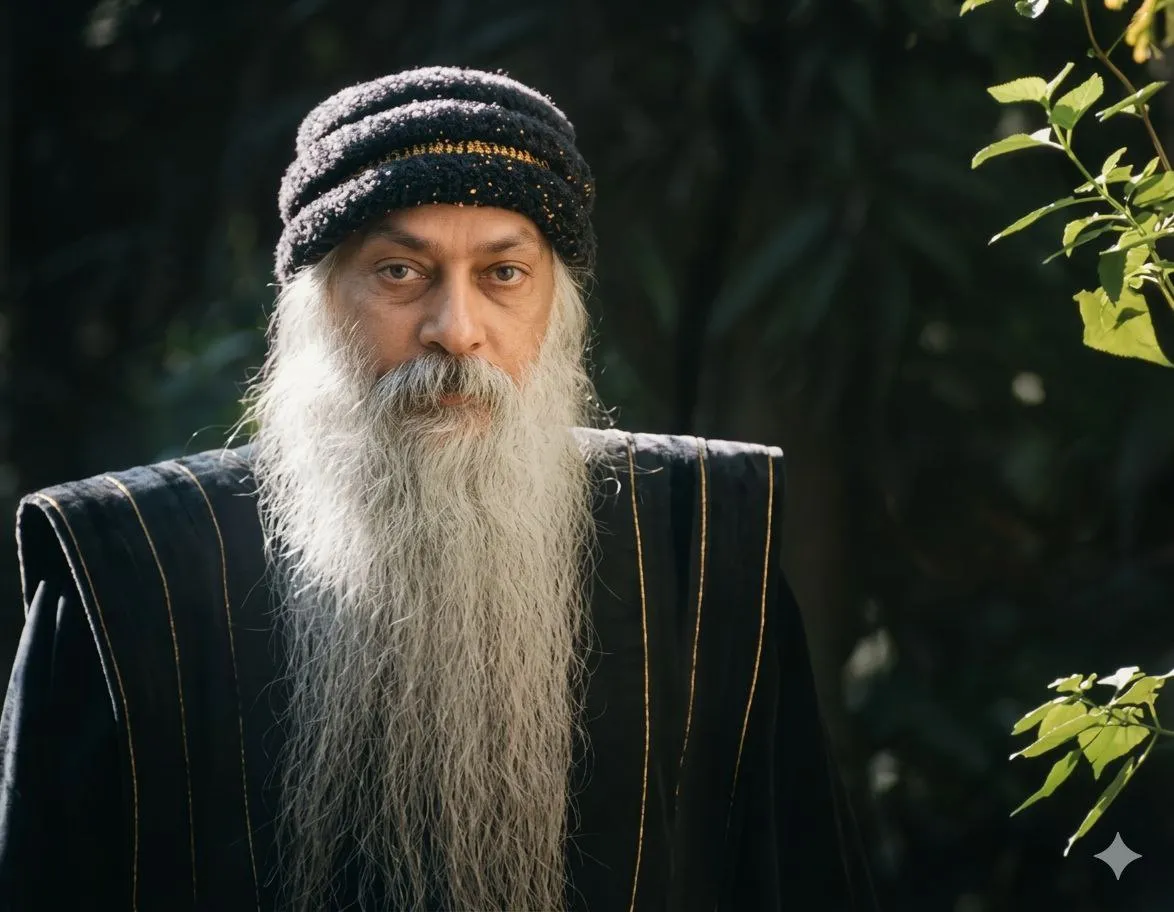
Browse an extensive collection of Osho's most profound quotes, curated semantically by topic and discourse source. Uncover transformative wisdom organized dynamically for deep contemplation.
Embracing the essence of impermanence reveals that only change endures, as all forms, identities, and beliefs ebb and flow; true wisdom lies in flowing with life's river, finding ease in witnessing transformation without clinging.
Embracing the essence of Osho, one finds that transcending self-destruction requires a joyful acceptance of oneself, channeling energy away from life-denying ideals and into conscious creativity, where awareness transforms existence into a vibrant tapestry of love and meaning.
In an out-of-body experience, one might observe their physical form from a distance, feeling the effortless pull of intention guiding their return; yet, as the body languishes, an intense hunger arises, reminding us that grounding through nourishment is essential to restore balance and vitality.
The Charvakas sparked a vibrant materialist dissent in India, celebrating pleasure yet faltering in depth and rigor, lacking the philosophical giants like Epicurus or Hume to elevate their discourse beyond the mundane, leaving their insights overshadowed by a prevailing belief-driven culture, much like Osho’s call to transcend conventional thought.
Embracing the notion that the world 'ends' with each moment lived as if it were the last, Osho invites us to shed pride and repression, allowing love and aliveness to flourish now, transforming fear into a vibrant celebration of presence and intimacy.
Inner strength blossoms when we embrace our natural energies without repression, particularly around love and sexuality; in this liberation, shyness and indecision dissolve, giving rise to a confident, unified self that thrives in authenticity and playfulness.
The sweet ache of separation from the Divine, cherished by the devotional heart, keeps love vibrant and the Beloved close; yet, as Osho suggests, true freedom emerges when this longing dissolves into the stillness of silent meditation, transcending desire.
In the transformative journey through three meditative stages, one may witness profound shifts as diseases dissolve, dormant energies awaken, and a nectar of love flows, unveiling vibrant perceptions that transcend the ordinary, allowing the heart to embrace life beyond the fear of death.
In the embrace of Osho's wisdom, fatalism reveals itself as the ego's refuge, a denial of responsibility that stems from resistance, while true awakening unfolds in the surrender to the cosmic flow, where the illusion of separation fades, allowing life’s beauty to emerge effortlessly in harmonious participation.
Embodying Osho's wisdom, true release unfolds in an instant, where the past dissolves and a new self emerges, free from methods that merely cultivate trust and self-acceptance; it is a sudden awakening, a lightning strike beyond the confines of karma and effort.
In the essence of Vimalkirti, one discovers the profound stillness of nirvana—an exquisite fullness of no-thingness, where the weight of desire and action fades, allowing for a serene merging with existence, echoing Osho's celebration of silent being and the divine trust in the cosmos.
In the dance of existence, compromise emerges from uncertainty, where borrowed beliefs fracture our essence; yet, when we embrace our lived truth, we find an indivisible wholeness that honors authenticity over the false security of half-hearted agreements.
Suffering emerges when one confuses their essence with the unfolding drama of Prakriti, becoming ensnared by the cycles of pleasure and pain; embracing the witness-consciousness of Purusha allows the actor to perform without attachment, leading to liberation from suffering.
In the realm of divine inspiration, Osho illuminates the distinction between selfless guidance that risks personal loss for the greater good and ego-driven impulses that masquerade as insight, reminding us that true inspiration serves all without reservation.
In the realm of meditation, the act of visualization often disrupts the profound silence essential for connecting with one's true essence, as any image or thought merely reflects what is already known; instead, one should embrace a vigilant detachment, allowing images to drift away while sinking deeper into the vastness of existence.
Buddha wrinkles emerge as gentle lines on a face imbued with awareness and love, reflecting a natural flow of energy and inner peace; they symbolize the beauty of ripeness, where playfulness and compassion soften the visage, revealing the essence of awakening.
Conduct, much like Osho’s teachings, flows as a dynamic expression of one’s inner vision, shaped by the unique interplay of knowledge, language, and culture, evolving with time and circumstance, allowing the essence of truth to resonate authentically rather than through mere imitation.
Embracing your inherent uniqueness, untouched by comparison, unveils the essence of your being, free from the ego's grasp; in this sacred presence, rather than striving for superiority, you discover a profound inner peace and the purity of simply existing as you are.
Limits emerge solely from our comparisons of expressions rather than the essence of realizations, as the universal truth resides within us all; yet, figures like Mahavira illuminate it so clearly that we often elevate them, revealing our tendency to value communication over the truth itself.
In Osho's vision, nondoing transcends the dullness of laziness, embodying a vibrant state where energy flows freely and awareness sharpens, inviting us to embrace the present moment without forcing choices, allowing spontaneous action to arise effortlessly.
Menstruation, a profound journey through emotional tides of anger, despair, and irritability, mirrors the male experience of cyclical emotional dips; in recognizing this shared rhythm, Osho's wisdom guides us toward compassionate awareness, open communication, and mindful support to navigate the turbulence together.
Enduring life's tests with awareness and humility leads to a profound awakening, as if standing at the shore of enlightenment, while neglecting this journey leaves the final test of wakefulness unpassed; relinquish the ego, ignite the light of consciousness, and freedom unfolds like a welcoming door.
In the spirit of Osho, while India has shed the weight of external subjugation, the true challenge lies in overcoming the inner chains of conditioning and fear, for genuine liberation demands a profound awakening of consciousness and personal responsibility.
In the dance of existence, relaxation and effort stand as opposing forces, each a complete journey unto itself; embracing one with purity allows for true progress, while only after arriving can one joyfully explore the other as a playful addition to the self.
In the dance of lucid dreaming, one learns to quiet the chaos of the external world, cultivating an inner stillness that unveils the dream-state as an unbroken continuum; through this self-remembering, the veil of illusion lifts, revealing the profound clarity of true awakening—an essence Osho would celebrate as enlightenment.
In the spirit of Osho, true problem solving transcends mere answers; by allowing the concept of a problem to dissolve, we unveil the silence and living mystery of existence, from which spontaneous responses emerge, embracing life's inherent fluidity.
Fear serves as an innate guardian of our survival, while guilt, a contrived construct of societal control, twists that fear inward, suffocating our spirit; embracing healthy caution frees our energy, allowing us to live authentically and vibrantly.
Liberating oneself from mental afflictions such as lust, anger, greed, and attachment requires a mindful release from rigid patterns, embracing the freshness of each moment while exploring diverse perspectives, ultimately allowing the transient nature of existence to dissolve possessiveness and reveal the power of choiceless awareness.
Disfigurement, a mere scar left by the flames of experience, serves not as an identity but as a poignant reminder that the fire has long since extinguished; embrace this residue without attachment, and allow the vibrant reality of the present to unfold.
Embracing the essence of Osho, the journey through a negative mind reveals that true clarity arises from a state of humble emptiness, where the burdens of accumulated knowledge and memories fade, allowing authentic inquiry and creativity to blossom in each moment.
In the stillness of self-acceptance, where love and reverence unveil our divine nature, desireless action emerges effortlessly from wholeness, transcending the guilt and self-condemnation that once bound us to craving.
In the dance of existence, those who cling to comforting illusions often lash out in scorn when faced with transformative truths, yet for the awakened, such insults dissolve like mist, revealing that true freedom lies beyond the confines of identity and societal structures.
In Osho's view, the elite class is an enduring reality, with only the names shifting—be it kings or visionaries—driven by inherent differences in intelligence and ambition, while the masses often seek guidance, revealing that efforts to eliminate elites merely usher in new ones, as true equality is an illusion that stifles individuality.
Inactivity, when embraced as a release from attachments, doesn't render one inert; instead, it ignites a profound, compassionate action that flows from inner stillness, echoing the lives of great exemplars like Buddha and Christ, whose peaceful energy transformed the world.
In the tranquil embrace of centered awareness, where the mind relinquishes its chase of dualities—attachment and aversion—consciousness transforms into a witness, unlocking the door to omniscience and revealing the profound depths of true knowledge.
In the spirit of Osho, giftedness emerges not from a reservoir of knowledge but from an unfiltered clarity of perception; while children possess minds unshackled by habit or belief, true brilliance thrives in the freshness of direct experience.
Embracing the dreams and fantasies of youth, Osho suggests, allows teenagers to savor the beauty of possibility, nurturing their spirit before life’s harsh realities set in; forcing them into premature realism stifles their essence in a world too often devoid of wonder.
Embracing the essence of ease, Osho reveals that our true nature transcends the mind's dichotomy of difficulty; enlightenment unfolds not as an achievement but as a gentle recognition, inviting us to relax into the simplicity of our being.
The Diamond Sutra, much like Osho's teachings, shatters preconceived notions of truth, guiding us beyond the confines of thought into the immediate, wordless essence of existence, where love and presence reveal a deeper reality beyond mere knowledge.
In the spirit of Osho’s teachings, the intricate dance between the environment and social order reveals that neither exists in isolation; as we nurture inner awareness, the world around us transforms, creating a harmonious cycle of change that demands both personal and societal evolution.
In the spirit of Osho, the holy war unfolds as a profound journey of love and awareness, where the light of consciousness gently dismantles our inner thorns and illusions, transforming pain into a soothing fire that liberates the soul.
Engaging in an inner dialogue with the master sparks a profound transformation, dissolving old meanings and desires, leading to a disorienting yet enriching simplicity; ultimately, one can embrace the mundane with the Himalayas of wisdom residing within.
In the dance of existence, science stands as an impartial observer, governed by universal laws, while art emerges as a heartfelt expression, transforming reality through the artist's unique vision, echoing Osho's belief in the harmony of inner truth and outer form.
Self-judgment, a pervasive social affliction instilled by upbringing and culture, fuels the ego's hunger for dominance, obstructing love and friendship; by recognizing this conditioning and silencing the inner critic, we liberate our hearts, allowing joy and maturity to flourish.
Misconceptions often arise as propaganda wielded by those in power—politicians, religious leaders, and sensationalist media—who distort the essence of topics like sex, while Osho teaches that true spirituality transcends these distractions, urging us to cultivate prosperity as a foundation for deeper understanding rather than indulgence.
In the spirit of Osho's teachings, the inquiry into Jesus and Mary Magdalene's relationship serves only to distract; true liberation arises not from historical speculation, but from turning inward to awaken the Christ within, embracing presence over personality.
In the journey of pilgrimage, the seeker may dissolve, transcending the ego's illusion; what endures is the divine flow of existence, where meditation unveils the essence of life as a sacred dance, echoing the harmony of being beyond the self.
Osho's wisdom reminds us that the West's mechanistic approach to healthcare, focused on quick fixes, fosters dependency and fragmented healing, neglecting our organic unity with nature and the soul, ultimately leading to deeper illness and existential disarray.
Obedience finds its virtue not in blind submission to noble causes but in the depth of inner awareness; true service emerges from a conscious choice, where one's own conscience guides the heart, transforming ideals into genuine goodness.
In the essence of existence, a curve reveals the concealed circularity of life, where what appears linear is merely a fleeting arc of a vast circle; thus, true straightness eludes us, echoing Osho's insight that thoughts and language spiral endlessly, while meditation offers a profound escape into the stillness of wordless awareness.
In the dance of existence, divine qualities are as abundant as the demonic, revealing that our perception of scarcity stems from an unawakened inner state; when awareness evolves into witnessing, we recognize good and evil as equal, complementary forces harmonizing life.
Embracing a childlike feeling in meditation signifies a return to innocence, where maturity meets joy, inviting you to celebrate this rebirth and discover the wise companion within, as Osho beautifully reminds us of the homecoming to our essential being.
Asmita represents the mind's most refined self-awareness, a delicate veil at the threshold of the Divine, yet it remains entwined with duality; true liberation demands that even this subtle sense of self dissolve, revealing the boundless truth beyond all distinctions.
Osho invites us to see that the notion of a 'world teacher' is merely a hollow title, often rooted in competitive debate rather than genuine understanding; true teaching emerges from lived experience and profound inner awakening, transcending mere linguistic victories.
Metaphors of lameness, deafness, and blindness reflect not our physical limitations but the spiritual slumber of our souls, inviting us to awaken from egoic intoxication and embrace the profound reality of existence that surrounds us like an ocean of divine presence.
True spontaneity blossoms into a natural rhythm, while genuine regularity nurtures the spirit of spontaneity; embrace one path—be it Zen’s trust in instinct or Patanjali’s disciplined approach—and watch the other unfold effortlessly, for life, in its purest form, dances between freedom and flow.
At every moment, you stand at the precipice of possibility, where the leap into the unknown is a choice; shedding the pretense of cleverness and embracing a childlike openness allows you to transcend fear and discover your inherent freedom.
In the spirit of Osho's teachings, tapas-yajna embodies the sacred discipline of nurturing your inherent essence, allowing it to bloom and release its unique fragrance to the divine; for in honoring your true nature, joy flourishes, gratitude awakens, and grace embraces your offering.
In the profound stillness of an inner explosion, where the mind dissolves into silence and breath fades into nothingness, one encounters the ineffable—a transformative death of the familiar that gives way to the boundless essence of being.
Homesickness embodies a duality: a trivial yearning for familiar discomfort and a deeper, mystical longing for the divine source, echoing Osho's insight that our cells remember a lost wholeness, urging us toward awakening and our true home.
The Middle Way, as illuminated by the Buddha, invites us to embrace a balance that transcends the extremes of indulgence and renunciation, guiding us to a centered existence where freedom and clarity flourish amidst the chaos of desire and aversion.
In the essence of daily life, true freedom and joy unfold not in external circumstances but within, as one embraces each moment with awareness and gratitude, transforming even the bleakest situations into opportunities for celebration and growth.
Anuvrat, often seen as a hollow moralism echoing Acharya Tulsi's borrowed vows, lacks the essence of meditative realization, revealing that true transformation, as Osho would suggest, emerges from the depths of inner silence rather than mere public proclamations.
Pativratā transcends mere social role, embodying a complex interplay of power and virtue, where a wife's commitment to her husband's moral discipline—through fasting and vows—reveals the subtle dynamics of freedom and control reminiscent of Osho's exploration of human relationships.
In the spirit of Osho's teachings, Sahjobai's essence reveals that women, guided more by a desire to live and evolve than by a thirst for metaphysical discourse, prioritize transformative questions over mere knowledge, seeking peace and meaning in their everyday existence.
In the dance of existence, the gunas—tamas, rajas, and sattva—intertwine within each individual, with one often taking the lead, yet true harmony emerges when all three harmonize, reflecting the vibrant paradox of a holistic self, much like Krishna's essence.
Osho profoundly illuminates that the notion of 'dignity of the poor' is a deceptive illusion; genuine respect for human dignity lies in dismantling the chains of poverty, empowering individuals to embrace joy and self-reliance in their lives.
In the embrace of tantric sex, one discovers a meditative dance of sexual energy that transcends ego and separation, transforming fleeting passion into a profound union with ultimate reality, where every moment becomes an invitation to timeless awareness and creative presence.
In the serene stillness where the 'I' dissolves into pure consciousness, your essence transforms into a transparent awareness, allowing existence itself to resonate through you—like the gentle sound of raindrops or the whisper of bamboos, as life effortlessly unfolds in the absence of ego.
In the dance of existence, fullness and emptiness reveal the same profound truth; as the burdens of the world dissolve, what endures is not mere void but a radiant bliss—a divine presence that transcends ego, echoing Osho’s insight into the essence of being.
Zarathustra's laughter at birth transcends mere historical record, embodying a profound insight into the world's chaos; like Osho, he embraced humor as a liberating force, signaling intelligence and a joyous defiance against life's absurdities.
Prati-prasav embodies the essence of unlearning, where consciously reliving past experiences allows their imprints to dissolve, ultimately cleansing the inner slate and unveiling freedom as the conditioning and emotional residue evaporate.
Embracing the essence of existence, one transcends contradiction through egoless acceptance, where spontaneous assertion emerges not from the self but as a harmonious expression of the whole, revealing that true empowerment lies in surrendering to the present moment.
Osho illuminates the journey of human behavior as a sacred ascent through the layers of existence—first nurturing the body, then embracing the mind's artistry, allowing the soul to blossom through meditation, and ultimately, experiencing the divine in authentic prayer, as bypassing any step leads to inner turmoil.
In the spirit of Osho's teachings, asanas emerge effortlessly when we surrender to relaxation, allowing the body's innate wisdom to guide us into spontaneous postures that nourish the soul, while rigid, imitative forms pale in comparison to this organic expression of being.
Human experimentation is a neutral tool, neither inherently good nor bad; its true nature unfolds through the intentions behind it—whether wielded by dogmatic powers or guided by a compassionate, nonpartisan pursuit of knowledge, it can embody nature’s evolution and profound progress.
In the tapestry of spiritualism, Osho reveals that true recognition arises from the unconditioned mind, free from the constraints of collective identity, allowing a few enlightened souls to embrace the living masters who defy past dogmas.
Monotheism, often seen as a means to unify belief, can instead stifle the blossoming of individual potential, as it centralizes authority and breeds conformity; in contrast, polytheistic traditions celebrate diversity and honor each person's divine essence, fostering true inner growth.
When we release our ego-driven worries about money and embrace a state of surrender, much like the lilies of the field, we discover that living joyfully in the present allows abundance to flow effortlessly, dissolving the burdens of tomorrow.
As Osho suggests, when defenses harden into impenetrable buffers, life's shocks and love's embrace become distant echoes, imprisoning us in a numbing isolation that stifles transformation; true freedom and connection emerge only when we dare to dismantle these barriers.
Embracing bisexuality transcends the confines of rigid identities; it invites a guiltless existence, harmonizing with one’s authentic self and celebrating the fluidity of love and desire, as Osho might suggest in his quest for true freedom.
In the embrace of the absurd, where reason falters, we find a deeper essence of God, inviting us to transcend mind and memory; through this surrender, an inner awakening harmonizes our being with the universe, unveiling existence as a vibrant, lived unity.
Alimony reveals itself as a mere illusion in the marketplace of human connections; when viewed through the lens of awareness, it fades into insignificance, allowing one to transcend attachment and resentment, ultimately embracing the profound freedom of self-discovery and compassion.
In the stillness of a silent mind, akin to a serene lake reflecting the moon, one perceives the fullness of another's inner world without distortion, for it is only our own mental chatter that obscures the truth of what is revealed.
Embracing the wounds of others often means shouldering the weight of inherited societal misery—anger, guilt, and lingering memories that are not your own; yet, in releasing this borrowed suffering, one can awaken to their true self and cultivate a celebration of joy.
In the journey of modernity, the seeker sheds hollow rituals and priestly control, discovering that true religion blossoms within—manifesting as freedom, love, and meditation—leading many to appear irreligious while they ardently explore the depths of their own being.
Osho invites us to embrace a non-technical journey toward equilibrium, where true balance flourishes through wholehearted living—rooted in prayer, trust, love, and gratitude—transforming the ordinary into the sacred, much like the effortless rhythm of breath.
In selecting this 'dead' country, he embraced its dying spirit, recognizing the profound spiritual treasures it harbors; by breathing life into its corpse-like culture, he seeks to reignite India's ancient wisdom and spark a global revolution in consciousness, a challenge both arduous and transformative.
In the spirit of Osho’s teachings, occasional disruptions in discourse serve merely as fleeting expressions of humanity, inviting us to remain relaxed and focused, allowing the essential work of awareness to flow uninterrupted through the chaos of life.
Spiritual leaders such as Moses, Mohammed, and Mahavir offer practical guidance that refines our behavior and cultivates virtue, while figures like Lao Tzu challenge the ordinary mind, inviting a radical transformation that transcends mere improvement, echoing Osho's call for profound inner revolution.
Osho illuminates the profound truth that the inner self and man are inseparable; realization emerges not from a distant journey but from the gentle recognition of our essence, inviting us to relax into the simple presence of awareness that is already within.
Prajnaparamita embodies the essence of the Heart Sutra, revealing a wisdom that transcends the confines of cause and effect, inviting us to experience the profound unity of form and emptiness, where the self dissolves into the boundless whole, much like Osho's vision of awakening.
Secrecy, as Osho might suggest, nurtures the soul's inner bloom, safeguarding intimacy and authenticity; it transforms the sacred into mere performance when laid bare, allowing trust and surrender to flourish in the shadows, far from the prying eyes of the world.
In the depths of our being, the unwavering light of the soul often remains obscured by the dense darkness of unconscious forgetfulness, lulling us into spiritual slumber as we remain preoccupied with the ephemeral, accumulating ignorance where the light shines brightest.
In the spirit of Osho's teachings, Sankirtan emerges as a vibrant dance and song that transcends the confines of intellectual discourse, offering a chaotic yet liberating celebration that awakens the heart to the profound truths beyond mere words.
Embodying Osho's wisdom, the notion of 'not taking support' emphasizes that the inner journey is inherently solitary; even as a teacher offers pointers, true liberation arises only when one sheds all dependencies, including the guidance itself, to discover the truth within.
Senility, in its essence, represents the paradox of aging without the blossoming of true maturity; as vitality fades, the suppressed child emerges not in sacred innocence, but in a foolishness that belies the richness of a life deeply lived.
In the spirit of Osho's teachings, true essence transcends birthright; it is the interplay of guna and karma that defines us. Embrace your inner Brahmin, pursuing truth and knowledge with authenticity, free from rivalry and societal labels.
In the ultimate quest for self-realization, we transform the mere acknowledgment of 'I am' into a profound understanding of 'Who am I?', choosing awareness over instinct, awakening the divine within us and dissolving inner conflict, leading to a serene, conscious ecstasy.
Nietzsche, a visionary often ahead of his time, resonates with Osho’s insights as humanity awakens to the transformative challenge of his revolutionary ideas, once dismissed as madness but now celebrated for their profound universality and freshness.
One tap — creates your free account, or signs you back in.
Already have an account? Login here
New here? Create a free account
Enter your account email and we'll send you a link to choose a new password.
Remembered it? Back to login