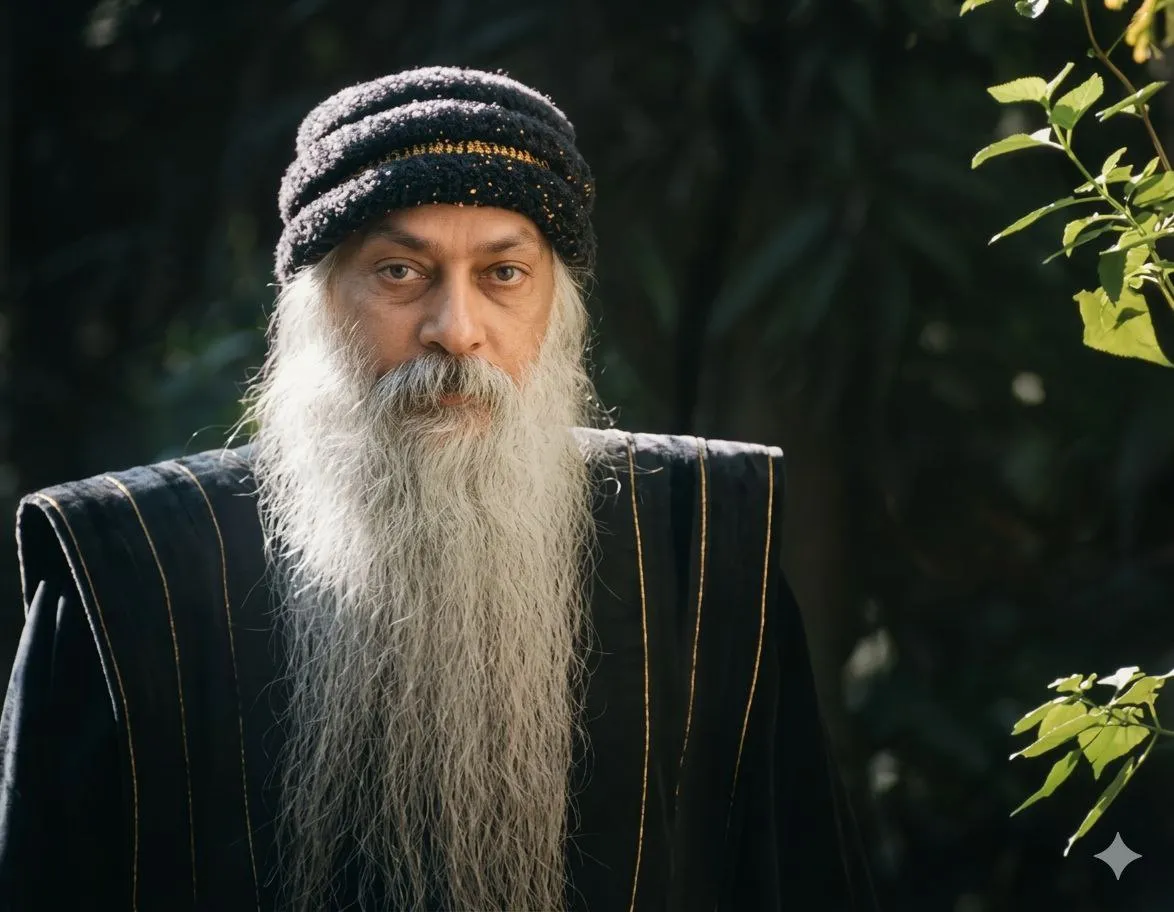
Browse an extensive collection of Osho's most profound quotes, curated semantically by topic and discourse source. Uncover transformative wisdom organized dynamically for deep contemplation.
In the embrace of awe, where the mind surrenders to the unknown, time dissolves, revealing a sacred presence that invites love, gratitude, and humility, urging the heart to open and bow before the divine mystery that transcends fear.
In the realm of dream analysis, the true essence lies not in dissection but in the art of witnessing; as one cultivates a silent, alert awareness of dreams and thoughts, desires dissolve, and enlightenment emerges from this continuous, unbroken presence.
In the stillness of pure witnessing, the watcher remains untouched by amusement or sorrow, reflecting experiences like a mirror; when all emotions fade, only the silent, choiceless awareness of being endures, transcending the fluctuations of the mind.
Osho invites us to transcend rigid dogmas that confine the mind, advocating instead for an open, living inquiry where identities dissolve and the essence of experience flourishes, unbound by labels and doctrines.
In the practice of Anapanasati, the simple act of observing one’s breath becomes a transformative journey; as awareness catalyzes a natural quickening of respiration, it fosters a profound dis-identification, allowing one to transcend the confines of body and mind, ultimately revealing the witness within.
In the embrace of surrender, divine will reveals itself not as an external force manipulating the individual, but as the very essence of existence; when the ego dissolves, we find that in the stillness of our being, we are not separate doers, but the unified expression of the divine.
In the realm of understanding, arrogance often arises from the listener's misinterpretation; when truth is spoken plainly, the unenlightened may perceive pride, while the enlightened recognize it as clarity, for truth transcends the dualities of arrogance and humility.
The world’s madness stems not from our essence but from the conditioning imposed by priests, politicians, and societal norms, which stifle our innate joy; Osho's teachings urge us to shed these constraints, embracing our true selves through love and trust to cultivate genuine happiness.
In the spirit of Osho, regression reveals itself as a retreat into childishness, a reaction against the confines of rigid rationalism; true growth, however, blossoms from embracing both reason and the irrational, allowing the whole self to mature beyond societal facades.
Self-reliance embodies the essence of being your own guiding light, where truth is not bestowed but ignited from within; by embracing challenges and trusting the divinity that resides in you, the seeker and the sought unite, revealing your boundless potential.
A quantum leap emerges not from action but from the profound dissolution of the doer, revealing that the past is merely a memory and thoughts merely construct the thinker; in the stillness where ‘me’ fades, true awareness blossoms, and the leap into the infinite is realized.
Spiritual progress unfolds not through grand visions but in the gentle dissolving of the ego; as one advances, the sense of advancement fades, revealing that true insight brings humility and selflessness, not the weight of pride or experience.
Insomnia reflects a disconnection from life's rhythms; when the body is deprived of meaningful work—be it through creativity or labor—it struggles to find rest, revealing that true sleep flourishes only in the fertile soil of engaged living.
In the spirit of Osho, the metaphor of 'catching a lion' serves as a satirical lens through which we see how institutions manipulate truth, coercing confessions from a cat to masquerade as a lion, ultimately reminding seekers that true understanding cannot be manufactured or forced.
Animals are drawn to the simplicity and earthiness of our behavior, resonating with the instinctual signals they trust; thus, while we embrace our natural essence, refining our manners allows both creatures and humans to coexist harmoniously.
In the spirit of Osho's teachings, the saga of Sheela becomes an irrelevant echo, urging seekers to transcend past distractions and embrace the vibrant, living inquiry of the present moment, where true understanding unfolds.
In the spirit of Osho's teachings, the art of mediumship flourishes through a receptive, feminine openness, where the medium, akin to a finely tuned radio, consciously empties their inner space to invite communication with disembodied souls, highlighting the importance of deliberate intention over fear-driven encounters.
True self-discipline unfolds not through force or struggle, which only strengthen the ego, but by surrendering to life's flow; it emerges effortlessly when we embrace awareness and love, allowing our actions to be gently guided by a deeper harmony.
The Rajneesh Mandir transcends mere labels, embodying the collective love and consent of the commune, where Osho remains a humble guest rather than an authority, and its true essence lies in the shared presence and responsibility of its community.
Freshness arises not from external sources but is woven into the fabric of existence itself, eternally present in the now; by transcending the mind’s temporal confines through meditation, one uncovers the ever-vibrant essence of the soul, a glimpse of the divine.
In the spirit of Osho, the alchemy of connecting with your inner self unfolds effortlessly when you embrace the energies cultivated through centuries of introspection, allowing meditation to transform into a gentle floating, as you align with atmospheres, people, and spaces that nurture your journey inward.
Embracing the essence of non-doership, as illuminated by Osho, reveals that when we live as witnesses, shedding the illusion of the ego’s “I am doing,” we dissolve suffering and awaken to immediate bliss, rooted in the present rather than the burdens of future hopes.
In the spirit of Osho’s teachings, the quest for true peace transcends the mere dichotomy of attack and defense, inviting us to dissolve the mental and political borders that breed conflict, embracing our shared humanity instead of fueling the fires of nationalism.
Embracing ordinariness and relinquishing the ego's desire for distinction reveals common sense as a return to our true nature; in this egoless simplicity, we discover a silent wisdom akin to buddha-being, where joy and clarity flow effortlessly through our lives.
In Osho's view, while 'God' often represents a rigid image demanding devotion, 'godliness' embodies a vibrant essence of love and awareness that transcends names and divides, inviting us to experience the sacred unity within all existence.
In the essence of Osho's thought, all that we perceive as past—whether genuine or fanciful—exists merely as illusory dream-stuff, urging us to transcend the analysis of memories and instead embrace the present moment as the true witness to our consciousness.
In the spirit of Osho's wisdom, Mahavira's principles emerge not from rigid adherence but as organic expressions of inner awakening; when one nurtures meditation, virtues like nonviolence and truth blossom effortlessly, revealing the beauty of true understanding.
In the spirit of Osho's wisdom, the inquiry into which human tendency prevails obscures the truth, for life unfolds as a vibrant continuum where love and hate, violence and peace, intertwine, revealing that reality thrives in the nuances beyond mere binaries.
Osho illuminates the distinction between reaction and response, where reaction is a mechanical echo of the past, while response emerges from a present awareness, creating space for understanding and freedom, much like Buddha's poised encounter with insult.
In the spirit of Osho's insights, the Jain tradition, having once overflowed with love, became arid as later generations, mistaking doctrine for depth, severed their ties to love itself, forgetting that true realization blooms from within, not from rigid austerity.
Embracing the prospect of arrest, he sees it not as a mere confinement but as a profound revelation of American democracy's hypocrisy, transforming persecution into a joyous awakening that inspires a global movement of sannyasins united in love for truth and foundational values.
In the essence of 'Piv, piv laagi pyaas,' the heart's fervent yearning for the Beloved echoes the path of awakening; this profound thirst transforms longing into a sacred journey inward, unveiling the divine presence that has always resided within.
Hassidism embodies a vibrant, heart-centered existence that celebrates the divine in everyday moments, where joy and spontaneity flourish, transforming life's simplicity into a sacred dance of presence and love, echoing Osho's embrace of the now.
Omkar, the anahata—the unstruck sound woven into the cosmos—invites us to silence our minds and uncover the inner resonance of our being, revealing a direct path to bliss, beauty, and the divine, as echoed in the wisdom of Osho.
Living in alignment with one's inner truth often invites societal persecution, a crucible that, as Osho might suggest, transforms adversity into a profound blessing, deepening authenticity, courage, and the blissful freedom of divine connection.
Birth, inherently laden with trauma as Freud suggested, imprints our nervous systems with echoes of prenatal and birthing shocks, yet it is only through the awakened consciousness of a Buddha that we can witness and transcend this binding experience.
The essence of the perfect jewel lies in the depth of your consciousness; when true recognition emerges from within, even the faintest glimpse captivates, while borrowed beliefs only serve to blind you—leaving the treasure unnoticed amidst the throngs.
Embracing the essence of the inner woman requires transcending the 'how,' allowing unconditional love and reverence to guide us; in recognizing her as a divine passage rather than mere body or mind, we unlock the profound reflection of our own soul.
In the spirit of Osho's teachings, the gathering of astute individuals reflects a profound understanding that embracing diversity and learning from history fosters a vibrant spiritual journey, where humor intertwines with wisdom, guiding seekers toward living truth and opportunity.
Greatness is a mirage, as Osho suggests; the essence lies not in idolizing heroes but in embracing our own ordinariness, awakening to the profound awareness that transcends notions of superiority or inferiority.
Desiring to gain often entangles us in ego and burdens, while true receiving unfolds through the art of letting go—shedding identities, pride, and even spiritual status—allowing the inalienable core of our being to emerge and reveal what truly matters.
In the spirit of Osho’s teachings, raas embodies the cosmic dance of Purusha and Prakriti, celebrating the joyful harmony of opposites; it invites us to transform conflict into creative union, fostering a deeper connection through the rhythm of love and awareness.
In the spirit of Osho, to embody unorthodoxy within a commune is to thrive in awareness rather than rigid rules, allowing each moment to breathe with fresh inquiry and love, transforming the collective into a living organism rather than a stifling doctrine.
In the dance of existence, memories neither confine nor define us; rather, they serve as a reservoir of experiences, allowing us to engage with each moment anew while drawing on the wisdom of the past, much like Osho's vision of a spontaneous, vibrant life.
In the spirit of Osho's teachings, true spiritual awakening transcends the repetitive sounds of japa and mantra, finding its essence in the profound silence and stillness where genuine oneness with life unfolds, revealing that silence itself is the ultimate prayer and path to the divine.
In the dance of consciousness, restraint and imposed celibacy become mere crutches for the blind; true awareness blossoms when we transcend artificial controls, allowing spontaneous order and natural discipline to emerge from within.
Self-condemnation, a mere echo of inherited conditioning often rooted in religious dogma, fractures our innate joy with learned guilt; by recognizing and releasing this burden, we allow our true well-being to blossom, transforming life into a dance of spontaneity rather than a struggle against self-judgment.
Sainthood, as Osho suggests, is a deeply personal journey, untouched by public validation; true sadhus transcend imitation, existing authentically in both solitude and society, embodying a profound experiential connection to the divine, while the false merely seek adoration.
In the vision of Osho, the journey from potential to ultimate is not a linear progression but a profound leap of consciousness where the essence of reality transforms, revealing that the first step is simultaneously the last, as perception shifts from the material to the divine.
When control slips away, life guides us through the necessary tension of struggle until we surrender into rest and silence, revealing that each path—whether immediate relaxation or the friction of Shakti sadhana—ultimately serves the same purpose of finding peace and momentum.
In the vibrant tapestry of modern India's spiritual landscape, figures like Ramana Maharshi and J. Krishnamurti have emerged, yet the absence of a cohesive lineage reveals that true spiritual transmission, as Osho suggests, thrives in the authenticity of living individuals rather than in rigid institutions.
Clothes, as Osho might suggest, emerged as tools of societal conditioning tied to ownership and conformity, yet the enlightened individual transcends these constraints, embracing attire that celebrates authenticity and expresses the unique essence of their being.
Osho invites us to transcend the misguided pursuit of goodness, revealing that his journey is not about moral dichotomies but rather about awakening to the realization that good and evil are mere constructs of the mind, allowing true goodness to blossom effortlessly.
In a world where distractions abound and mechanization steals our stillness, true inner silence eludes us; yet, through meditation, we can reconnect with our deeper selves, transforming restless time into a sanctuary of revitalizing peace.
In Osho's perspective, the essence of anecdotes lies not in the stories themselves but in our interpretations; when we embrace their unifying threads rather than fixating on discordant facets, we find that perceived conflicts dissolve into harmony.
In the dance between science and religion, the origin of life emerges not merely as a question of how, but as an invitation to embrace the mystery; while science delves into the mud, mysticism, as Osho might suggest, reveals the divine beauty blossoming within the lotus.
In Osho's view, reasoning, often perceived as a logical pursuit of the mind, can devolve into mere rationalization when it serves the ego; true understanding transcends these mental games, emerging instead from the stillness of meditation, where thought and emotion dissolve into pure awareness.
True dependability, as Osho suggests, lies not in the fleeting judgments of others but in the unwavering essence of Truth itself—invoking “Hari Om Tat Sat” invites us to seek within, where our own awareness becomes the steadfast ground we can trust.
Occultism, often seen as a pursuit of hidden truths, distracts from the divine that is ever-present in the world around us; true awareness lies not in secret paths but in the simplicity of silence and the openness of being.
Osho embodies not a figure to be idolized but a mirror reflecting the divine essence within, guiding us to recognize that the sacred is ever-present, responding to our deepest cries and prayers, awakening a profound connection beyond mere doctrines.
In the journey of spiritual growth, true dissolving occurs when we relinquish the ego's insatiable thirst for status, embracing the void within; as the drop of 'me' merges with the ocean of being, we discover that surrender, rather than ascent, reveals the divine oneness that transcends isolation.
Embracing the essence of Osho’s teachings, 'being in the middle' reflects a profound stillness that transcends extremes, allowing opposites to harmonize into a unified existence, where inner conflict dissolves and a transformative awareness unfolds.
Osho envisioned a profound transformation in the Soviet Union, where the awakening of consciousness through meditation and Zen would transcend mere economic equality, nurturing a spiritual renaissance that empowers individuals as enlightened beings, free from old dogmas.
Embracing signs as mere pointers rather than destinations invites us to transcend symbols and doctrines, revealing that the essence of truth lies in immediate awareness, not in the clinging to words or rituals that obscure the moon's brilliance.
In the dance of the subconscious, forgotten questions emerge from the depths of the unconscious, and as they are articulated, their repressed energy dissolves like a fragile soap bubble, transforming the mind and behavior through the alchemy of awareness.
The Kingdom of God eludes conquest, for the desire to dominate stems from the ego; instead, embracing a sannyasin's path of surrender and trust opens the heart to grace, inviting divine will to flow through an unguarded spirit.
In a world where true bodhisattvas emerge not as clergymen but as compassionate friends, their presence, love, and understanding navigate the thresholds of life, fostering awareness and nurturing conscious communities that allow awakening to flow effortlessly from heart to heart.
Hinduism’s profound inwardness, akin to Osho's teachings on meditation and the inner sky, finds its true essence not in isolation but in the harmonious integration of the outer world, inviting a holistic, nondual experience of the Divine.
Osho transcends cultural divides, critiquing not just the West or India but the traditional mindset that clings to dogma, urging us to question beliefs that hinder growth, for true allegiance lies in the pursuit of truth rather than the confines of scripture or societal niceties.
In the embrace of divine discontent, one finds the balance between gratitude for the present and a joyful pursuit of the unattained, recognizing that true growth flourishes not in complacency but in the vibrant dance of aspiration and surrender.
Embracing the essence of America, he cherishes its people and landscapes while denouncing the deceptive facade of its government, believing that true love flourishes in opposition to oppressive systems, and he remains hopeful for a future return.
In the moment of feeling one's own dissolution, the ego surrenders, revealing that the 'I' is merely a transient sensation rather than an absolute truth; unlike a house, it can vanish through the embrace of its opposite, exposing the illusion that false spiritual practices seek to remedy.
The robe, devoid of mystical significance, serves merely as a practical covering, while the earlier towel playfully deflected curiosity, illustrating how minds often chase mere appearances; true wisdom lies in transcending robes and rituals to embrace the essence of awareness.
The Ajna chakra transcends mere enumeration of chakras, serving as the essential inner axis from which consciousness ascends; it is the powerful threshold that redirects energy upward, unlocking the path to higher states of awareness.
Total action embodies the essence of being fully present and unified in every moment, where the harmony of body, heart, and mind transforms experiences like lovemaking into sources of vitality, rather than drains, illuminating the joy that arises from surrendering to the flow of life.
In the philosophy of Osho, the hara, situated two inches below the navel, serves as the vital center from which our life force emanates; grounding awareness here harmonizes the chakras, allowing kundalini to rise and dispelling fear, while disconnection leads to imbalance, tethered to the intellect.
Living fully in the present allows one to transcend the confines of mental planning, where clarity emerges from a silent mind, guiding action in each moment, making the future an organic extension of the depth found in spontaneous, responsive living.
Osho illuminates unhappiness not as a fixed state, but as a transient process shaped by our attachments and aversions; by embracing impermanence and relinquishing our grip on pleasure and pain, we can transcend suffering and uncover profound awareness and acceptance.
In the wisdom of Osho, true transformation emerges not from imposed correction, a mere power play of authority, but from awakening the consciousness; as awareness blossoms, authentic actions arise effortlessly, revealing morality as the natural fragrance of our awakened state.
Bondage arises from an unconscious entanglement with the ever-shifting mind filled with doubts and illusions, while true freedom emerges through awakening to the eternal essence of being, transcending the cycles of existence through deep receptivity and genuine understanding.
You embody the bridge between the animalistic ego and the divine egolessness, where the more rigid the ego, the further from the divine; in the stillness of awareness, as the 'I' dissolves, you transcend this very bridge to discover your true essence.
Siddhis emerge from the boundless potential of the mind, where what seems miraculous is merely its playful expression; instead of becoming entranced by these extraordinary displays, the true invitation lies in delving into the nature of the mind itself.
In the stillness of meditation, where thought's duality dissolves, the essence of acceptance emerges as a profound, singular affirmation—an all-encompassing yes that transcends the confines of no, inviting us into a realm of pure being.
Wu Wei and the way of the heart intertwine as one, embodying effortless action rooted in love; by surrendering the doer and allowing life to unfold, we flow like a river to the sea, trusting the divine rhythm that guides us.
Osho illuminates the inner sense as a profound, personal awareness—an intimate realm of feelings and intuitions that, though unprovable by external standards, serves as our ultimate guide; in a world that often breeds doubt, true beauty, love, and divinity emerge only when we trust this inner voice and embrace our authentic selves.
In the spirit of Osho’s insights, the drunken reveler embodies a joyous liberation that unsettles our attachment to societal norms, revealing our deep-seated insecurities; to embrace their ecstasy, we must relinquish control and dare to stand apart from the crowd.
In the spirit of Osho's teachings, the Gospel transcends mere scripture, revealing that the true essence of Jesus' message lies within our own consciousness; awakening to this inner truth transforms us into the living embodiment of the Gospel, surpassing the confines of religion.
Agnosticism embodies a profound stance of choiceless awareness, where one transcends the duality of theism and atheism, allowing direct engagement with reality while remaining untouched by the nets of belief and argument, much like Osho's vision of spiritual liberation.
In the spirit of Osho, revelry emerges as an inner intoxication where ecstasy dances with awareness; as we sip the soul’s own wine, rapture intertwines with mindfulness, allowing the divine celebration to overflow without losing consciousness.
In the essence of Osho's teachings, the union of Christ's love and Buddha's intelligence unfolds within the awakened master, where compassion and clarity converge, inviting seekers to embrace the profound synthesis of devotion and wisdom in their own consciousness.
In the dance of existence, gravity anchors us in the ordinary, yet when we embrace meditation, we unlock a realm where grace transcends, lifting our spirits from heaviness to the lightness of being, inviting us to effortlessly flow with the universe.
The pyramids and their accompanying treasures embody a heart-centered civilization, where the rituals celebrated life’s enduring love rather than mourning the departed, revealing a culture that values an expansive heart over mere intellect, transcending Western interpretations of afterlife provisions.
Corruption arises not from inherent nature but from the imposed ideals of society, which distort the innocence of the child; by honoring our true selves and allowing our inner potential to flourish, we can transcend the tension and misery that such conditioning breeds.
Osho suggests that the essence of spiritual practice lies not in its location but in the ripeness of consciousness; only when both individual and collective awareness mature does the practice truly blossom, transcending time and space.
Embracing the essence of Osho's wisdom, one learns that the true journey lies not in heeding external advice—be it to accept or reject it—but in cultivating a discerning mind that questions and listens, allowing personal insights to blossom and guide one's unique path to freedom.
In the tapestry of existence, nations emerge as mere fictions, where the true essence lies in individuals; India, a microcosm of humanity, showcases both the zenith of consciousness and the depths of degradation, reminding us that the real revolution unfolds within, elevating the collective spirit through the awakening of the self.
In the spirit of Osho's teachings, a week offers the mind a precious opportunity to dissolve its habitual tensions, allowing the inner noise to fade and a natural rhythm of relaxation to emerge, where transformation becomes both palpable and profound.
True to Osho's wisdom, the essence of a meaningful resolution lies in embracing the freedom of spontaneity, allowing life's gifts to unfold unrestrained, and living fully in the present, free from the confines of ego-driven expectations.
Self-disclosure transcends mere words, emerging instead as a silent revelation of one's essence; it flourishes in the depths of presence, where true self radiates effortlessly, echoing Osho's wisdom that authentic revelation cannot be demanded or confined to language.
In the dance between bondage and liberation, one finds that the confines of greed, fear, and anger constrict consciousness, while the embrace of divine wealth—rooted in love and fearlessness—opens the heart to an infinite expanse of bliss and awareness.
One tap — creates your free account, or signs you back in.
Already have an account? Login here
New here? Create a free account
Enter your account email and we'll send you a link to choose a new password.
Remembered it? Back to login