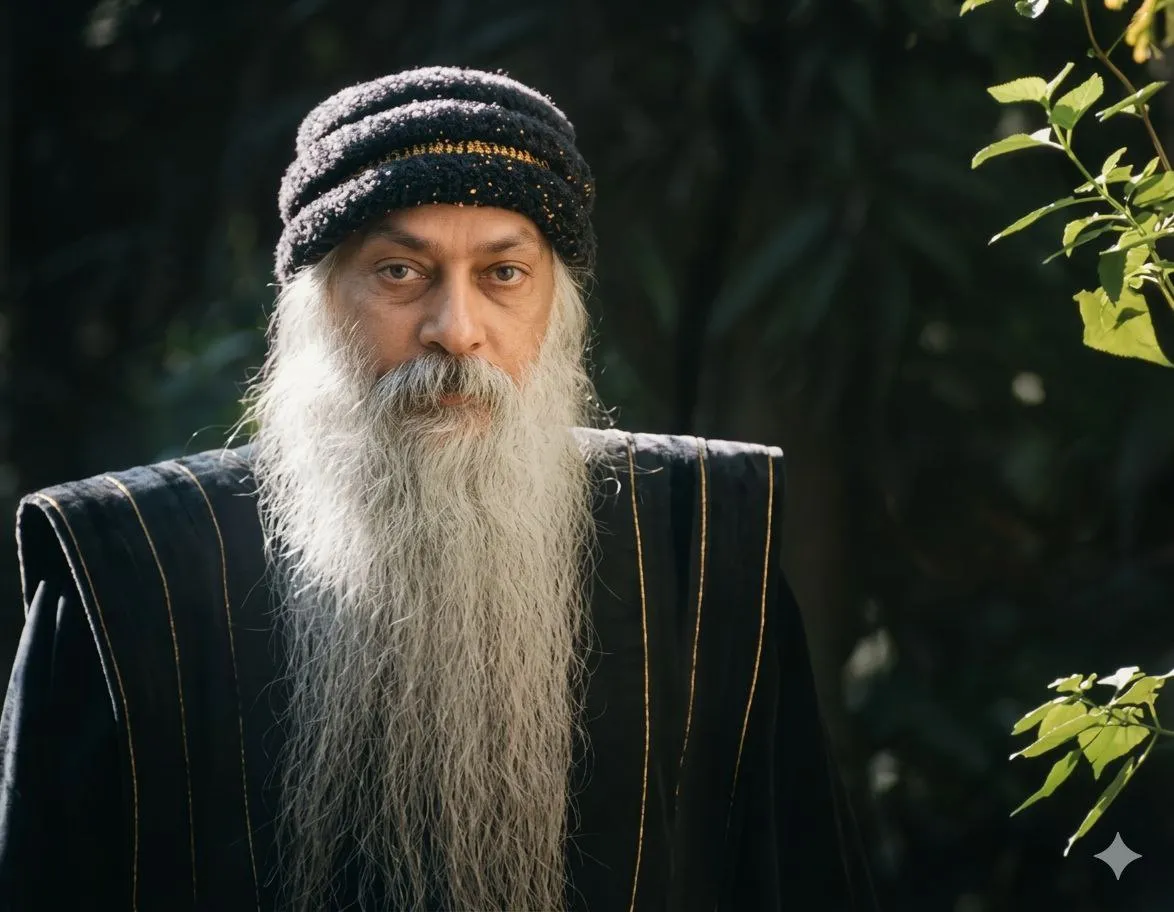
Browse an extensive collection of Osho's most profound quotes, curated semantically by topic and discourse source. Uncover transformative wisdom organized dynamically for deep contemplation.
In the spirit of Osho's teachings, parables serve as a mystical dance of words that confound rationality, inviting listeners to fill in the gaps and embark on a journey of meditation and imagination, ultimately transcending the confines of the mind toward profound inner awakening.
In the spirit of Osho's teachings, Switzerland's absence of war heroes exemplifies a profound virtue, revealing that in a landscape of peace, it is the collective humanity of its people that embodies true heroism, transcending the need for singular icons.
In the dance of existence, a seeker who has embraced true understanding realizes that choosing a womb grants the gift of life yet binds them to the body's limitations, making freedom over death a delicate balance of urgency and acceptance.
In the spirit of Osho's teachings on authenticity, the destruction of the Charvaka corpus reveals how the threat of true skepticism can unsettle those who cling to fragile theism, compelling them to silence the very doubts that could lead to genuine faith.
For Osho, money embodies a lifeless concept, as he has embraced a life devoid of currency, relying instead on the intuitive generosity of his community; in surrendering control and trusting existence, he experiences a seamless flow of support that transcends material concerns.
Osho might suggest that the courtroom oath, a mere remnant of bygone superstitions, fails to anchor truth in our scientific age; instead, genuine integrity arises from individual responsibility and the pursuit of empirical evidence, not from hollow rituals or sacred texts.
A hobby often serves as a fleeting distraction, a way to evade the solitude within when the routine of work fades; yet, true relaxation lies not in busyness but in the stillness of being, where one can discover the profound bliss of simply existing.
In the dance of existence, true spiritual potential transcends time, revealing that when personal will softens and one surrenders to the present moment, the essence of life flows effortlessly, unhindered by resistance or boundaries.
In the dance of existence, excessive familiarity can stifle curiosity and lead to boredom, yet in the embrace of love, prayer, or meditation, as Osho suggests, the closer we draw to the infinite, the more profound the mysteries unfold, inviting us on an endless journey of deepening attraction.
When you awaken from the robotic slumber of unconsciousness, the law of necessity fades, allowing the natural flow of power—freedom, mastery, and presence—to emerge effortlessly through mindful practices like vipassana, slow breathing, and conscious movement.
In the essence of Osho's teachings, the misinterpretation of Buddha's wisdom in Eastern cultures transforms the profound truth of suffering into a passive acceptance, where the allure of outward desires persists, cloaked in a veneer of spirituality that stifles the authentic journey toward inner joy and awakening.
Crucifixion embodies society's neurotic yearning for truth to be forged in suffering, a projection of the sleeping mind that equates mastery with martyrdom; true spirituality, as Osho suggests, embraces awakened intelligence and the liberation found in abundance without guilt.
Different paths, embodied by distinct masters like Mahavira, Muhammad, Christ, and Krishna, along with their sacred texts, invite us to explore diverse yet interconnected journeys toward truth, encouraging a comparative and unbiased study of their teachings to unveil the myriad doors leading to the same profound realization.
Righteousness flourishes not in the clamor of the masses but through the awakening of individual souls; true transformation stems from nurturing love and creativity, embodying peace rather than inflaming identities or rallying behind hollow slogans.
Inward travel transcends the confines of fixed destinations, inviting us to embrace the vibrant flow of the present; as we fully inhabit each moment, spontaneity guides our journey, revealing the next step through the heart's intuitive whisper.
In the absence of thought, a profound silence envelops us, revealing an innate power where challenges dissolve effortlessly; as we immerse ourselves in singular, focused action, the ego fades, leaving only pure movement and a tranquil mind.
Severing ties with all ‘isms’ transcends even Rajneeshism, as Osho invites us to embrace a belief-free inquiry that fosters heart-to-heart communion and a childlike openness, where true connection arises not from dogma, but from the direct experience of life’s profound essence.
A siddha embodies an unbroken, indivisible presence, transcending all divisions—self and other, light and dark—wherein the essence of existence flows as a single continuum, merging seed, field, farmer, and fruit into a harmonious unity of being.
In the stillness of no-mind, Osho reveals that true reality transcends division and counting, inviting us to embrace the wholeness of being beyond the duality of one and many, where the essence of elements lies in direct, wordless knowing.
As consciousness transcends from the fourth to the fifth plane, the cycle of physical rebirth dissolves, liberating one from the karmic ties of earthly existence and allowing a journey through subtler realms of pure awareness, free from bodily identification.
The beyond unfolds as a vibrant dimension, revealing itself when the heart, weary of the known, yearns deeply; in this awakening, like a newborn's first cry, intense longing transforms into yoga, guiding us to the divine realm beyond worldly illusions.
In the harmonious union of male and female energies, a transformative balance emerges, reflecting the androgynous essence of Brahman, where one transcends gender duality and discovers an inner wholeness, embodying both and neither in a state of pure being.
Preparing the inner soil for truth involves relaxing the ego, unlearning borrowed beliefs, and nurturing silence, love, and alertness, as the master gently loosens the hardened earth of conditioning, allowing the seed of awareness to sprout effortlessly in the fertile ground of receptivity.
Stinginess stems from a deep-seated fear of confronting our inherent emptiness, leading us to hoard wealth, power, and knowledge in a futile quest for fulfillment; true transformation arises when we embrace this emptiness, unveiling it as the divine essence of our being.
Osho insightfully reveals how organized religions exploit universal conditionings of guilt and fear, labeling natural joys as sins and enforcing rigid norms like monogamy, thereby fostering obedience and misery while sustaining their own power across traditions.
In the embrace of a spiritual shelter, where the ego dissolves and clarity unfolds, one finds refuge akin to Ram, transcending restlessness to reveal a profound peace that nurtures the soul, whether by a river or in the presence of a master.
In the spirit of Osho's teachings, jnana-nishtha and karma-nishtha emerge as harmonious paths to the same summit, catering to diverse temperaments—while introverts find solace in the wisdom of Sankhya, extroverts thrive in the dynamism of Yoga, revealing that our complexities shape the balance we seek.
In the essence of Sat-Chit-Anand, truth, consciousness, and bliss intertwine as a singular, vibrant experience, where meditation serves as the illuminating catalyst that unveils the harmonious unity of existence, much like a bird taking flight, embodying both wings and body in perfect synchrony.
Achourya transcends mere property theft, revealing that imitation is the subtlest form of stealing from one's own essence; true non-stealing, as Osho might suggest, lies in being a witnessing center, where we engage authentically, preserving our individuality amidst the currents of connection.
Mamatā, the grip of 'mine-ness', stands in stark contrast to love, which flourishes in the absence of possessiveness; true love, as Osho would suggest, celebrates autonomy and reverence, nurturing the soul rather than binding it.
Rasa transcends method, embodying the essence of supreme bliss, love, and inner celebration; it weaves through all paths, revealing that even in Ashtavakra’s austere journey, the realization culminates in an inner festival, where the divine essence of raso vai sah unfolds.
In the rush dictated by societal norms, where a singular life amplifies desires and the imperative of action, we become trapped in a cycle of anxiety; yet, embracing the timeless wisdom of multiple lives, as Osho suggests, invites us to transcend this conditioning and find peace in simply being.
In the stillness of meditation, where the mind quiets and desires fade, the Divine's gentle call emerges, resonating through every sound and moment, transforming our awareness into a pure, wordless prayer that reconnects us with the essence of existence.
In the spirit of Osho, Sivananda's approach reveals that true enlightenment cannot be manufactured through methods, as such techniques merely serve to tire the restless doer into surrendering to the profound stillness where genuine transformation effortlessly unfolds.
A true mentor embodies a living mirror, awakening your awareness and dissolving illusions with a silent love that liberates rather than binds, guiding you gently from borrowed beliefs to the profound experience of your own truth.
Sexual desire, a primal force intertwined with our biology and shaped by learned patterns, invites transformation through conscious choice—whether embracing the total immersion of Tantra or redirecting energy towards the ascetic path of Yoga, urging us to boldly navigate our passions rather than linger in complacency.
Martyrdom, often mistaken for holiness, reveals itself as a veiled form of suicide, where the wounded ego seeks to manipulate others in a destructive dance; true contentment transcends the duality of life and death, dissolving the need for sacrifice.
In the dance of existence, Zorba embodies the exuberance of life while Zen whispers the wisdom of stillness, merging the joyous celebration of the outer world with the serene depths of inner silence, creating a complete and guiltless embrace of reality.
In the spirit of Osho, new beginnings flourish when individuals embrace their shared experiences without succumbing to rigid structures, fostering a vibrant unity that celebrates freedom and individuality, while vigilantly guarding against the perils of institutionalization.
Lunch serves as a reflection of our inner desires; when sexuality is stifled, our cravings shift from love to food, intertwining sustenance and sensuality. Embrace simple, mindful eating, cultivating awareness that transcends mere indulgence or denial.
Embracing inner conflict as a vital part of our journey, Osho invites us to endure its flames consciously, allowing them to refine our understanding and lead us from hasty escapes to a profound, authentic clarity that nurtures true faith.
Osho perceives the act of sharing profound truths not as a mission to enlighten or save, but as a joyful invitation to explore and celebrate beauty together, fostering a connection that transcends hierarchy and embraces mutual discovery.
In the stillness of meditation, individuals transcend tribal collectivity and the discord of isolated egos, awakening a watchful awareness that nurtures compassion and fosters a transformative unity, where consciousness blossoms beyond the confines of nation and herd.
In the essence of Hari-katha, one discovers a divine narrative flowing through an egoless vessel, akin to music emanating from a hollow flute, where true devotion transcends personal opinion, allowing the Divine to resonate freely, as beautifully illustrated in Krishna’s Gita.
In the embrace of deep meditation, a weightless expansion within the belly and chest heralds the awakening of the inner lotus, where the authentic self is born, transcending the confines of the material world and inviting one into the divine unknown.
In the tapestry of existence, he embodies the gardener, nurturing his disciples as a vibrant garden where their blossoming reflects his joy; the distance between them dissolves in bliss, revealing that in enlightenment, they are one, urging all to bloom like a rosebush.
Morning emerges as the inner dawn of awareness, where the darkness of confusion deepens before true clarity takes shape; in this sacred transition, false consolations fall away, allowing genuine faith to blossom as truth breaks free from the ruins of the old self.
Honor, when bound to a nation, becomes a mere reflection of collective ego, a fragile construct defended by stereotypes and violence; true dignity emerges from our shared humanity and awareness, inviting us to connect as individuals beyond the confines of nationality.
Bigotry and prejudice manifest as the crowd's rigid certainties, demanding that sages conform to narrow moral images; true awakening, as Osho suggests, lies in transcending these constraints and embracing the spontaneity of one's own consciousness.
In the wisdom of Osho, the 'gap' emerges when we take the present for granted, drifting in complacency until absence ignites urgency, revealing the chasm between being awake to opportunity and the chaos of delayed action.
An avadhut embodies the essence of the Imperishable, embracing direct knowing that transcends theory, perceiving the transient world as mere dust, and awakening to the divine within—all while dissolving ego and living the Eternal in every moment.
In the dance between the old sage, a mere echo of societal norms, and the new rebel, who boldly embraces truth as his religion, Osho illuminates the profound journey from repression to authentic freedom, where the heart dares to challenge tradition for the sake of enlightenment.
In the harmonious dance of existence, science illuminates the outer world with its power, while religion nurtures the inner self, and only through their synthesis can humanity achieve a profound balance of strength and serenity.
The holy fire, a sacred flame of awareness ignited within, transcends mere ritual; it is the transformative heat that dissolves ignorance and ego, guiding us toward love and clarity, radiating warmth, courage, and joy through the alchemy of meditation.
In the intricate dance of sex and money, Osho illuminates how institutionalized power transforms intimacy into ownership, revealing that repressed desires often manifest as insatiable greed, where wealth becomes a hollow substitute for true connection.
In the face of others' troubles, Osho embodies a profound inner freedom, offering compassionate clarity that illuminates the path to liberation, gently urging those who suffer to awaken to the simple truths that lie just beyond their grasp.
Scientology, often viewed as a hollow construct that misuses the allure of science and technology, entraps seekers in a web of measurable mind-states, while true spirituality, as Osho might suggest, lies in transcending ideologies and embracing the profound silence of our inner selves.
In the spirit of Osho, true understanding transcends the confines of external studies and citations, revealing that genuine truth unfolds within through meditative awareness, where personal experience becomes the ultimate form of research.
Exercise, in the spirit of Osho's philosophy, becomes a joyous celebration of movement that lightens both body and mind, dissolves tension, and awakens a playful energy, transforming each act into a meditative dance of vitality and awareness.
Fortune, as Osho suggests, reveals itself not in the guise of misfortune but in the blessings hidden within our projections; each loss, when embraced with awareness and courage, transforms into an opportunity for deeper growth and liberation.
In the dance of existence, the mind flows as a vibrant stream of consciousness in motion, while the soul rests in serene stillness; only when the mental whirlpool subsides does the true essence of consciousness reveal itself as the soul’s tranquil nature.
In the essence of Osho's teachings, Lao Tzu’s concept of non-ability reveals a profound stillness where both body and mind rest in a luminous reservoir of untapped energy, transcending lethargy to embody pure being, meditation, and effortless spiritual growth.
Spiritual attainment unfolds not through beliefs or rituals, but through awakening from our metaphysical slumber via meditation-as-awareness, where each moment becomes a flame of watchfulness, revealing life's inherent significance and the ecstatic presence of the divine in all.
The abiding place transcends mere location or doctrine, revealing itself in the herenow—an awareness unclouded by desire; enlightenment, inherent within you, remains elusive only when pursued, while the master's role is to awaken you to this direct encounter with life, free from conceptual confines.
Buried rage towards men for historical injustices only perpetuates wounds, stifling the feminine intelligence; true liberation lies not in revenge but in alchemical transformation, where hurt becomes love, reclaiming the wise, healing essence of the witch through awareness and meditation.
Osho suggests that the relentless pursuit of ambition, rooted in a fixation on the future, impoverishes the spirit, urging us instead to embrace the present—shedding our burdens, sharing joy, and allowing our true selves to bloom in the simplicity of now.
In the stillness of existence, where thoughts and moments dance, the gaps emerge as the sacred silence that reveals our true nature; embracing this emptiness invites us to dissolve the mind's grasp and experience the profound tranquility within.
In the essence of sthitaprajna lies a profound inner awakening, where life unfolds spontaneously and freely, driven by an inherent order; here, each moment is met anew, transcending memory and ego, revealing a shared truth that renders separateness an illusion.
In the journey of awakening, choices and judgments dissolve into the mind's marketplace, revealing that true aliveness emerges not from evaluation, but from embracing the silent emptiness where the self and other cease to exist.
In the depths of spiritual exploration, the apparent divide between bhakti and jnana dissolves, revealing that devotion transforms into profound understanding, and knowledge blossoms into love, ultimately unveiling the unity of truth where distinctions fade into oneness.
Rejecting the label of godman, Osho embodies the essence of awareness, urging us to transcend identities and recognize that the divine consciousness flows through all, inviting us to embrace our own watchfulness in a category-free existence.
In his playful embrace of the term Polacks, Osho captures the essence of Polish people as both courageous seekers yearning for sannyas amid communist shadows and a testament to how humor can bridge cultures, inviting a vibrant Polish community into the fold of spiritual exploration.
Osho teaches that true mastery over our impulses begins with cultivating awareness in simple, everyday actions, allowing us to pause and find inner calm, ultimately enabling us to navigate the fiery depths of stronger emotions like anger and desire with grace.
In the light of Osho’s teachings, non-possession emerges not as a sacrifice but as a natural unfolding, where inner richness of awareness and bliss renders material attachments insignificant, allowing one to embrace freedom without loss, whether in palaces or simplicity.
Drinking, when approached with a light heart, becomes a celebration of presence rather than a means of escape; it invites playfulness and moderation, allowing us to savor life's moments without the weight of guilt or condemnation.
In the spirit of Osho’s insights, the bond between J. Krishnamurti and him transcended mere physical encounters, embodying a profound, wordless communion where two awakened souls recognized each other, resonating in silence and joy, much like the timeless connection of Kabir and Farid, where truth flourishes beyond language.
In the realm of perfect knowing, as Osho might suggest, realization remains a deeply personal journey, where the challenge lies not in the knowledge itself but in the art of conveying it, for true expression requires a delicate balance of sensitivity and disciplined communication to resonate with the myriad souls around us.
Gluttony reveals a deeper sorrow, and rather than battling with food, one must illuminate the inner self through meditation; as awareness blossoms, cravings and burdens dissolve effortlessly, allowing a natural balance to emerge without guilt or struggle.
In the stillness of daily introspection, as one sheds the confines of labels and simply observes, the essence of self emerges beyond transient roles; this profound awareness of life and death unveils true understanding, dissolving fear and illuminating identity.
In the wake of Mahavira, the once-living essence of 'code words' faded into mere written symbols, their profound significance as keys to inner transformation lost without a guiding master, rendering them lifeless relics, misunderstood and stripped of their meditative power.
Osho illuminates that truth transcends personal views and collective beliefs, urging a journey into direct experience through silence and awareness, where reality unfolds beyond the confines of opinion and consensus.
In the essence of Osho's teachings, true mastery transcends the ego, revealing that genuine freedom lies in pure awareness and selfless presence, while the illusion of control only serves to inflate the self, breeding pride and repression.
In a world where the essence of meditation has faded, diving straight into Dhyan awakens the inner fragrance of existence, igniting a deep longing that naturally unfolds the other limbs, ultimately guiding one to the bliss of Samadhi.
In the act of gazing into the abyss, one engages in a profound meditation, where the stillness of emptiness mirrors our own essence, inviting thoughts to dissolve and revealing the harmonious unity of the inner and outer vastness, a dance of self and the cosmos.
Spiritual awakening transcends the duality of existence, inviting us to witness the interplay of joy and sorrow without attachment, allowing the essence of the non-dual soul to emerge, where peace flourishes in the stillness of observation.
Osho suggests that to maintain harmony as the tejas body transcends, one must cultivate an extraordinary physical form through dedicated hatha yoga, blending asanas, mudras, and breathwork with rigorous training to forge resilience and stability over time.
In the realm of Osho's wisdom, the notion of “three free wishes” reveals the restless nature of desire; true awakening comes from relinquishing all wishes, finding freedom in contentment as life unfolds in its purest form, untainted by craving or disappointment.
The essence of human existence lies in transcending mere potential to embrace a conscious evolution, where the inner birth reveals our divine nature, transforming struggle into a journey of creativity, awareness, and realization of the Brahman within.
In the spirit of Osho's teachings, the transformative power of meditation elevates not just the individual but the collective, weaving a tapestry of truth, love, and compassion that forms the true essence of a vibrant, cohesive society. Without this inner dharma, a community risks becoming merely a mechanical assembly rather than a living, breathing nation.
Valmiki, an embodiment of innocence who chanted “mara, mara” into enlightenment, invites reflection on how later Brahmin scholars adorned the Ramayana with their interpretations; thus, Osho honors Valmiki’s awakening while urging a critical view of the narrative’s embellishments.
In the vibrant embrace of a true spiritual atmosphere, one inevitably becomes a 'fool'—a state where wisdom dances playfully beyond intellect, inviting trust, laughter, and a celebration of existence, revealing the paradox that true wisdom is both serious and childlike, flourishing in its delightful folly.
Hallucinogens, while real substances, may induce a fleeting illusion of enlightenment reminiscent of Osho's wisdom, revealing that true awakening arises not from external agents but from the profound depths of inner awareness and understanding.
The enigma of Earth's hollowness pales in comparison to the profound realization that within each of us lies a luminous core, the essence of our highest consciousness; by turning inward and embracing silence, we can uncover the truth that liberates our authentic selves.
In the spirit of Osho's teachings, a genuine Upanishad unfolds in the silent communion between master and disciple, where love and trust dissolve barriers, allowing profound wisdom to flow effortlessly in the sacred space of an open heart.
A spiritual explosion embodies a transformative rupture with the past, where the ego dissolves and the old self perishes, allowing for a profound emergence of the new; this awakening transcends effort, inviting us into the art of non-doing, where presence becomes a fertile ground for creation.
In the wisdom of Osho, agony and ecstasy intertwine as complementary aspects of our inner being, revealing that what seems like opposing forces from the outside is, in essence, a singular energy that transforms through the release of expectations into profound joy.
Basic comforts serve not as ultimate goals but as essential supports, nurturing a relaxed body and mind that foster meditation and awareness; true growth emerges when we embrace ease without clinging, transcending both self-torture and indulgent luxury.
In the spirit of Osho's teachings, Mahavira's realization transcended ekant, revealing a totality where the seer and their perspectives dissolve into oneness; it is only through fragmented thought that one-sidedness emerges, leading to diverse expressions among masters who, at their core, share a unified vision.
In the pure innocence of infancy, before the veil of language and societal conditioning clouds perception, one can see the vibrant auras surrounding all beings; to rediscover this saint-like vision, one must embrace silence through meditation, shedding the mind's chatter to return to a state of childlike wonder.
Reviving the essence of the varna system, as Osho might suggest, involves embracing a non-hierarchical, type-based approach that honors individuality and inner nature, discarding the decayed caste hierarchy to restore harmony and allow true aptitudes to flourish.
One tap — creates your free account, or signs you back in.
Already have an account? Login here
New here? Create a free account
Enter your account email and we'll send you a link to choose a new password.
Remembered it? Back to login