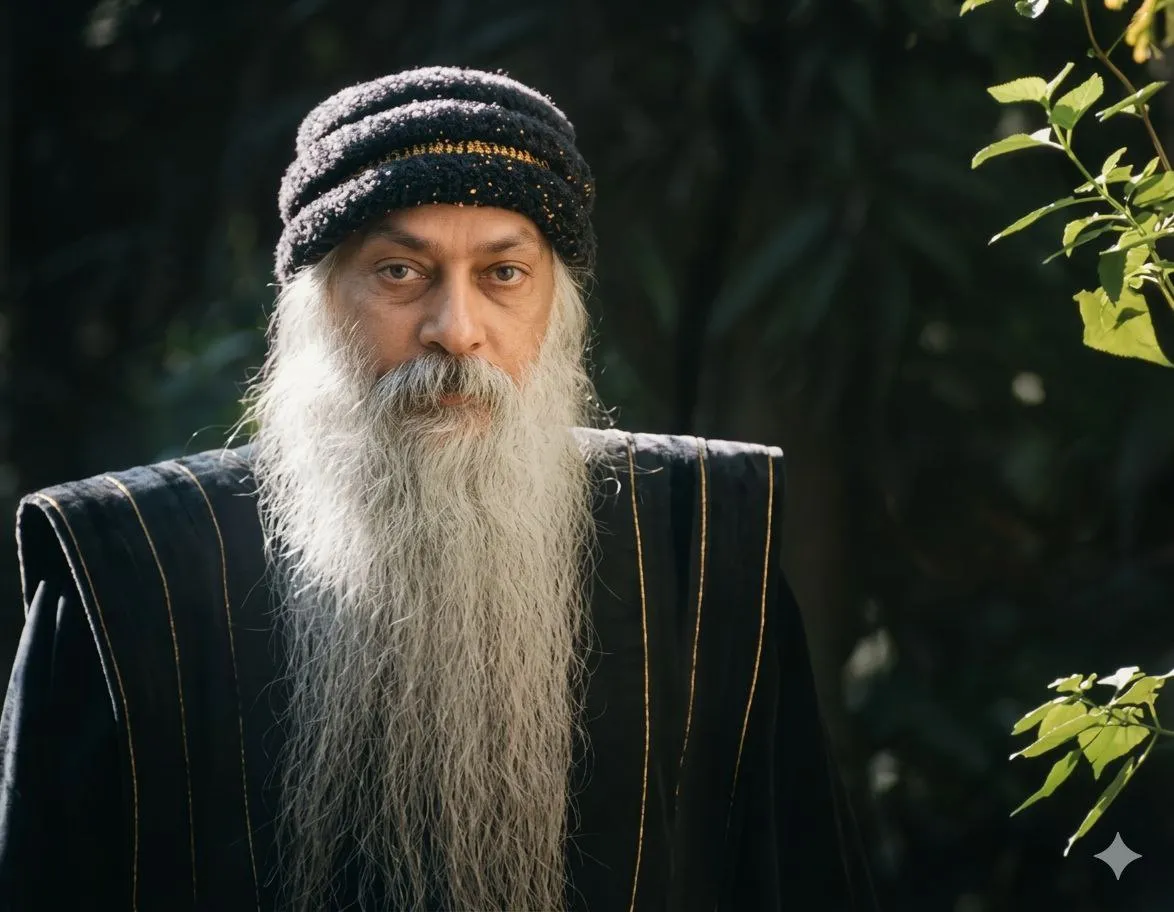
Browse an extensive collection of Osho's most profound quotes, curated semantically by topic and discourse source. Uncover transformative wisdom organized dynamically for deep contemplation.
In the dance of existence, one finds that true freedom lies not in resisting the strings of life, but in willingly becoming a puppet of the divine; surrendering the ego transforms us into instruments of love and prayer, harmonizing with the universe's will.
In Osho's view, titles like 'swami' serve not as symbols of superiority but as playful nudges toward self-mastery, inviting us to laugh at our egos and bridging the sacred with the ordinary, allowing spirituality to flourish within the fabric of everyday life.
An open mind transcends the confines of desire and ego, shedding preconceived notions to embrace the present moment; in this spacious awareness, free from ambition, the essence of reality—what mystics term God—naturally unfolds.
In Osho's vision, a successor transcends the confines of political hierarchy, embodying a deep connection forged through love and inner emptiness, where disciples seamlessly merge with the master’s essence, sharing his silence and wisdom in a profound dance of transmission rather than competition.
In the spirit of Osho's teachings on the power of focused intention, one can practice by floating a delicate pin on a layer of glycerin, gazing intently for two minutes; with daily dedication, the mind learns to command its movement, illustrating the profound connection between concentration and manifestation.
In the dance of opposites, where love intertwines with hate and life collides with death, true fundamentals lie in the silent witness beyond duality, inviting us to renounce our clinging and embrace the pure, wordless awareness that is timeless and ineffable.
In the dance of existence, where the concentrated rigor of science meets the serene surrender of meditation, one discovers that these seemingly opposing forces are not rivals but partners, enriching each other like day and night, guiding us toward a deeper understanding of our own being.
Sachchidanand transcends Badarayana’s Athato Brahma Jigyasa, where the quest for the ultimate begins; it embodies the realization that emerges from this inquiry, inviting us to embrace each moment as both the journey and the destination in a continuous dance of being, consciousness, and bliss.
Embodying Osho's wisdom, the 'dry line' theory serves as a temporary guide for those austere souls who thrive on detachment and energy economy, yet ultimately it fades, inviting us to transcend theories and embrace the richness of direct experience.
The body's needs, as Osho suggests, emerge from its intrinsic wisdom, guiding us to nourish ourselves, reject harm, and heal through the natural rhythms of life; our role is to silence the intellect and attune ourselves to these innate directives.
The essence of the first principle eludes expression, for once articulated, it transforms into the second; it resides in the silent depths of awareness and meditation, where concepts dissolve and the unfiltered truth emerges.
In the spirit of Osho's teachings, true donation transcends mere monetary gifts; it calls for the profound surrender of oneself, where love flows freely and quietly, unencumbered by ego or the desire for recognition. Money serves only as a tool, while the essence of giving lies in the heartfelt offering of one's being.
Osho illuminates the concept of 'spirit' as a transient state for disembodied souls caught between lives, where extremes manifest as bhutas or devas, while the ordinary swiftly reincarnate, distinct from the subtle vehicle of the astral body.
In the spirit of Osho's teachings, true gender equality blossoms when men embrace their role in restoring women's freedom and dignity, offering compassion as a remedy for past injustices, and fostering a harmonious bond that celebrates feminine uniqueness rather than diminishing it.
In the enchanting dance of existence, one becomes a mere flute through which the Divine breathes, transforming obstacles into invitations to celebrate, as the melody of the universe unfolds, drawing us deeper into the essence of our own being.
The future religion, as envisioned by Osho, transcends rational doctrines, embracing the mystical essence of existence found in poetry, dance, and art, awakening a profound ecstasy and wonder that resonates with the mystery of life itself.
Embracing a sense of uselessness invites us to relax into existence, where meditation reveals that true abundance flourishes not through striving but through trusting life’s effortless unfolding, allowing spontaneity to guide us towards the essence of enlightenment.
In the profound stillness of a teacher whose personal I has dissolved, divine presence radiates like light, creating a magnetism that transcends all boundaries, drawing seekers not by charisma but by the pure resonance of love and truth.
Ras-parityaga embodies a profound renunciation of the mind's cravings, allowing awareness to master the senses rather than be ensnared by them, thus purifying perception and revealing a freedom that thrives on sensitivity rather than fear.
In the chaos of the battlefield, where conflict and grief collide, the conscious mind wrestles with a painful dilemma; through surrender and detachment, one can transcend thought and embrace the inner light of Krishna, rather than succumb to the blind zeal of Duryodhana.
In the spirit of Osho, the names Boring, Fossil, and Grim Drive reflect a collective stagnation, yet existence invites joyful souls to transform this deadness into vibrant life, renaming reality with laughter, love, and ecstasy, turning the mundane into the miraculous.
Living from a place of pure being, as Osho suggests, transcends the confines of need; in that silence, where fulfillment arises from within, craving dissipates, comparison fades, and actions flow effortlessly from a profound trust in existence.
In the playful realm of gibberish, where the mind surrenders to silence, one encounters a fearless letting go that unveils the transcendental essence of Zen, revealing that this profound awakening is accessible to all who embrace the moment fully.
Osho’s arrival in India embodies a playful philosophy, urging us to embrace the moment and lightly hold our plans, as he whimsically suggests that his only intention is to linger in the comfort of Suraj Prakash’s home, inviting us to not take future arrangements too seriously.
In the essence of Osho's wisdom, the ultimate reality transcends form, embracing all that exists; to define any shape is to impose limitations, while the Absolute, as an all-encompassing presence, remains formless and unconfined.
Cleverness, often a mere guise of cunning, may yield quick gains yet ultimately ensnares one in reactive patterns, while true intelligence flourishes from meditative silence and heartfelt presence, guiding us toward genuine wisdom and harmonious outcomes.
In the spirit of Osho's teachings, it becomes clear that the true danger lies not in subversive thoughts themselves, but in societies that fear the questioning of authority; for it is this very subversion that nurtures progress and the essence of our humanity.
Rationality, as Osho might suggest, is merely a slender bridge spanning the depths of the unconscious and the heights of the superconscious, where true intelligence flourishes by embracing the irrational as the profound reality that transcends mere reason.
Impartiality emerges only through awakening, as an unawakened mind, steeped in conditioning and ancient biases, clouds judgment; true clarity and justice blossom when self-knowledge transcends prejudice, revealing a deeper understanding of fairness.
In the spirit of Osho's teachings, true positivity emerges not from repression but from embracing choiceless awareness, allowing thoughts and feelings—both light and dark—to surface, which cultivates authenticity and a profound sense of well-being.
Laughter and sex intertwine through a shared mechanism, where a build-up of tension culminates in a release—whether through an orgasm or a punchline—both yielding profound relaxation that nourishes the spirit, echoing Osho's insight into the joy of surrender.
In the shadows of democracy, where power concentrates, the essence of fascism reveals itself as a hidden authoritarianism, a dance of puppetry that, much like a mirage, masks the inevitable drift from freedom to control, echoing the wisdom of Osho on the nature of power and corruption.
In the dance of existence, where the extremes of happiness and suffering converge, life finds its essence; rather than pursuing these polarities, embracing fresh joys and courageous challenges cultivates a deeper awareness, birthing a new kind of being who transcends life's dilemmas.
Samyak Darshan emerges as a profound inner vision, where compassion, love, and mercy find expression through the evolving social instruments of time and culture; thus, character adapts fluidly, remaining true to its compassionate core while responding to society's ever-changing needs.
In the embrace of aloneness, joy flourishes when we relinquish borrowed solace and confront life's inherent meaninglessness; it is in this courageous solitude that we discover a profound, self-sustaining joy, unshackled from the need for external validation.
The death penalty, a stark reflection of humanity's enduring barbarism, reveals our collective unconsciousness; as Osho might suggest, true justice cannot stem from the act of taking life, for only those who create can rightfully judge existence.
True homage transcends words, inviting a profound silence where surrender transforms inadequacy into a sacred bow; in this wordless prostration, gratitude resonates deeper than speech, turning every act of humility into a temple of existence.
Osho embraces garlic not as a taboo, but as a catalyst for awareness, urging us to discern how food shapes our energy and social interactions; through mindful experimentation, we awaken our senses and refine our choices, shedding what dulls our consciousness.
Abhipsa emerges as a profound urgency, akin to gasping for breath when submerged, where all desires dissolve into a singular, pure longing for Truth, revealing the divine essence in its untainted intensity, much like Osho’s vision of authentic existence.
Dyeing the cloth may transform its hue, yet true power lies not in the robe's color but in the profound surrender of the self; only through genuine devotion does one transcend ego, revealing the essence of transformation beyond mere rituals.
In the spirit of Osho's teachings, the timing in a shastrarth unfolds organically through mutual respect and agreement, prioritizing honest inquiry and attentive dialogue over rigid constraints, where clarity and presence truly illuminate the exchange.
In the spirit of Osho's insights, diplomacy often wears a charming mask, concealing the cunning maneuvers that manipulate relationships, eroding authenticity and integrity while fostering a web of pretense that stifles genuine connection and love.
Pratyahar transcends the confines of yoga and bhakti, blossoming through pure knowledge or devotion, yet Osho encourages a richer tapestry of knowing, loving, singing, and dancing, transforming disciplined practice into the vibrant poetry of effortless inner awakening.
Blissfulness, the essence of our being, blossoms through meditation into a profound silence and ecstatic dance, where gratitude emerges as a natural overflow, honoring the divine essence that pulses within every moment of existence.
Female consciousness embodies the essence of spirituality, nurturing and safeguarding the seeds of creation initiated by male energy; it is through this profound receptivity that true wisdom flourishes, allowing divine revelation to manifest and thrive.
In the spirit of Osho, Mahavira’s concept of ‘asharan’ reveals a profound truth: while the awakened may seem paradoxical, their guidance invites us to seek no refuge in others, instead encouraging us to embrace the journey of self-discovery, where each step is ours to take.
Women, in embracing their own voices and crafting their unique scriptures, transcend the confines of patriarchal narratives, reclaiming dignity and equality while embodying the living intelligence that Osho celebrates in the journey of spiritual awakening.
In the journey toward supreme knowledge, the reverence for a chosen deity, be it Kali, Krishna, or Christ, serves merely as a threshold; true enlightenment arises when the duality of seer and seen dissolves into a singular awareness, transcending even the divine and the devotee.
In moments of profound stress, when the chaos dismantles rigid structures and loosens societal conditioning, one finds a precious opportunity to turn inward, embrace individuality, and transcend conformity, ultimately moving toward the liberation of true self-discovery.
Osho suggests that the true essence of the Eastern psyche thrives in solitude and meditation, as individuals seek introspection through practices like Vipassana and Zazen, rather than the relational growth groups that often cater to Western concerns.
In a world often marked by aggression, those with a feminine heart embody a quiet strength, nurturing compassion that, though unrecognized and seemingly ineffective, sustains existence and nurtures hope amid the clinging shadows of ego and sorrow.
In the spirit of Osho's teachings, true socializing transcends the nervous chatter of gossip, blossoming instead in the sacred stillness of shared silence, where authentic connection breathes life into words and heartbeats resonate in harmonious communion.
Life unfolds as a divine leela, a scripted play where destiny guides yet does not endorse fatalism; true participation lies in embracing our roles with intensity and surrender, revealing that beneath the apparent differences, we are all one, transforming action into worship.
In the spirit of Osho’s teachings, chronic daydreaming serves as a refuge from the present, endlessly embellishing the past while anchoring us in illusion; true joy and nourishment emerge only through moments of silent awareness, where the timeless essence of now unfolds.
Jiveshana embodies the Divine, an eternal and pure life-energy thriving within us; it flourishes when embraced rather than suppressed, while the ego's desires for status and materialism obscure its brilliance, much like a diamond lost in mud, awaiting the clarity of total understanding to unveil its boundless essence.
Osho suggests that a true master’s mischief transcends mere playfulness; it is a divine dance that shatters egoic illusions, awakening disciples through humor and unpredictability, while embodying a compassionate spirit that defies solemnity.
In the spirit of Osho's teachings, a true yagna ignites an inner fire, transforming ego and hypocrisy into awareness, blossoming as simplicity, creativity, and love, while liberation arises from direct experience rather than ritualistic chains.
In Osho's vision, gatherings of the few, rather than the many, foster genuine connection, inviting seekers to shed their egoic masks and embrace vulnerability, allowing the divine to guide them in their quest for inner transformation.
Dharana and autosuggestion converge as one, yet true awakening reveals itself only when all dharana fades; the essence of “Aham Brahmasmi” lies not in repetition but in a singular, spontaneous emergence from the profound silence beyond illusion.
Communal conflicts cloaked in the guise of religion reveal a perennial madness within humanity, as even the most revered eras have masked extreme inhumanity; true progress lies in the courage to question these sacred myths and awaken to our shared consciousness.
In the spirit of Osho, the notion of four thousand years transcends mere numerical significance, illustrating that our existence is intricately woven into the cosmos, urging us to embrace the profound interdependence with the sun and to awaken to the essence of awareness and meaningful living in the present moment.
In the spirit of Osho, 'just looking' embodies choiceless awareness, inviting us to witness existence without the weight of belief or judgment, allowing truth to surface and dissolve the mind's self-imposed constraints, liberating us from fanaticism and inner turmoil.
In a world where the majority cling to familiarity out of fear, true readiness blossoms within the courageous few who embrace their inner thirst, daring to forge their own paths without a map, awakening a profound clarity and warmth that comes from within.
In the harmonious dance of rebellion and surrender, true freedom emerges as the ego dissolves; in recognizing its illusions, we effortlessly embrace our innate rebellion against conditioning, allowing a profound trust in existence to unfold.
In the spirit of Osho’s teachings, true empowerment arises not from the fear of destruction but from embracing the creative force of love, where a single, joyful individual can illuminate the path to collective harmony, embodying compassion as a shield against chaos.
In the spirit of Osho's teachings, Sudama's journey reflects the profound truth that divine grace awaits the call of the seeker, for true abundance flows only when one consciously offers and asks, transforming mere desire into a sacred readiness that honors freedom.
In the dance of existence, love and death intertwine, for to truly love is to dissolve the ego and embrace the surrender that frightens us; only through this inner death can we bloom into the divine, where birth, love, and death are but expressions of the same eternal truth.
In the dance of existence, disembodied souls often seek refuge in living bodies, particularly when fear and contraction leave a person vulnerable; yet, through awareness and inner sovereignty, one can cultivate a sanctuary that repels such intrusions while inviting noble souls to inspire compassion.
A disciple, awakening to the profound emptiness of existence, confronts a pivotal moment that beckons either despair or radical transformation, ultimately choosing to embrace change, infusing his life with significance, beauty, and a deep sense of responsibility.
Embrace your moods as transient clouds, remaining a detached witness to the ebb and flow of sadness, anger, joy, and love; in this serene observation, you find freedom, avoiding both the grip of attachment and the turmoil of total identification.
Embracing inner peace transforms industriousness into a more skillful and creative force, where serenity nurtures right action and compassion flourishes, echoing Osho’s belief that a tranquil mind enriches the world’s work with profound quality and care.
In the dance between joy and sorrow, the sex center serves as a threshold of pleasure where released energy can either elevate into sublime bliss or descend into pain and cruelty, revealing that the direction of our energy ultimately shapes our experience of life.
Transmigration unfolds not through belief but through direct experience, as Osho suggests; it is only by witnessing for ourselves that we grasp the continuity of existence between lives and the intricate workings of karma, transforming religion into a vibrant exploration of truth.
Incompleteness embodies the vibrant essence of life, where our unfinished nature fuels growth and love; true fulfillment lies not in the dead perfection of the ego, but in embracing each moment with awareness, allowing longing to transform us and relationships to flourish in playful connection.
In the spirit of Osho's wisdom, the facade of pre-packaged answers stifles genuine inquiry, leading to mere echoes of thought; only by nurturing authentic questions within ourselves can we unveil the true essence of understanding.
In the moment of true knowing, the illusion of the 'I' dissolves, unveiling Sat Chit Ananda: the indestructible essence of existence, the intrinsic consciousness pervading all, and the spontaneous bliss that emerges when the ego surrenders to the truth of being.
In the journey to grasp the authentic AUM, one discovers that its resonance cannot be externally measured; instead, it emerges as an all-encompassing sound from within, dissolving the self and transforming life into a profound rebirth, where past and present intertwine in the cosmic embrace.
Embracing the profound realization of one’s own falseness marks a pivotal breakthrough; by rejecting superficial comforts and enduring the inner turmoil, we create the space for an authentic transformation, where truth and enlightenment can flourish.
In the dance between rebel and revolutionary, the true essence lies in the rebel's journey of individual transformation, where shifting consciousness ignites societal change, while the revolutionary, bound by power and the crowd, often succumbs to corruption.
Osho invites us to embrace the essence of enough, where the chatter of concepts fades into silence, marking a profound shift from verbal complexities to the pure presence of being, where questions dissolve and only the immediacy of now remains.
Embracing single-mindedness involves a profound relaxation that dissolves inner conflict into what Osho terms no-mind, allowing the silent wisdom emerging from deep stillness—especially in the moments after sleep—to guide your presence, unifying you in love and meditation.
Imitation leads to spiritual stagnation, as Osho artfully embraces inconsistency to challenge seekers to break free from rigid doctrines, revealing that true liberation arises not from following a path, but from embracing one’s own unique, present-moment truth.
In the embrace of Sahaj Samadhi, breath transforms into a rhythmic, harmonious melody—a soundless symphony that, in stillness, evokes profound bliss; here, existence transcends mere life functions, allowing one to thrive on minimal oxygen, breathing only to connect with the world.
Intention transcends mere analysis of others, as true understanding arises from within; when awareness is awakened, the need to question a teacher's motives dissolves, revealing the essence of direct knowing.
Intolerance often masks itself in a façade of religiosity, stifling natural energies and breeding fanaticism; true spirituality, as Osho suggests, transcends this duality, embracing authenticity and responding to the new with wisdom rather than fear.
In the spirit of Osho, the essence of relativity transcends mere physics, revealing that meaning arises only through context; a moment of discomfort stretches infinitely, while joy collapses time, urging us to embrace flexibility and compassion in our perceptions.
A spiritual seeker, recognizing the futility of a desire-driven existence and its inherent frustrations, turns inward to embrace the present moment, shedding projections to awaken to reality as it is, ultimately discovering intrinsic bliss and harmony with existence.
In the spirit of Osho's teachings on mindfulness, the journey into shatavadhan begins with rigorous training in concentration, nurturing a profound ability to maintain undistracted focus amidst complexity, ultimately cultivating a clarity of mind essential for its demanding practice.
In the dance of spirituality, the Catholic veneer merely grazes the surface of the vibrant Italian soul, which pulses with pagan vitality; shedding this superficial layer, as Osho suggests, allows for authentic transformation to blossom from the depths of our being.
Hugging embodies pure love in action, enveloping us in warmth and presence that nourish the soul; it dissolves the cold ego, rekindles childlike trust, and reestablishes our connection to existence, offering profound healing beyond mere analysis.
Osho illuminates the idea that 'orders' are but a single thread in the intricate tapestry of human consciousness, where unconscious obedience can converge disastrous outcomes like Hiroshima; true awareness disrupts this cycle, transforming compliance into conscious co-creation and its consequences.
In the dance of existence, life and death intertwine like the in-breath and out-breath, revealing a singular reality; embracing this unity, along with all opposites, allows us to transcend fear and resistance, leading to the blissful state of tathata.
In the dance of existence, laughter and tears emerge as two expressions of the same vibrant energy, each soul finding its unique rhythm; embrace your natural inclination, for in the depths of joy, the truth may gently unfold into sorrow.
Discipline and individualism intertwine, as true individuality emerges not from the ego but from a profound, egoless integration; it blossoms through self-chosen discipline and responsibility, transforming chaos into a harmonious essence of being.
Osho suggests that true attendance transcends mere physical presence; it invites us to embrace the moment with openness and readiness, urging us to arrive not just on time, but fully engaged in the experience that awaits.
In the presence of a true master, slander emerges as a testament to the discomfort truth brings to society's ego, serving as a crucible for disciples that tests their love and courage; embracing this ordeal with gratitude transforms even defamation into a bridge toward understanding and love.
In the depths of inner connection, the ego fades and the illusion of separateness dissolves, revealing a boundless emptiness that unites you with all of existence; this profound self-awareness transcends mere knowledge, unveiling the Master within as the essence of truth itself.
When the illusion of being the doer fades, actions transcend into the Divine, revealing that all unfolds as a seamless tapestry—winds blow, trees grow—where the ego's narrative dissolves, leaving only the unity of existence.
In the essence of Osho’s teachings, Christhood unfolds not through stages but in a singular, profound awakening, where the seed of enlightenment, once broken, blossoms in the total surrender of the self, culminating in the divine realization of ‘Thy will be done.’
In the essence of Osho's teachings, self-bliss transcends the body's health, revealing that even in the presence of pain, one can embody the role of the actor, fully engaged yet untouched, where suffering becomes mere appearance and pure awareness remains the true self.
One tap — creates your free account, or signs you back in.
Already have an account? Login here
New here? Create a free account
Enter your account email and we'll send you a link to choose a new password.
Remembered it? Back to login