
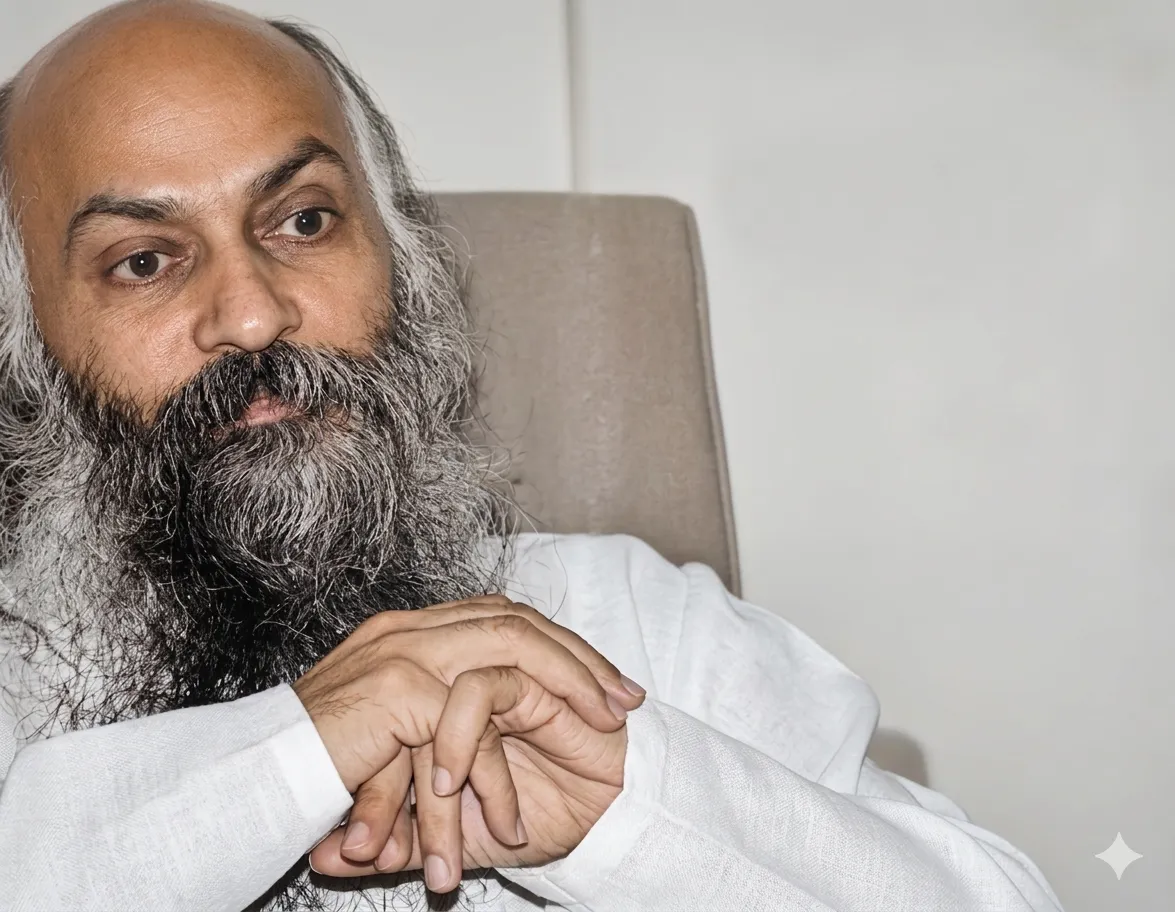
According to Osho, meditation is called the art of dying because true meditation doesn’t expand the ego—it dissolves it. If he called it ‘growing,’ the ego would feel flattered and cling on. Ego-growth is a cancer that imprisons and suffocates; meditation is its death. He uses the shock of ‘dying’ to bypass ego’s greed and point to liberation through the ego’s disappearance.
Meditation isn’t about making ‘me’ bigger; it’s about letting the ‘me’ drop away so you can be free.
From the Discourses
Passages where Osho speaks to this question — each links to the complete discourse.
Can you say something about death and the art of dying?
Indians are still hoping that with a little better technology, a little better government, a little more money, a little more production, things will all be perfectly okay. The Indian mind is hoping, it is very materialistic. The modern Indian is more materialistic than the people of any other country. The materialist countries are fed up with materialism. It has failed; they are disappointed and disillusioned. So let me tell you, my sannyasins are more Indian. They may be Germans, they may be Norwegians, they may be Dutch, they may be Italians, French, English, Americans, Russians, Czechs, Japanese, Chinese, but they are far more Indian. Journalists again and again come and ask, "Why don't we see more Indians here?" And I say, "They are all Indians! There are just a few foreigners -- just those few whom you think are Indians, just those few foreigners; otherwise they are all Indians."…
Osho, it seems as if a constant benediction showers from your eyes—sweet and tender. Your eyes move over the listeners, and the moment they fall on me it feels as if a spear has pierced my innermost core. My whole body trembles. Something like death happens. But why does the ultimate death not take place?
The goldsmith puts gold into the fire. If the gold had a little intelligence it would scream and writhe, saying, What are you doing—will you kill me? But how could the gold know that this is the very process of becoming pure? Passing through the fire, whatever remains is kundan, pure gold. What does not die in you even when you die—that is the soul. What is not erased in you even when you are erased—that is your true being. You will have to pass through death. If you go from me having learned anything else, you will have gone collecting trash. If you go having learned death, you have taken the key. We have called India’s supreme mystical scriptures the Upanishads. Upanishad means to be near the master; it means to sit close—just that. What happens by sitting close? By sitting near one who is gone, the courage to…
Death is more important than life. Life is just the trivial, just the superficial; death is deeper. Through death you grow to the real life, and through life you only reach death and nothing else. Whatever we say and mean by life is just a journey toward death. If you can understand that your whole life is just a journey and nothing else, then you are less interested in life and more interested in death. And once someone becomes more interested in death, he can go deep into the very depths of life; otherwise, he is just going to remain on the surface. But we are not interested in death at all: rather, we escape the facts, we are continuously escaping the facts. Death is there, and every moment we are dying. Death is not something far away, it is here and now: we are dying.
Osho, you have earlier said, “Live moment to moment, live in the present.” Now you are saying, “Return to the past.” What should we do?
So it is with the mind—there are ruts. The past means endless grooves. However much you understand, your intellect agrees, you make decisions, you resolve—at the moment of resolve you feel something is going to change. But not even an hour passes before your decision breaks. Then only self-condemnation is produced, nothing else. Your saints, your fakirs, your priests and pundits—most of the time they only succeed in producing self-condemnation in you, nothing else. Their words are logically correct. You cannot even say they are wrong; you have to admit they are right. In that admission you take a decision. But against what are you deciding? Inside are grooves carved since who knows when, deep tracks. Walking in them has become a habit. It is easy to walk in them. They will pull you again and again. The meaning of returning into the past is: these grooves must be erased.…
Man lives under the illusion of mortality. Of course there are reasons for the illusion, because he sees people dying, disappearing. Somebody was alive just the other day and today he is no more: there is death everywhere. Trees are dying, animals are dying, flowers are dying, people are dying, and one also sees people are born, trees are born, and seeing this all around on infers -- remember, it is an inference -- one assumes that "The same is going to be the truth about me; one day I was not, then I was born, one day I will not be again, I will die." It is very logical. In all the books written about logic you will find this statement: All men are mortal, Socrates is a man, therefore Socrates is mortal. This is our whole logical process.