
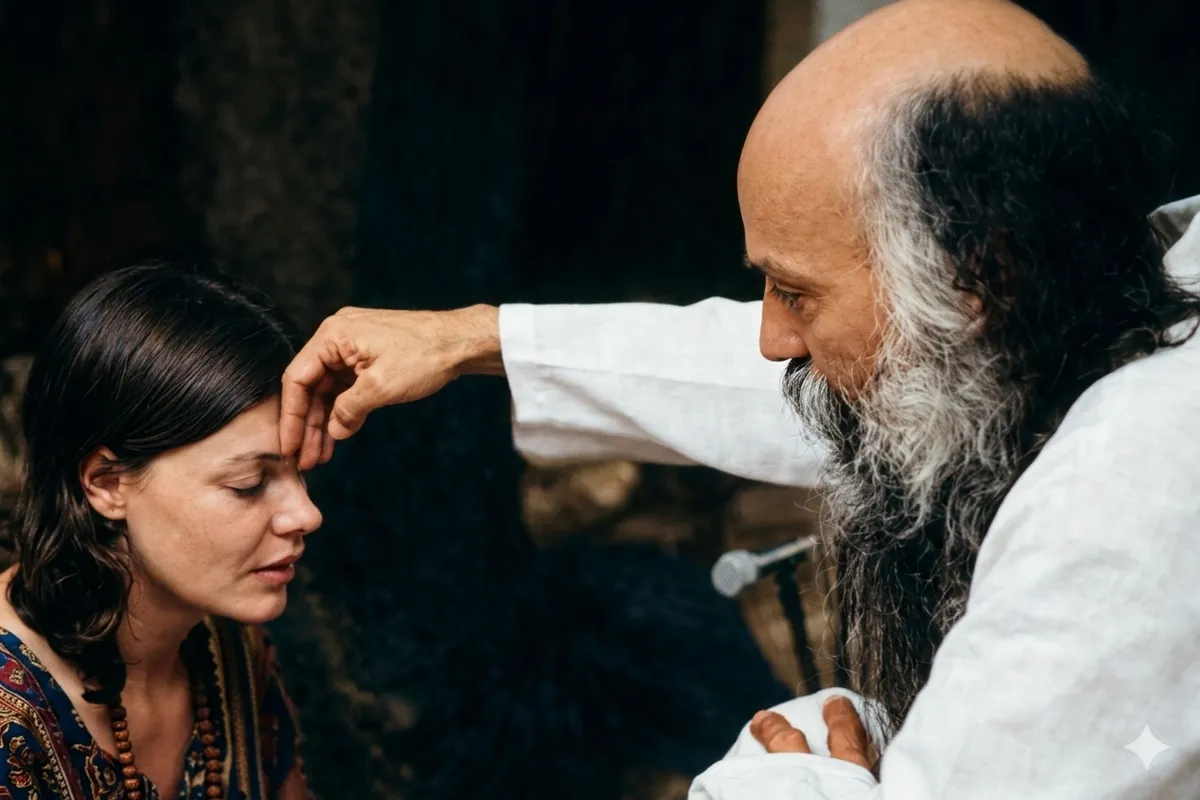
Watching your breathing shows you that you’re more than the body and helps you step toward your true inner self.
From the Discourses
Passages where Osho speaks to this question — each links to the complete discourse.
Why do you advise us to observe the breathing process?
I do so because breathing, inhaling and exhaling, is the bridge between the body and the soul. The soul resides in the body through breathing and because of breathing. By becoming aware of one's breath, by direct knowledge of breathing, a person gradually experiences that he is not the body. I am the body but I am not the body alone. It is my abode but not my foundation. As the direct realization of breathing goes deeper, one experiences the presence, the proximity of the one who is not the body. For a moment one sees clearly that the self is not the body. Then you will see the three layers, the three sheaths of your personality -- the body, the breath and the soul. The body is the shell; the breath is the bridge, the connecting link; the soul, the self, is the foundation. The role of the breath…
THE VEDAS HAVE SAID THAT BREATH IS BRAHMA. And it is right in a very subtle way. Breath is your life, and breath is also the bridge between the conscious and the unconscious, between your body and your soul. This bridge has to be used. If you can use this bridge rightly, you can go to the other shore. I wonder whether you have observed or not that your breath changes with your emotions. When you are angry, you breathe in a different way. Try to observe how you breathe when you are angry and then try to breathe differently while you are angry. You will not be able to be angry. You can be angry only in a certain way, with a certain rhythm of breathing. When you are in love, observe your breath: the rhythm, the music, the harmony. Disturb that harmony and the love will disappear.
The buddha asked a monk: how do you measure the length of a man's life? The monk answered, "by days." the buddha said: you do not understand the way. The buddha asked another monk: how do you measure the length of a man's life? The monk answered, "by the time that passes during a meal." the buddha said: you do not understand the way. The buddha asked a third monk: how do you measure the length of a man's life? The monk answered, "by the breath." the buddha said: very well, you know the way.
THE BUDDHA ASKED A MONK: HOW DO YOU MEASURE THE LENGTH OF A MAN S LIFE? THE MONK ANSWERED, "BY DAYS. ... It is just like money: if you go to the market, it has value. If you simply sit alone with your money, it has no value. The value comes only when you relate with others, because the value is just an agreement between you and the others. That's why money has a beautiful name: it is called currency.'Currency' means: when money moves it has value; when it does not move it has no value. If you go on keeping it in your pocket always and always, it is meaningless. You can keep anything else instead of it; it will be the same. Money has value when it changes hands. From one hand to another -- then there is value. Value is in its being a currency, a moving force.
How is one to watch breath when it is not seen but felt?
Watching need not be a seeing, it can be a feeling. In fact it has to be a feeling because how can you see your breath? You feel it, the touch of it. When the breath moves through the passage, you feel the touch of it. The whole thing is not a question of seeing. The thing is to be alert that it is going in, that it has reached to the very innermost core of your being, that now it has stopped; that now it is coming back. The ebb and the tide: now it has gone out, moved completely out, stopped; then again moving back. The whole circle of it -- coming in, going out, coming in, going out -- one has to be aware. If you feel it, that is awareness -- but one should not miss feeling it. If you can do it every day for…