
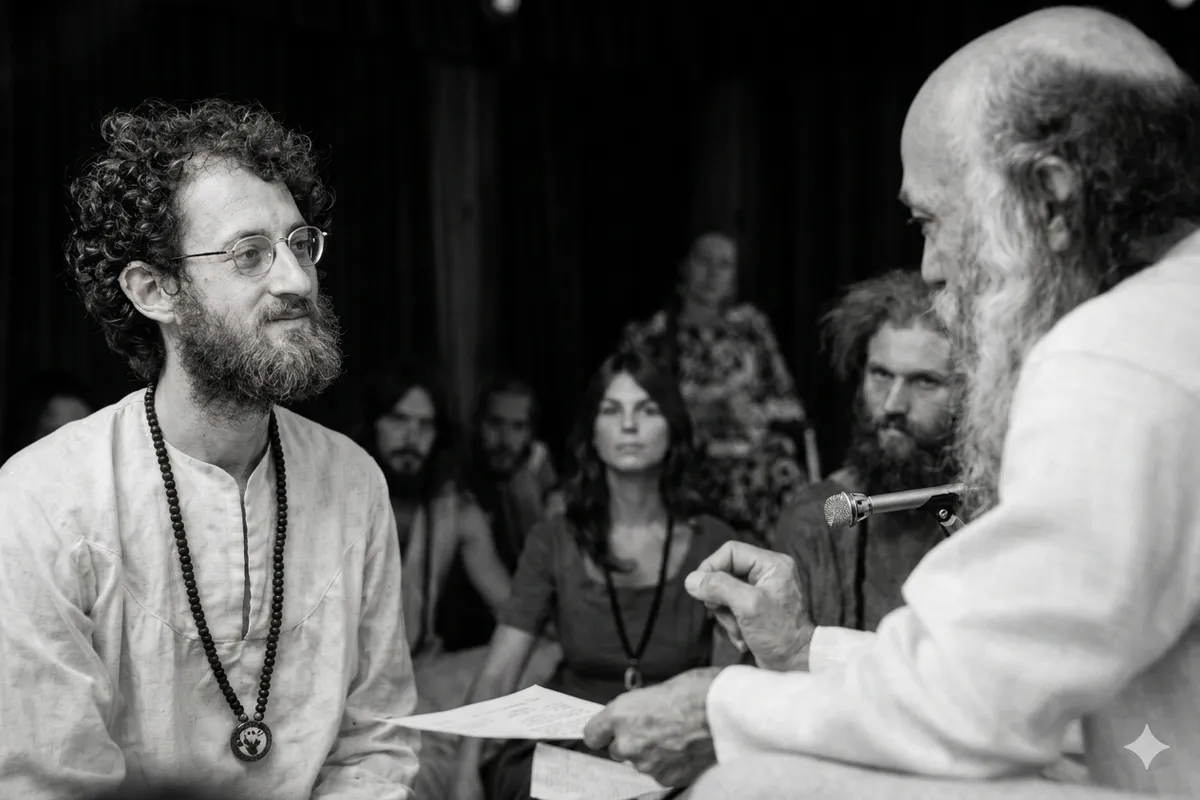
Feel your breath come in, stop, go out, stop, and just keep noticing it without trying to change it.
From the Discourses
Passages where Osho speaks to this question — each links to the complete discourse.
How is one to watch breath when it is not seen but felt?
Watching need not be a seeing, it can be a feeling. In fact it has to be a feeling because how can you see your breath? You feel it, the touch of it. When the breath moves through the passage, you feel the touch of it. The whole thing is not a question of seeing. The thing is to be alert that it is going in, that it has reached to the very innermost core of your being, that now it has stopped; that now it is coming back. The ebb and the tide: now it has gone out, moved completely out, stopped; then again moving back. The whole circle of it -- coming in, going out, coming in, going out -- one has to be aware. If you feel it, that is awareness -- but one should not miss feeling it. If you can do it every day for…
Osho, in the Buddhist practice of anapanasati, when one meditates on the breath, what effect does it have on the amount of oxygen?
A great deal. In fact—this is very amusing and worth understanding—whatever functions of life there are, if you take your attention to any one of them, its speed increases. The functions of life are going on outside your attention. For example, your pulse is beating. When your doctor checks your pulse, it is not exactly what it was before he checked; it goes up a little, because your attention and the doctor’s—both—have gone to it. And if a lady doctor is checking, it will go up even more; because even more attention goes there. You understand, don’t you? It isn’t exactly what it was; a slight difference appears. Try this experiment: first check your own pulse; then keep your attention on the pulse for ten minutes—how it is beating—and check again; you will find its vibrations have increased. In truth, whatever processes are running inside the body are running outside…
प्रश्न: ओशो, बुद्धिस्ट साधना में जो अनापानसती है, उसमें श्वास पर ध्यान करने से ऑक्सीजन की मात्रा पर क्या असर पड़ता है?
बहुत असर पड़ता है। असल में--यह बहुत मजे की बात है और समझने जैसी है--जीवन की जो भी क्रियाएं हैं, इन में किसी पर भी अगर तुम ध्यान ले जाओ, तो उनकी गति बढ़ जाती है। जीवन की जो क्रियाएं हैं वे ध्यान के बाहर चल रही हैं। जैसे तुम्हारी नाड़ी चल रही है। तो जब तुम्हारा डाक्टर तुम्हारी नाड़ी जांचता है, तो वह उतनी ही नहीं होती जितनी जांचने के पहले थी, थोड़ी सी बढ़ जाती है; क्योंकि तुम्हारा ध्यान और डाक्टर--दोनों का ध्यान उस पर चला जाता है। और अगर लेडी डाक्टर जांच रही है तो और ज्यादा बढ़ जाएगी; क्योंकि ध्यान और ज्यादा चला जाएगा। समझ रहे हैं न? उतनी ही नहीं होती, जितनी थी; थोड़ा सा अंतर पड़ जाता है। इसको तुम ऐसा भी प्रयोग करो: अपनी नाड़ी ही जांचो पहले; और फिर दस मिनट नाड़ी पर ध्यान रखो कि वह कैसी चल रही है, और इसके बाद जांचो; तो तुम पाओगे: उसके कंपन बढ़ गए।
Just look in crowded trains, a local train -- so many people standing. Just watch people's faces... everybody will look like a closed thing. Even if a person is standing just by the side of someone else, even if the bodies are touching, they are not touching. The touch is not even human... no warmth. But soon we will have a big place where people can have enough space around them, mm? [A sannyasin says: In Arica they taught us a certain way of breathing which requires concentration, so I kept losing my natural rhythm of breathing, because the conditioning from Arica training was pretty heavy. So I started concentrating on the breath going in and out here (indicating nostrils) and then it went better.] That will be good -- so remember it.
THE VEDAS HAVE SAID THAT BREATH IS BRAHMA. And it is right in a very subtle way. Breath is your life, and breath is also the bridge between the conscious and the unconscious, between your body and your soul. This bridge has to be used. If you can use this bridge rightly, you can go to the other shore. I wonder whether you have observed or not that your breath changes with your emotions. When you are angry, you breathe in a different way. Try to observe how you breathe when you are angry and then try to breathe differently while you are angry. You will not be able to be angry. You can be angry only in a certain way, with a certain rhythm of breathing. When you are in love, observe your breath: the rhythm, the music, the harmony. Disturb that harmony and the love will disappear.
Beloved Osho, when we start watching our bodies, and then our minds and emotions, there remains an element, although subtle, of concentration. Initially, for example, watching my breathing, I would watch it to the exclusion of everything else -- here there was an element of focus. On other occasions, when silence is just there, the breathing may be all there is to watch. This seems to be nearer, but still I feel that more soft focusing of the awareness would take me further and further back, as if relaxing enough to let the watcher move far enough away so that all is seen, rather than any one
It is true. Relaxation helps the most. No part of concentration should be in your watchfulness. Concentration is sabotaging the whole process of watchfulness, because concentration is an act of the mind, and watchfulness is something that comes from above, from beyond. If there is any concentration... I can understand, if you start watching your breathing -- in the name of watching, you are concentrating on the breathing, you are excluding everything else. Don't exclude. Watch your breathing inclusive of all. Watching your breathing... a temple bell starts ringing, a car passes by, a child starts crying -- all that should be included. Your watchfulness should be open. Watching the breathing is simply to begin with. It is not the end. It is just learning how to watch. But there is a difficulty -- you can start thinking that concentration is watching. Concentration is not watching. Concentration is narrow, narrowing…