
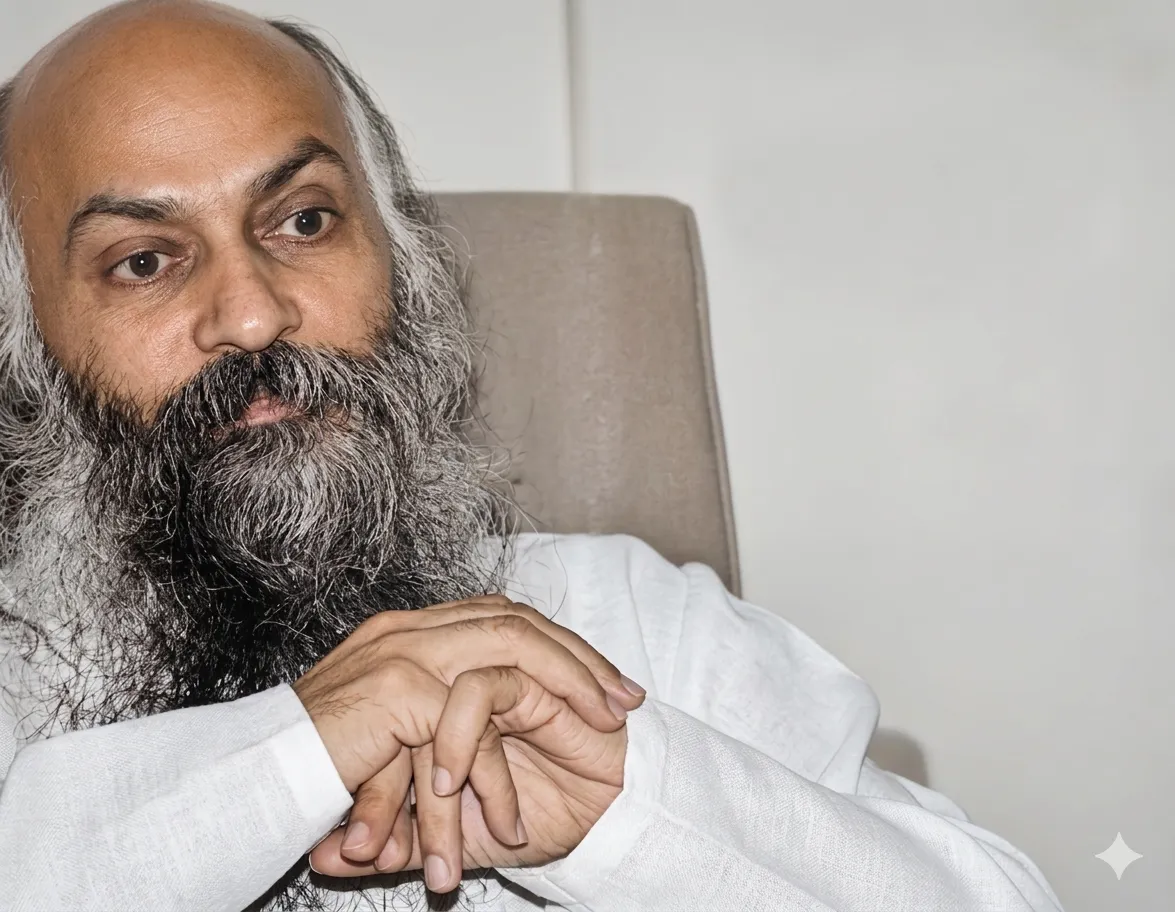
When all your inner colors shine equally, they blend into white—so a white aura means everything in you is balanced and generously giving, not just one part.
From the Discourses
Passages where Osho speaks to this question — each links to the complete discourse.
A white and small aura is visible just over your head. Why is not a colored one visible?
IT IS a colored one -- but all the colors are there, hence it looks white. White is not colorless. White is the presence of all the colors together. White is the most colorful thing in the world -- hence it looks white. When a white ray passes through a prism it divides into seven colors. That's how a rainbow is created in the rainy season. Small particles of water hanging in the air function as prisms. White rays of sun enter through those hanging particles of water and are divided into seven colors. If you mix all the colors in the right proportions, you will create white. White is all the colors together. I am not a Buddhist, I am not a Hindu, I am not a Christian, I am not a Jain, I am not a Mohammedan -- and I am all. All colors together! Hence white is…
If you wear tight clothes you will start climbing stairs two at a time; in loose clothing your gait becomes royal—you barely climb one step at a time. Tight clothes bring speed; loose bring gentleness—the haste is lost. The colors you choose also tell of your mind, for choice is not causeless—the mind is choosing. Mahavira divided the mind’s waves into six by color. Three he calls adharma-leshyas—through which man falls. And three he calls dharma-leshyas—through which man is purified, sanctified. The first leshya Mahavira calls Krishna—black. The second Neel—blue. The third Kapot—the color of a pigeon’s neck. The fourth Tej—the color of fire, scarlet red. The fifth Padma—peet, yellow. The sixth Shukla—shubhra, white. These are the six leshyas. The first three are adharma-leshyas; the last three, dharma-leshyas. Why choose by color? Because when a particular modification is in your mind, an aura, a halo arises around your face.
महावीर ने रंग के आधार पर चित्त की तरंगों के छह विभाजन किए हैं। तीन को महावीर कहते हैं, ‘अधर्म-लेश्याएं’, जिनसे मनुष्य पतित होता है। और तीन को महावीर कहते हैं, ‘धर्म-लेश्याएं’, जिनसे मनुष्य शुद्ध होता है, पवित्र होता है। पहली लेश्या को महावीर कहते हैं, ‘कृष्ण’--काली। दूसरी लेश्या को ‘नील’--नीली। तीसरी लेश्या को ‘कापोत’--कबूतर के कंठ के रंग की। चौथी लेश्या को ‘तेज’--अग्नि के रंग की, सुर्ख लाल। पांचवीं को ‘पदम’--पीत, पीली। छठवीं को ‘शुक्ल’--शुभ्र, सफेद। ये छह लेश्याएं हैं। इनमें प्रथम तीन अधर्म-लेश्याएं हैं और अंतिम तीन धर्म-लेश्याएं हैं। रंग से चुनने का कारण यह है कि जब आपके चित्त में एक वृत्ति होती है तो आपके चेहरे के आस-पास एक ऑरा, एक प्रभामंडल निर्मित होता है। इस प्रभामंडल के अब तो चित्र भी लिए जा सकते हैं। आपके प्रभामंडल का चित्र भी कह सकता है कि आपके भीतर क्या चल रहा है? कारण हैं, क्योंकि आपका पूरा शरीर विद्युत का एक प्रवाह है। आपको शायद खयाल न हो कि पूरा शरीर वैद्युतिक यंत्र है।
[NOTE: This is an unedited tape transcript of an unpublished darshan diary, which has been scanned and cleaned up. It is for reference purposes only.] White Cloud is a beautiful name. It symbolizes my whole philosophy. The white cloud represents many things. Basically, the color white is not a color. In one sense, it is a transcendence of all colors; and in another sense, very paradoxically, it is the synthesis of all the colors. All of the seven colors are part of whiteness. When they meet and merge in a certain proportion white is born. White has the whole rainbow in it. The rainbow is created when raindrops are hanging in the air in the rainy season and the sun suddenly comes out from behind the clouds.
Osho, when one experiences different forms of light and colours in meditation -- such as red, yellow, blue, ochre, etc. -- how can one know to which layers of being they belong? Is there any gradual sequence of colour and light experiences before reaching the ultimate light experience?
There is a Sufi sect which uses black -- black clothes for their fakirs. Black is also very, very meaningful. It shows absence of color, everything absent. It is just the contrary of white. Sufis say that unless we become totally absent, the God cannot be present to us. So one must be like black -- absolutely absent, a nonentity, a nonbeing, just a nothingness. They have chosen black. Colors are meaningful. So with whatsoever you choose you show much. Even your clothes indicate much. Nothing is just accidental. If you have chosen a particular color for your clothes, it is not accidental. You may not be aware why you have chosen it, but science is aware -- and it shows much. Your clothes show much because they belong to your mind, and your mind chooses. You cannot choose without your mind having certain leanings, certain tendencies. So the sequence…
Osho, in yesterday’s talk you said that a seeker should first be concerned with becoming a vessel, and should not go about begging from place to place. But the very meaning of a seeker is that he has obstacles in practice. He doesn’t know how to become a vessel, how to prepare. So if he does not go asking, what should he do? How difficult it is to meet the right guide!
But searching and begging are two different things. In fact, the one who does not want to search is the one who begs. Searching and begging are not the same; they are opposites. He who wants to avoid searching begs; a seeker never begs. And the processes of searching and begging are entirely different. In begging you have to keep your attention on the other—the one who will give. In searching you have to keep your attention on yourself—the one who is to receive. It is true that there are obstacles on the path of the seeker. But if we understand rightly, saying there are obstacles on the path of the seeker means the obstacles are within the seeker; the path too is within. And to understand one’s obstacles is not very difficult. So we will have to speak a little more extensively on what the obstacles are and how…
प्रश्न: ओशो, कल की चर्चा में आपने कहा कि साधक को पात्र बनने की पहले फिकर करनी चाहिए, जगह-जगह मांगने नहीं जाना चाहिए। लेकिन साधक अर्थात खोजी का अर्थ ही है कि उसे साधना में बाधाएं हैं। उसे पता नहीं है कि कैसे पात्र बने, कैसे तैयारी करे। तो वह मांगने न जाए तो क्या करे? सही मार्गदर्शक से मिलना कितना मुश्किल से हो पाता है!
लेकिन खोजना और मांगना दो अलग बातें हैं। असल में, जो खोजना नहीं चाहता वही मांगता है। खोजना और मांगना एक तो हैं ही नहीं, विपरीत बातें हैं। खोजने से जो बचना चाहता है वह मांगता है, खोजी कभी नहीं मांगता। और खोज और मांगने की प्रक्रिया बिलकुल अलग है। मांगने में दूसरे पर ध्यान रखना पड़ेगा--जिससे मिलेगा। और खोजने में अपने पर ध्यान रखना पड़ेगा--जिसको मिलेगा। यह तो ठीक है कि साधक के मार्ग पर बाधाएं हैं। लेकिन साधक के मार्ग पर बाधाएं हैं, अगर हम ठीक से समझें तो इसका मतलब होता है कि साधक के भीतर बाधाएं हैं; मार्ग भी भीतर है। और अपनी बाधाओं को समझ लेना बहुत कठिन नहीं है। तो इस संबंध में थोड़ी सी विस्तीर्ण बात करनी पड़ेगी कि बाधाएं क्या हैं और साधक उन्हें कैसे दूर कर सकेगा।