
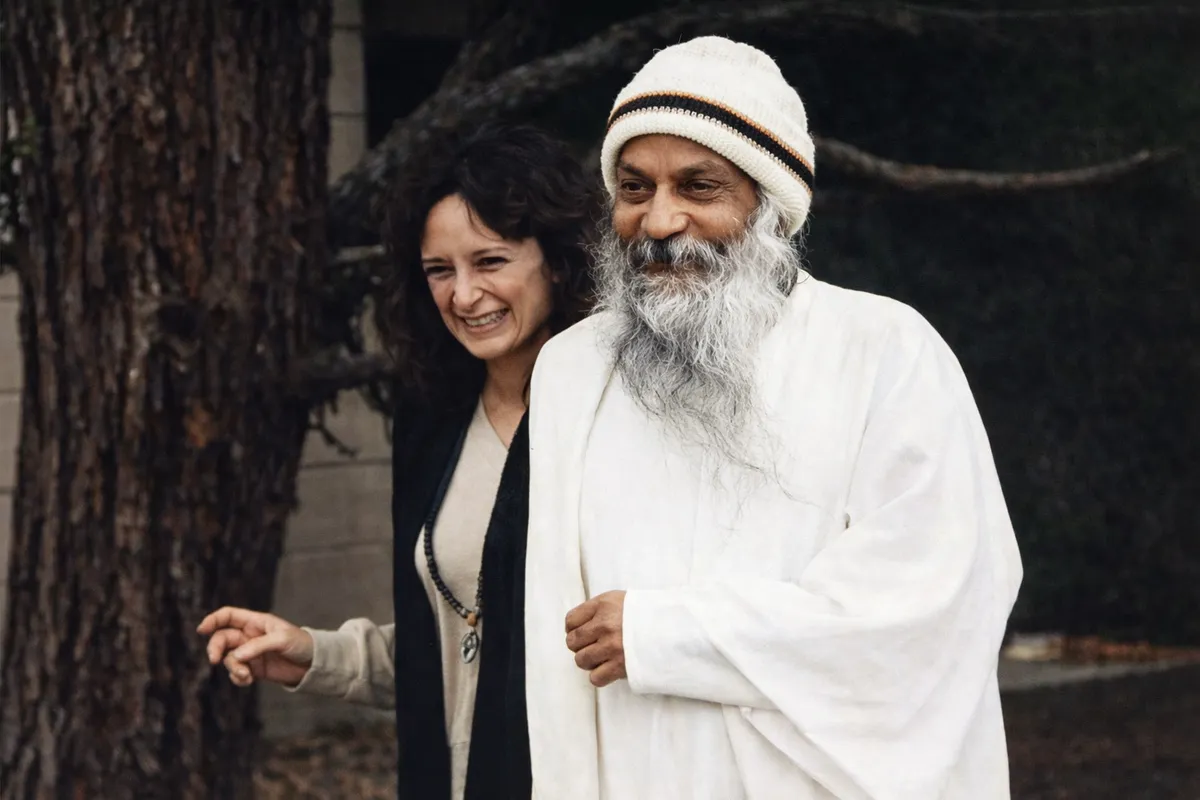
He checks his hands because they silently do the real work of dissolving your questions, while his words just keep you listening.
From the Discourses
Passages where Osho speaks to this question — each links to the complete discourse.
Beloved Osho, why do you always look in your hand before you start answering the first question? Do I see it wrongly, or do you find the answer there?
My hands are empty. I don't have any answer. You have questions; I don't answer you, I simply destroy your questions. And before destroying your questions I have to look at my hand because it is not only with my language that I destroy your questions, it is also with my hands. So I have to prepare them, to ask "Are you ready?" When they say, "Yes, master, go ahead" I start! Without my hands, I cannot answer you. They do almost most of the work. My words keep you engaged, and they go on doing the real work. So you are not seeing wrongly; you are seeing absolutely right. I look at them -- not for answers, but just to see whether they are ready or not.
Osho, questions arise—and for many of them the answers also come. What is all this?
Girls want people to tell them they are beautiful. A handful of fools to say it—that’s all it takes—and you’ll always find such fools loitering on the seafront; no matter what she looks like—even if she resembles Kali of Calcutta, motherly and forbidding—some fool will still exclaim, “Ah, what beauty!” It feels good when someone says, “You are intelligent!” You gather your self-image from others’ borrowed opinions. You ask their questions and paste on their answers. You call this your knowledge. All of it stale and borrowed... No—no one else can give you knowledge. No one else can answer your questions. The one who truly wishes you well, who truly wants you to become a flame of life, will tell you: the answer to every one of your questions is within you. Therefore the way is to sit silently and go inward. And a moment comes, as you keep finding…
Osho, the questions we ask you all arise out of unconsciousness. And your replies come from total awareness. How can the two ever meet? And if they cannot meet, then asking itself seems wrong. Then what do you mean when you tell us to ask?
What is the difference between resonance and string? The string is gross, the resonance is subtle. The string can be grasped; the resonance cannot be grasped. Catch hold of the string and you remain on the surface. Catch the string and you will be bound—the string becomes a chain. Resonance enters your very life-breath. And resonance sets aquiver the resonance already asleep within you. Resonance is liberation. Do not take my strings, my words. Do not be concerned with what I say; be absorbed in what I am. Take the aura, not the form! If you take the form, you are bound. Take a form and you enter a prison. Take the aura! The halo that surrounds a lamp cannot be clutched in a fist, cannot be locked in a safe. But if you look at it with full eyes, your eyes will begin to shine. If you drink in…
Osho, no real question forms. I don’t even know whether I want to ask anything or not. But I want to hear something from you—for me. Please don’t mention my name.
What you appear to be on the surface, you are not. Your body is no more than clothing; your mind too is only the inner garment. Body and mind are not separate: the mind is the inner aspect of the body, the body the outer aspect of the mind. You are neither. You are the letter that never takes birth and never dies. You are part of that great epic which some call God, some Liberation, some Nirvana. You are a drop of the Lord’s eye—an immortal tear. You are a limb of the Divine; not separate. What name could you have? Thus the rishis of the Upanishads proclaim their Brahman-being—not their personal being, but Brahman’s being. Thus Al-Hallaj Mansur cries “Ana’l-Haqq!”—I am the Truth! Not “I am,” but Truth is. Our name separates us. Remember your namelessness, so this separateness dissolves. Our form, color, caste, class—these divide us. And…
Osho, Master Joshu went to the place where a monk was meditating. He asked the monk, "What is, is what?" The monk raised his fist. Joshu replied, "Boats cannot stay where the water is too shallow," and left. A few days later, Master Joshu went to the monk again and asked the same question. The monk answered in the old way. Joshu said, "Well given, well taken, well killed, well saved," and he bowed to the monk. Osho, please explain the purport of this Zen anecdote.
A few days later Joshu returned to that monk and asked the same question. The monk gave the traditional answer again. Joshu said, “Well given, well taken, well killed, well saved,” and bowed to the monk.