
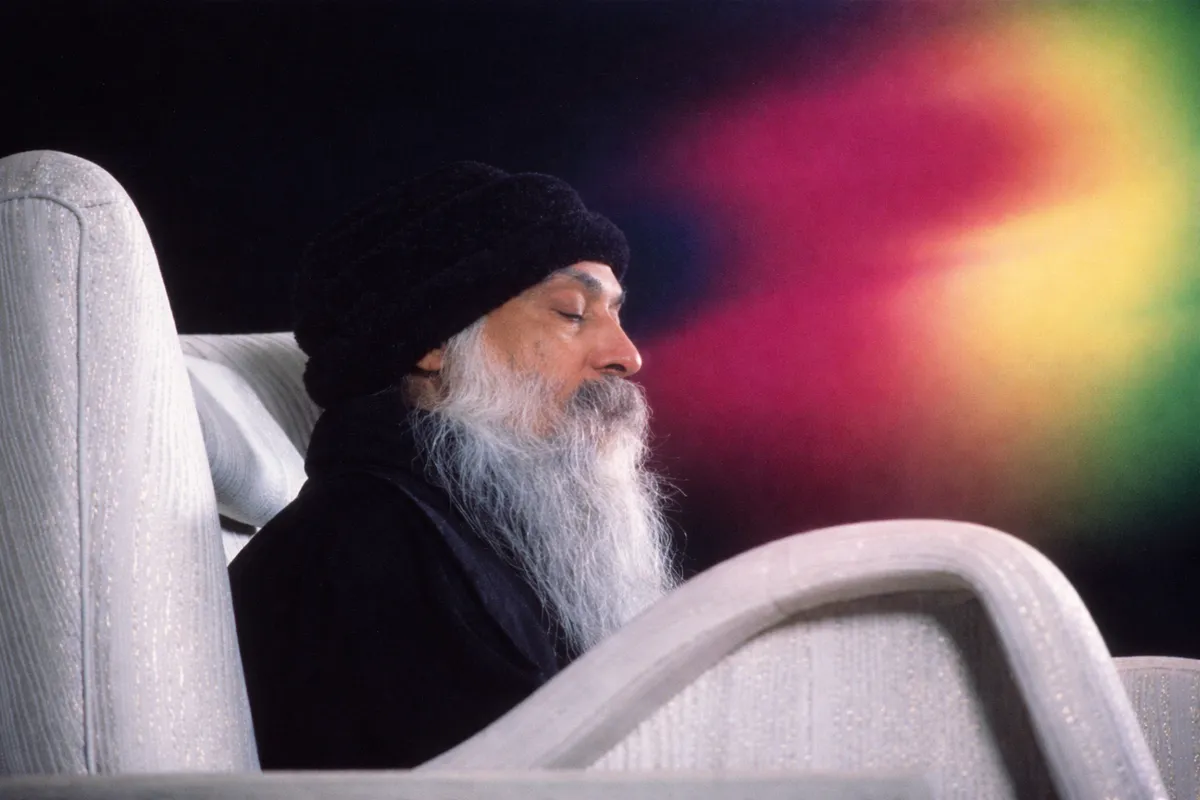
I bow because the same living God is in you and me, and love—not fear—makes that bow real.
From the Discourses
Passages where Osho speaks to this question — each links to the complete discourse.
A friend has asked: Osho, why do you bow to the God within human beings? One friend has also asked: yesterday you said that people bow out of fear. So are you afraid of people that you bow to them? And another friend has asked: when you say that God is within people, doesn’t that create an ideal—and you are against ideals.
Both these points need to be understood. I did not say that all bows are bows of fear. I did not say that all prayers are prayers born of fear. I only said: try to recognize whether the prayer you are doing is out of fear; whether the bow you are making is out of fear; whether the love you are professing hides fear within it. Ninety-nine times out of a hundred it is so, because man stands upon fear. And because he stands upon fear, no moment ever seems to arrive in his life when he can do something without fear—no moment at all. Even if we greet someone on the road, we do it out of fear; it is not without a cause. But the joy of a causeless bow is altogether different—when there is no reason at all. If you have ever bowed for a reason, the…
Osho, there is an old belief that if the noble and the great bow to those who are smaller than themselves, the juniors incur sin. Obviously, that would feed their ego. Then why is it that, both when you come for discourse each day and again when you take your leave, you fold your hands and bow to us?
So that you keep remembering that you are not small; so that you keep remembering that, though you may have forgotten, your very nature is divine; so that you keep remembering that godliness is your treasure. Yes, if you inflate your ego, it will be a mistake. And if you awaken your godliness, it will be merit. Sin and virtue depend on your vision. For me there is no way except to see God in you. Once That is seen within oneself, it begins to appear in everyone. Every straight or slanted line, your form emerges. How many times I wished to paint some other picture, to free my mind from the prison of your shape— but in every mirror your beloved reflection descends. I do look at you, of course, but it is not you that appears there; I bow to that which appears. You too, slowly, with the…
Osho, what should I call you—Prabhu, Vibhu, or Shambhu? I ask this so that I may bow at your feet continuously. Only there do I wish to bow for all three times. Now please hear my prayer!
So absorbed in worship that one forgets even to raise the hands. You don’t remember to bow—you are bowed. So immersed in devotion! “Now, for prayer, my hands no longer rise; the heart seems lost in surrender and consent.” The temperament is so drowned in worship, in prayer: who remembers when to raise hands, when to offer flowers, when to mark the forehead? Bowed is bowed. Bowing is not an outer affair. It is inner—an inward mood. You ask to bow for three times. You will be in trouble, and you’ll put me in trouble too. If you must bow, bow—just spare me! “Because I may bow at your feet continuously.” What is the fear? Why make it “continuous”? Is this moment not enough? Settle this moment within itself. The next moment will care for itself. Why keep accounts of tomorrow? Surely your today is poor. Talk of tomorrow arises…
Osho, why is life so dear? Every thing, every person, all creation, the manifest and the unmanifest too! Color, sound, movement, taste—even discord! Just remembering it, the heart brims over, tears flow, the breath draws long. Speech stops. There is sobbing. I cannot say anything! My eyes close and I just sit.
Consider this: this man does not know how to bow. He says, “I will bow when my condition is met.” Even in bowing there is a bargain, an ego. “If you want me to bow, if it pleases you that I bow, then fulfill my condition. I will bow only to my conception. How you are—I have nothing to do with that. You stand there with a flute and peacock plume—stand if you like; that is not my creed. I bow to my creed. Take the bow and arrow, then I will bow.” This is the obstacle. How can trees take bow and arrow in hand? How can the sun? How can the moon and stars? It is difficult. And the Divine stands at your door like the sun, but you will not bow. If Baba Tulsidas did not bow, how will you? “Take the bow, then I will bow.”…
Osho, you say there is no place for prayer in Buddhism. But in Buddhist temples their followers are seen bowing in prostration and prayer. How is that?
Buddha said: there is no God. This does not mean there is no divine. It only means that if there is the divine, it is hidden in your consciousness. It is the fragrance of your consciousness. Refine your consciousness and the divine will be revealed. Not by prayer, by meditation. In prayer there is an other. In meditation there is no other; you descend within yourself. You polish yourself, cleanse yourself, wipe away the dust. Little by little, when thoughts shed off, when desires fall away, then within you that luminous, consciousness‑made being is revealed. In your clay‑made form, the consciousness‑made is hidden—this is what Buddha said. It will not happen through prayer, it will happen through meditation. But, as I said earlier, who listens to Buddha! People began to pray to Buddha himself! They built temples to Buddha. And they said, “All right, if there is no God, so…