
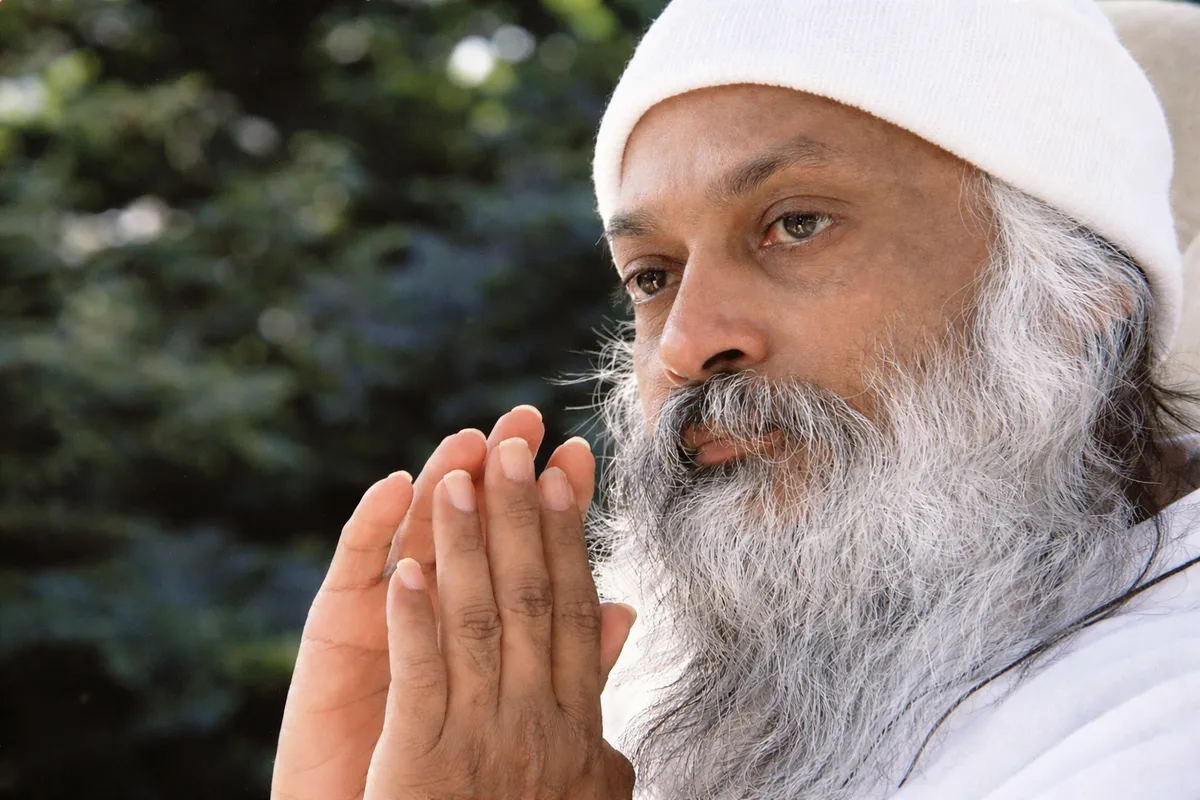
If you just believe or dismiss things without checking for yourself, you keep swapping one trap for another.
From the Discourses
Passages where Osho speaks to this question — each links to the complete discourse.
Another friend asks: Osho, from your talks it seems that the very things we want to erase—the chains of delusion, superstition, blind belief, the chains we want to break—end up getting stronger. From what you say, rebirth seems real, spirits seem real, gods seem real, the soul’s transmigration seems real. Then won’t the superstitions we want to remove only become stronger?
So the real issue isn’t “remove this leader, remove that superstition.” Change the basic man. The scientific mind won’t be preoccupied with superstitions as objects; they will continue as long as man chooses blindness. And who among us is ready to open our eyes? We don’t want to, because open eyes reveal truths we don’t want to see. So we shut our eyes and imagine what we prefer. A man thinks himself pure, saintly; if he looks closely, he will find the greatest sinner within. He doesn’t want to see that; otherwise his saintliness collapses. He surrounds himself with those who keep him blind—collects disciples who tell him, “You are a great saint.” There are wonderful tricks for collecting people—even shouting, “Don’t come near me! I want no one!” That too attracts crowds: “See, an extraordinary saint—he beats people away!” In California, on a beach, there was a simple fellow…
Another friend has asked: the things we want to destroy -- such as the chains of blind faith or superstition -- find even more confirmation in your talks. It seems, according to what you are saying, that there is life after death, that there are gods and there are ghosts, that there is transmigration of the soul. In that case, it would be difficult to get rid of superstitions, won't they become even stronger?
The man said, "Yes, I certainly did. I was very puzzled. I came here to wait for somebody, and suddenly I felt that my body was about to fall asleep. I lost control and went to sleep. And then I felt strongly as if someone was telling me 'Get up, get up. Get up in seven minutes!' I can't figure any of this out." The man had no idea what had happened. Communication of thought without any medium has become a scientific truth, but an educated man would call it superstition. It is possible that a sick man in one town can be cured from a faraway town; it's not too difficult. It's also possible that a snakebite can be healed from a distance of thousands of miles; there's not much difficulty to it. But there are many different kinds of superstitions. And remember, the superstition of an educated man…
Osho, that is what is being taught. Yes, that is being taught. That very thing is being taught, and it is precisely because of that teaching that such a corrupted world has come into being, and such corrupted human beings have been produced—because of that teaching.
What is the fruit of these five thousand years of such teaching? The people we see all around us—this very world of ours. This world has been born of that “education,” hasn’t it? So where has five thousand years of all this teaching brought you? Day by day you fall lower, and you will go on falling. The mistake is at the very foundation. The mistake is at the very foundation. There is no need for reverence, no need for belief. What is needed is inquiry, what is needed is courage. One must search, one must dare. All that—reverence, belief—are symptoms of weakness. That is why the more a community leans on faith, the more it falls behind. Look. Any community that has relied on belief has lagged. Because the very question of taking the next step does not arise. If you are sitting in a bullock cart and you…
प्रश्न: ओशो, वह सिखाया जा रहा है। हां, वह सिखाया जा रहा है। वही सिखाया जा रहा है और उस सिखाने की वजह से ही इतनी करप्टेड दुनिया पैदा हुई है, और इतने करप्टेड आदमी पैदा हुए हैं--उस सिखाने की वजह से।
… यही दुनिया पैदा हुई न इस शिक्षा से? तो पांच हजार साल की यह सारी टीचिंग कहां ले गई है आपको? रोज नीचे गिरते जाते हैं और रोज गिरते जाएंगे। वह बुनियाद में ही बात गलत है। बुनियाद में ही बात गलत है। न तो श्रद्धा की जरूरत है, न विश्वास की जरूरत है। खोज की जरूरत है, साहस की जरूरत है। खोजने की जरूरत है, साहस करने की जरूरत है। ये सब कमजोरी के लक्षण हैं। इसलिए जिन कौमों ने जितनी ज्यादा श्रद्धा पर विश्वास किया, वे कौमें उतनी ही नीचे पिछड़ गईं। देखें। जिन कौमों ने भी इस पर विश्वास किया, वे उतनी पीछे पिछड़ गईं। क्योंकि कदम आगे बढ़ने का सवाल ही नहीं रहा। अगर बैलगाड़ी में बैठे थे, तो बैलगाड़ी में बैठे हुए हैं श्रद्धा और विश्वास से, तो फिर और आगे उठने का सवाल कहां उठता है।
Osho, the other day, speaking of India, you said that this country’s fundamental problem is its superstitions and that it is about fifteen centuries behind the times. Would you kindly tell us how to distinguish between faith and superstition, and whether today’s faiths will not become tomorrow’s superstitions? Would you also graciously tell us what an individual or a community should do to be contemporary, to remain modern?
It is a fact of life worth understanding: neither the poor nor the rich revolt; the middle class does. All revolutions—of ideas, of economy, of society—arise from the middle. This land has much experience of trust—its taste, its peace. It knows that an event like Buddhahood can happen; it has that certainty. Therefore, even if there is no Buddha, “let a Buddha’s statue do”—it clings to something or other. Other countries don’t have so much superstition because they haven’t had so many occasions for trust. In America there isn’t much superstition because America has known no Buddha, no Mahavira, no Krishna. In that sense America is non-superstitious. And superstition cannot arise until trust has arisen. Where there is pleasure, there is the sense of pain; where there is wealth, the sense of poverty; where there is the taste of trust, the shadow of distrust is cast. Then fear of distrust…
दूसरा प्रश्न: ओशो, उस दिन भारत के प्रसंग में आपने कहा कि इस देश की बुनियादी समस्या उसके अंधविश्वास हैं और यह कि यह देश समय से ड़ेढ हजार वर्ष पीछे है। क्या बताने की कृपा करेंगे कि विश्वास और अंधविश्वास की परख क्या है, और क्या आज के विश्वास कल अंधविश्वास नहीं हो जायेंगे? क्या यह भी बताने की अनुकंपा करेंगे कि कोई व्यक्ति या जनसमूह समसामयिक होने के लिए, आधुनिक रहने के लिए क्या करे?
यह जीवन का एक तथ्य है समझने जैसा कि न तो गरीब बगावत करते हैं न अमीर बगावत करते हैं--बगावत मध्य-वर्गीय लोग करते हैं। सारी क्रांतियां मध्य-वर्गीय लोगों से पैदा होती हैं। विचार की, अर्थ की, समाज की--सारी क्रांतियां! थोड़ा अनुभव होना चाहिए। इस देश को विश्वास का अनुभव है, बहुत अनुभव है। विश्वास की छाया और विश्वास की शांति इस देश ने जानी है। इसको पता है कि बुद्धत्व जैसी घटना भी घटती है। इसकी प्रतीति इसको है। इसलिये अगर बुद्ध न हों तो चलो बुद्ध की प्रतिमा ही सही, मगर किसी न किसी चीज को यह पकड़ लेता है। दूसरे मुल्कों में इतना अंधविश्वास नहीं है, क्योंकि विश्वास के इतने मौके ही नहीं। अमरीका में अंधविश्वास नहीं है, क्योंकि अमरीका ने न तो कभी कोई बुद्ध जाना न कोई महावीर जाना न कोई कृष्ण जाना। अमरीका इस अर्थ में गैर-अंधविश्वासी है। और असंभव है तब तक अंधविश्वास पैदा होना, जब तक कि विश्वास पैदा न हो जाये। सुख हो तो दुख का बोध होता है। धन हो तो गरीबी का बोध पैदा होता है। …