
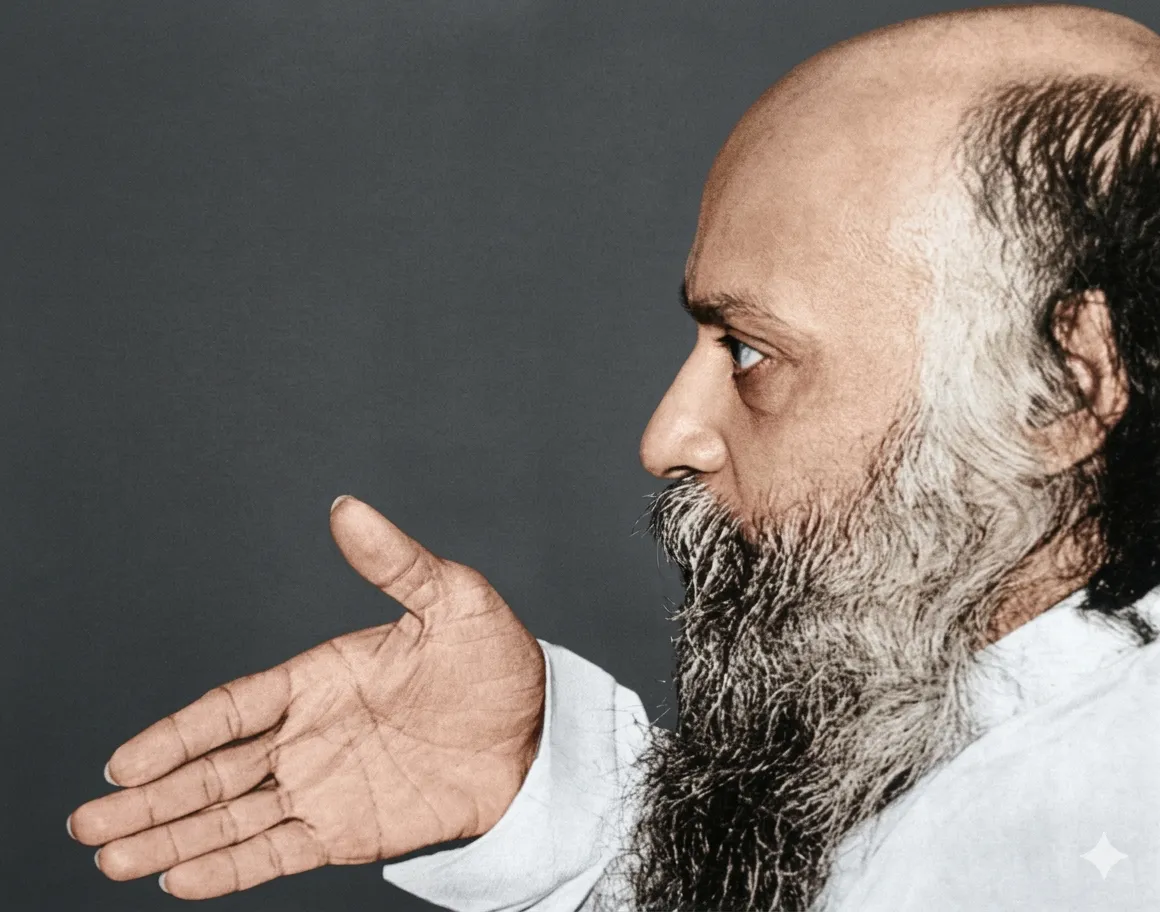
Truth is one big moon, and teachers point at it from different windows, so their words look different even though they mean the same thing.
From the Discourses
Passages where Osho speaks to this question — each links to the complete discourse.
One of the sannyasins has asked a question: WHAT IS MISSING IN COMMUNISM?
If you really want celibate people, then they need a brain operation. The center of sex should be removed. But then you will be simply impotent -- not celibate. Karl Marx was right, that such religions should be finished. They are against humanity. They protect poverty and they protect the rich. They are against revolution, they are against any change -- obviously, he was right to call them the opium of the people, the hope of the hopeless. If Christianity and Judaism were the only religions, then the Soviet Union would not have any need, any urge to find the inner world! But just think about it. You cannot have the outside world without having the inside world; they exist together like two sides of the coin. And there are scientific methods available. Zen is the most scientific method to inquire into your consciousness. It takes you beyond mind into…
Osho, awakened ones, considering place, time, circumstance, and the era-appropriate psychology of people, have expressed the same truth in very different forms. To the point that they appear mutually quite disputatious and even contradictory. Is an absolute expression of the ultimate truths of life and existence not possible? Will the limits of the age and the condition of the people always continue to be imposed upon truth?
Expression will always be limited. Expression will always be relative. The speaker and the listener—both create the boundaries of expression. I will say only what can be said. You will understand only what can be understood. Truth is vast. If I go to see the ocean and you say to me, “On your way back, bring a little of the ocean,” I will not be able to bring the whole ocean. I may bring a little water from it. But in that water much will be missing. There will be no storm of the ocean, no waves. And that was the real ocean: that tumultuous roar and fierce thunder! Waves crashing against cliffs! Those surges rising and spreading for miles! That swell! None of that will be there. I will bring a vessel filled with a little ocean water. Still, there will be something! If you taste it, it will…
Osho, why do all the buddhas say the same thing?
TRUTH IS ONE. Even if it is said differently, it is the same truth. Languages may differ, metaphors may differ parables may differ, but if you really look a little deep, then al parables, all languages, all metaphors, culminate in one truth. TRUTH is one -- what can Buddhas do? Although each Buddha speaks in his own way, and his expression has HIS signature on it. His expression is just his and nobody else's. But still those who can see will always find that it is the same diamond -- maybe we have been shown only one aspect of it by Krishna, another aspect by Christ, still another by Mohammed, but those are aspects of the same diamond. The diamond is one, this universe is one -- and all the Buddhas have been saying the same thing, in different languages, in different ways. Those differences come from their individualities, not…
Osho, why are there so many confusions in philosophy?
There is no confusion in darshan; in shastra there will be confusion. Shastra itself means confusion. Shastra means: doctrines, arguments, words. Darshan is simple and direct. Darshan means vision—the capacity to see—the eye. When the eye is empty, void of ego, free of thought, when the mind does not interfere, what happens then is darshan. To see what is, just as it is—that is darshan. Remember the difference between darshan and darshan-shastra. Darshan-shastra is not darshan; darshan-shastra is speculation, intellectual tussle. Darshan is vision, experience. In philosophy there will be entanglement. In philosophy a single question will carry a thousand questions, and from each answer a thousand more will arise. And in philosophy no question ever gets resolved. In five thousand years of history, philosophers have not solved a single question. For five thousand years they have asked many questions, but not given a single answer. They cannot. A philosopher…
Osho, you can read in the bible that jesus warned about other masters coming in the future. Do you think his warnings were also including you? Your message is very different from important parts of the teachings of jesus. How is it possible that enlightened masters can say so many contrary things?
ONE THING of great import has to be understood first. Jesus became enlightened only at the last moment on the cross. Hence his statements that he has made before that experience are not of an enlightened person -- close, very close, approximate, but as far as truth is concerned there is nothing like approximate truth. This thing has not been told to Christians at all, that Jesus became enlightened at the very last moment. On the cross he became enlightened, on the cross he became a Christ. To me the cross is important not for the same reasons as it is for Christians. To them the cross is important because Jesus was crucified, and the cross has become the symbol of crucifixion. To me that is absolutely wrong -- that is a kind of life-negation, that is worshipping death, that is making too much fuss about crucifixion. I call Christianity…