
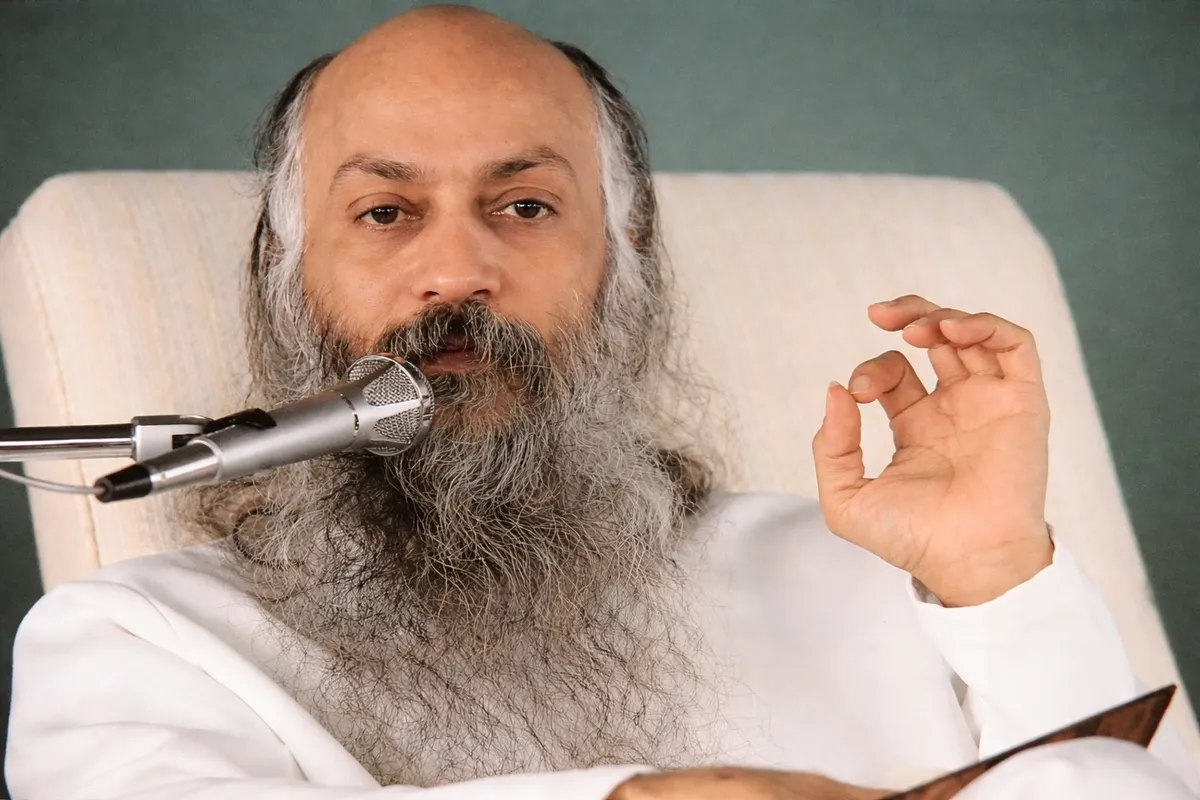
You’re the one who decides—nobody and nothing outside you pushes the button.
From the Discourses
Passages where Osho speaks to this question — each links to the complete discourse.
Osho, is my destiny nothing but a long series of sadness and frustration written in advance?
It is in your hands. If you go on writing it, it will remain written. No one else is giving you melancholy; it is your choice. You have chosen it. No one else will give you bliss either—if you choose it, you will have it. What you find, what you choose—that is your destiny. Let us understand a little. The old notion of fate says: it is written—and written by someone else, not by you. I want to tell you: destiny is not already written; it has to be written day by day. And not by someone else—your own hands write it. It may be that you write in such unconsciousness that your own hands seem alien. It may be you write in such unawareness that only after it is written do you realize something got written. You cannot catch yourself red-handed. Your awareness is lacking. But no one else…
पहला प्रश्न: ओशो, क्या मेरी नियति में सिर्फ विषाद की, फ्रस्ट्रेशन की एक लंबी श्रृंखला लिखी है?
भाग्य की पुरानी धारणा कहती है, लिखा हुआ है; और किसी और ने लिखा है, तुमने नहीं। मैं तुमसे कहना चाहता हूं, भाग्य लिखा हुआ नहीं है, रोज-रोज लिखना पड़ता है। और किसी और के द्वारा नहीं, तुम्हारे ही हाथों से लिखा जाता है। यह हो सकता है कि तुम इतनी बेहोशी में लिखते हो कि अपने ही हाथ पराए मालूम होते हैं। यह हो सकता है, तुम इतनी अचेतन अवस्था में लिखते हो कि लिख जाते हो तभी पता चलता है कि कुछ लिख गया। तुम अपने को रंगे हाथ नहीं पकड़ पाते। तुम्हारे होश की कमी है। लेकिन कोई और तुम्हारा भाग्य नहीं लिखता है।
Osho, is sadhana a natural development, or is it a leap beyond nature’s evolutionary process and its transcendence? If sadhana is not an overstepping leap beyond natural growth, then will the whole of humanity, within the cosmic process, arrive on its own at spiritual heights? And if evolution always moves forward, why did the great ancient spiritual cultures recede from the evolutionary current?
There are many strands here. First: the moment we separate man from existence and look at him as apart, these questions begin to arise. For example, heat water to one hundred degrees and, at that point, it “leaps” and becomes steam. Water becoming steam is a natural event. Its heating is also natural, not unnatural. Heating is natural; the leap into steam is natural. If nature did not contain the law that at one hundred degrees water can jump into steam, water would have no way to become steam. If nature did not contain the potential to heat to one hundred degrees, water would have no power to reach that heat. Even so, if water had consciousness, it could save itself from fire—or it could put itself on the fire. That too would be a natural happening: to save itself or to offer itself—both. My point is: in this universe…
ओशो, साधना प्राकृतिक विकास है अथवा प्रकृति के विकास-क्रम से बाहर छलांग व उसका अतिक्रमण है? यदि साधना सहज विकास का अतिक्रमण व छलांग नहीं है, तो क्या सृष्टि के विकास-क्रम में सारी मनुष्य-जाति आप ही आप आध्यात्मिक ऊंचाइयों को पहुंच सकती है? यदि विकास-क्रम आगे ही आगे बढ़ता है, तो प्राचीन श्रेष्ठतम आध्यात्मिक संस्कृतियां क्यों विकास-क्रम से पीछे हट गईं?
इसमें बहुत-सी बातें हैं। पहली बात तो यह कि जैसे ही हम मनुष्य को जगत से तोड़कर देखते हैं अलग, वैसे ही ये सवाल उठने शुरू हो जाते हैं। उदाहरण के लिए, हम पानी को सौ डिग्री तक गरम करें, तो सौ डिग्री पर पानी छलांग लगाकर भाप बन जाता है। पानी का भाप बनना एक प्राकृतिक घटना है। पानी का गरम होना भी एक प्राकृतिक घटना है, अप्राकृतिक घटना नहीं है। पानी का गरम होना भी प्राकृतिक घटना है, पानी का छलांग लगाकर भाप बनना भी प्राकृतिक घटना है। अगर प्रकृति में यह नियम न होता कि सौ डिग्री पर पानी छलांग लगाकर भाप बन सकता है, तो पानी के पास कोई उपाय न था कि वह भाप बन जाए। अगर प्रकृति में यह उपाय न होता कि सौ डिग्री तक गरम हो सके, तो भी पानी की कोई सामर्थ्य न थी कि वह सौ डिग्री तक गरम हो जाए। फिर भी पानी के पास अगर चेतना है, तो पानी अपने को आग से बचा सकता है। और पानी के पास अगर चेतना है, तो वह अपने को आग पर चढ़ा सकता है। और यह भी प्राकृतिक घटना है कि वह अपने को बचाना चाहे या चढ़ाना चाहे--दोनों। …
Is this difference -- the difference in their stages -- due to their own choice, or is it their destiny?
To me, the solution to the whole problem takes on a different shape. Do not divide them. They are not two, they are already one -- they have always been one. When the energy becomes conscious it is soul, when it becomes unconscious it becomes body. Sometimes you are more a soul and less a body, sometimes you are more a body and less a soul. This flickering back and forth between one and the other goes on continuously. In the morning you may be more a soul, in the evening you are more a body. When you are in anger you are more a body, when you are in love you are more a soul. The degrees change continuously. When you meditate your consciousness expands and your body shrinks; when you take an intoxicant your consciousness shrinks and your body expands. Body and consciousness are two poles of one…
Osho, you said... then you will find that the devotee is God. The question arises: if one devotee prefers to be God and another wants to remain only a devotee, then which of the two is superior?
The one who wants to be God will not be able to be. And the one who wants to remain a devotee will become God. The question of superior or inferior does not arise, because only one of the two will happen. The one who does not want to be will be. The one who wants to be will be deprived. That very wanting is of the ego. But the matter is a little delicate. Sometimes humility too belongs to the ego. Beware that your humility may not be of the ego. Perhaps you are saying, “No, I don’t want to be,” because you know that those who refuse are the ones who attain. Then you are clever. Then your humility is adulterous. Your humility is not pure, not sacred, not virginal—it is like a prostitute. The one who wants to be God, whose ego says, “I must become God,”…
दूसरा प्रश्न: ओशो, आपने कहा... तब पाओगे कि भक्त ही भगवान है। प्रश्न उठता है कि एक भक्त भगवान होना पसंद करे और दूसरा सिर्फ भक्त रहना चाहे, तो दोनों में श्रेष्ठ कौन है?
जो भगवान होना चाहे वह तो हो न पाएगा। और जो भक्त भक्त ही रहना चाहे वह भगवान हो जाएगा। श्रेष्ठ-अश्रेष्ठ का सवाल नहीं उठता, क्योंकि एक ही हो पाएगा। जो नहीं होना चाहता वही हो पाएगा। जो होना चाहता है, वह तो वंचित रह जाएगा। वह तो चाह भी अहंकार की ही है। लेकिन मामला थोड़ा नाजुक है। कभी-कभी ऐसा होता है कि विनम्रता भी अहंकार की ही होती है। कहीं तुम्हारी विनम्र्रता भी अहंकार की ही न हो। कहीं तुम इसलिए ही न कर रहे होओ कि नहीं मैं नहीं होना चाहता, क्योंकि तुम जानते हो कि जो इनकार करते हैं वही हो पाते हैं। तो तुम चालाक हो। तो तुम्हारी विनम्रता व्यभिचारी है। तो तुम्हारी विनम्रता शुद्ध नहीं, पवित्र नहीं, कुंआरी नहीं, वेश्या जैसी है।
When life itself is so fulfilling, overflowing, so blissful, then what is that which makes a man miserable?
So an egoist remains miserable, because to be happy one has to be happy with that which one has. You cannot be happy with that which you don't have; you can only be unhappy with that. You can be happy only with that which you have. How can you be happy with that which you don't have? And ego is always interested only in that which you don't have. You have ten thousand rupees -- ego is no more interested in it. It is interested in twenty thousand. By the time you have twenty thousand, it is no more interested in it. It is interested only in thirty thousand. And so on, so forth... it goes on. The ego only gives you goals, but whenever those goals arrive, it does not allow you to celebrate. One becomes more and more miserable! As life passes, we go on gathering misery, we…