
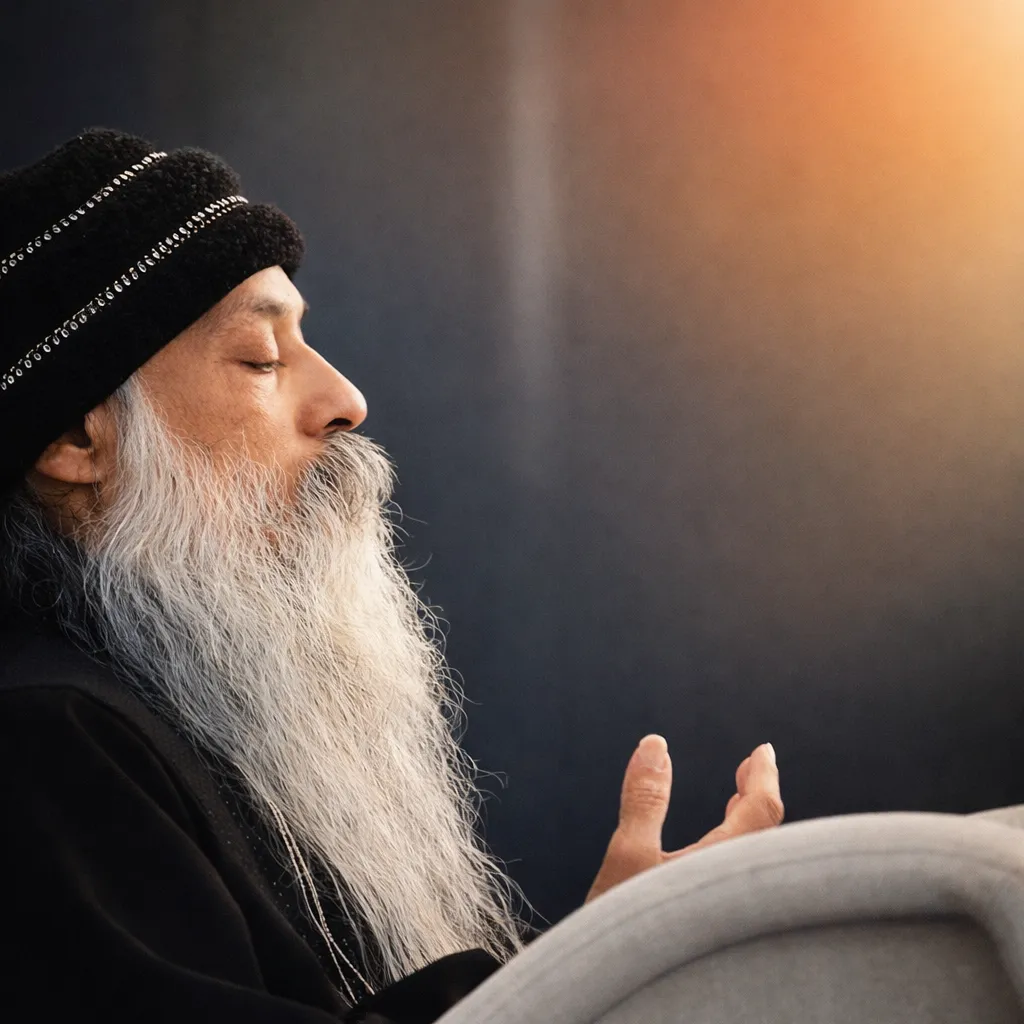
You can’t ask who knows nothingness, because when nothingness truly happens, there’s no one left to know it.
From the Discourses
Passages where Osho speaks to this question — each links to the complete discourse.
Osho, who is it that knows non-being, and on what basis is it known?
No, this is not a question; this question does not arise. It neither arises nor can it be formed. Because when we say, “Who knows non-being?” we have already assumed that someone remains. Then non-being has not happened. Nirvana is not an expression of bodily experience.
Who knows nonbeing and on what basis can it be known?
The question itself is wrong. This question cannot arise and cannot be formed, because when we ask, "Who knows nonbeing?" we take it that someone remains behind. Then it is not nonbeing.
And someone has asked: Osho, who is it that thinks when one is witnessing?
As it is now, whenever we know, three things are present: the one who knows—the knower; that which is known—the known; and the relationship between the two—knowledge. Knowledge is bound and burdened by the knower and the known. Keval-gyan means the known dissolves—the object disappears. And when the known dissolves, where will the knower be? He was bound to the known. When the known dissolves, the knower dissolves. What remains then? Only knowledge remains. In that moment of pure knowing there is the sense of liberation and of freedom. So keval-gyan means to experience pure knowledge. What I have called samadhi is the experience of pure knowing. These are different names in different traditions: what Patanjali called samadhi, the Jains called keval-gyan, and Buddha called prajna. Keval-gyan does not mean telling what is going on in your head. That is very easy—a simple thing. That is ordinary telepathy, thought-reading; it…
और पूछा है, ओशो, साक्षी होकर कौन विचार करता है?
अभी जब भी हम कुछ जानते हैं, तो जानने में तीन चीजें होती हैं--जानने वाला होता है, वह ज्ञाता होता है; जिसको जानते हैं, वह होता है, वह ज्ञेय होता है; और इन दोनों के बीच जो संबंध होता है, वह ज्ञान होता है। तो ज्ञान जो है, ज्ञाता और ज्ञेय से दबा रहता है, उनसे बंधा रहता है। केवल-ज्ञान का अर्थ है कि ज्ञेय विलीन हो जाए, आब्जेक्ट विलीन हो जाए। और अगर ज्ञेय विलीन हो जाएगा, तो फिर ज्ञाता कहां रहेगा! वह तो ज्ञेय से बंधा हुआ था। जब ज्ञेय विलीन हो जाएगा, तो ज्ञाता विलीन हो जाएगा। तब क्या शेष रह जाएगा? तब मात्र ज्ञान शेष रह जाएगा। उस ज्ञान की घड़ी में मुक्ति का बोध होता है और स्वतंत्रता का बोध होता है। तो केवल-ज्ञान का अर्थ है, शुद्ध ज्ञान को अनुभव कर लेना। जिसको मैंने समाधि कहा है, वह शुद्ध ज्ञान का अनुभव है। यह अलग-अलग संप्रदायों के अलग-अगल सत्य हैं। जिसे पतंजलि ने समाधि कहा है, उसे जैनों ने केवल-ज्ञान कहा है, उसे बुद्ध ने प्रज्ञा कहा है।
Do you know who I am?
NO Sir, NOT AT ALL. Because you are not. You are an emptiness -- anatta. No sir. On the surface you may be somebody, but I am not concerned with your surface. In the deepest core you are simply a nobodiness, not even a nobody -- nobodiness. How can I know you? And that's the beauty, because if I can know you I have defined you, I have made you limited by my knowledge. If you can be known, immediately you become an object, you are no more a consciousness. If you can be known you cannot be infinite, and you are -- infinite in your emptiness. How can I know you? Even you yourself cannot know. There exists nothing like self-knowledge. When you come to realize it, it is a NO-SELF-knowledge. When you come to settle with it, suddenly you become aware that the knower and the known have…
There is a very unique thing in the Vedas. “What is all this?”—the seer has asked.
“Perhaps the Divine who made it knows—or who knows, maybe even he does not!” This is something astonishing. God! The Vedic seer says: “What is all this?” “Perhaps—perhaps the One who made it knows; or who knows, maybe even He does not!” They must have been very courageous people. The gist is: even God may not know. In truth, whatever becomes known turns trivial. Once it is known, what remains? To know is to define. Existence has never been defined. Has anyone ever said what it is? That is why Buddha fell silent. Ask him, “Is there God?”—he is silent. “Is there a soul?”—he is silent. That, precisely, was Buddha’s answer! He says: Stop this prattle about soul and God. Who has known? Wake up! Drop the worry about knowing. So there is, first, the race of the doer—that is the race of ego. Then there is the race for…
वेदों में एक बड़ी अनूठी बात है। ‘यह सब क्या है?’--ऋषि ने पूछा है।
… शायद, परमात्मा जानता हो जिसने यह सब बनाया, या कौन जाने वह भी न जानता हो!’ बड़े हिम्मतवर लोग रहे होंगे। इसका सार अर्थ हुआ कि परमात्मा को भी पता नहीं है। असल में जिस चीज का पता हो जाये, वह व्यर्थ हो जाती है। पता ही हो गया तो फिर क्या बचा? पता चल गया तो परिभाषा हो गयी। इस अस्तित्व की अब तक कोई परिभाषा नहीं हो सकी। कोई कह सका, क्या है? इसलिए तो बुद्ध चुप रह गये। जब तुम उनसे पूछो ईश्वर है? वे चुप रह जाते हैं। आत्मा है? वे चुप रह जाते हैं। यह ठीक-ठीक उत्तर दिया बुद्ध ने! वे कहते हैं: यह बकवास बंद करो आत्मा, ईश्वर की! कौन जान पाया? जागो! जानने की चिंता छोड़ो।