
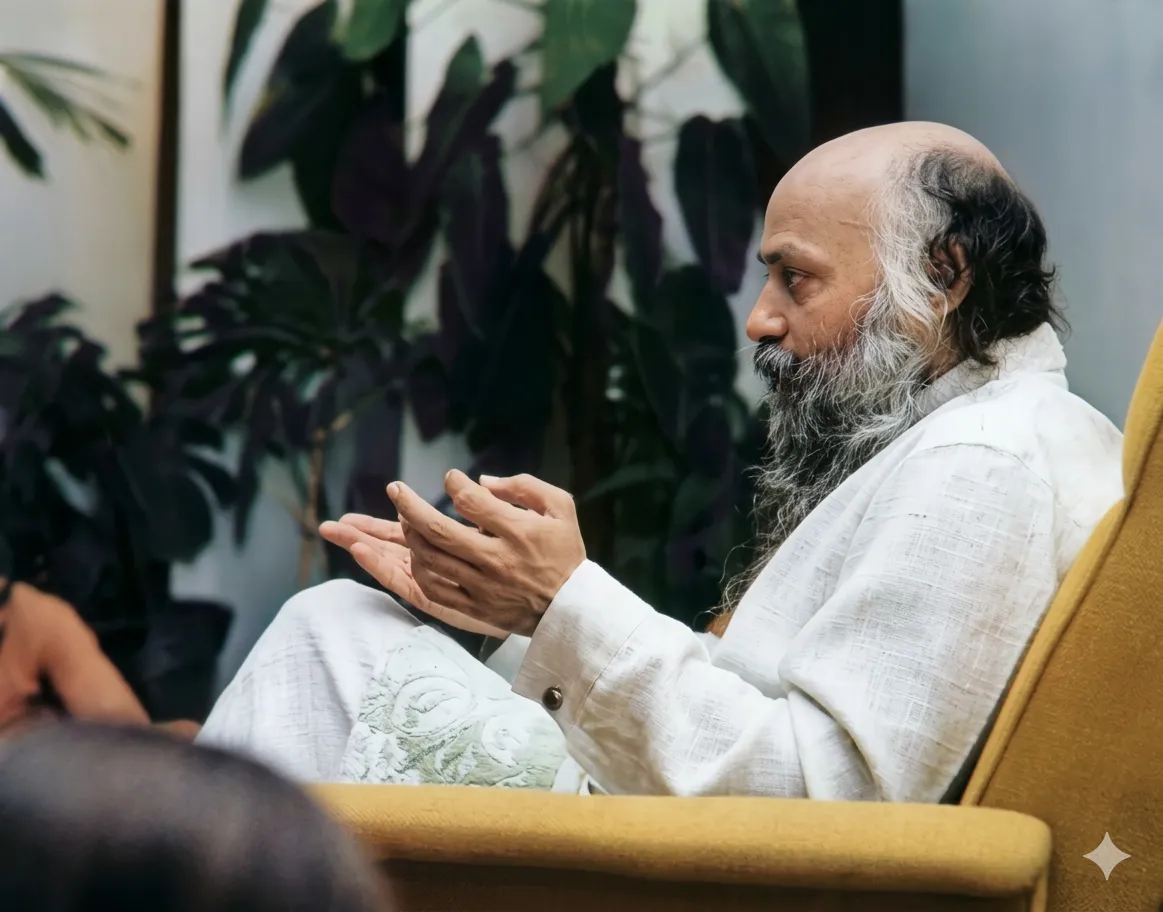
Science will grow by teaming up with spirituality, so we get smart tools guided by a wise heart.
From the Discourses
Passages where Osho speaks to this question — each links to the complete discourse.
Beloved master, in your prophetic vision, what do you think will be the future of science?
Science and religion are becoming one. They are already becoming one. I am not saying they will become one, they are already becoming one. All the greatest scientists -- Eddington, Planck, Einstein -- people of the highest caliber in the world of science, became aware that science alone is not enough. There is something far more mysterious which cannot be grasped only through scientific methodology and means, something which needs a different approach, which needs more meditative awareness. Eddington says in his autobiography, "When I started my career as a scientist I used to think that the world consisted of things, but as I grow old I am becoming more and more aware that the world does not consist of things but of thoughts." Reality is far closer to thoughts than to things. Reality is far more mysterious than you can weigh, measure, than you can experiment with. Reality is…
Osho, in yesterday’s talk you said that a seeker should first be concerned with becoming a vessel, and should not go about begging from place to place. But the very meaning of a seeker is that he has obstacles in practice. He doesn’t know how to become a vessel, how to prepare. So if he does not go asking, what should he do? How difficult it is to meet the right guide!
But searching and begging are two different things. In fact, the one who does not want to search is the one who begs. Searching and begging are not the same; they are opposites. He who wants to avoid searching begs; a seeker never begs. And the processes of searching and begging are entirely different. In begging you have to keep your attention on the other—the one who will give. In searching you have to keep your attention on yourself—the one who is to receive. It is true that there are obstacles on the path of the seeker. But if we understand rightly, saying there are obstacles on the path of the seeker means the obstacles are within the seeker; the path too is within. And to understand one’s obstacles is not very difficult. So we will have to speak a little more extensively on what the obstacles are and how…
Osho, modern science has taken humankind away from nature and developed many dimensions of life. Please tell us: given the complexity of the scientific way of living, how can a balance be established today with the Taoist era’s effortless, natural way of life?
There is no question of establishing a balance. It is not a matter of balancing Lao Tzu and modern science. If Lao Tzu’s vision truly comes into view, an entirely new science will be born—utterly new. A science founded on Lao Tzu’s vision would be born, because the whole perspective on life would be different. The science that has evolved on Aristotle’s foundations is very incomplete, ignorant. It has tried to understand such a tiny fragment of life and has left the whole. One should say it is childish. It has made no attempt to see the totality. But until now it could not have. Now it will have to. After the discovery of atomic weapons and the development of atomic energy, science has been compelled to reconsider all its basic premises. Why? Because if science keeps moving as it has till now—if it says, “We will go on this…
Question: IT IS RECORDED THAT SOMEONE SAID TO THE GREAT PHILOSOPHER SAADI, "I WISH FOR PERCEPTION, SO THAT I SHALL BECOME WISE. " SAADI SAID, "PERCEPTION WITHOUT WISDOM IS WORSE THAN NOTHING AT ALL." HE WAS ASKED, "HOW CAN THAT BE?" SAADI SAID, "AS IN THE CASE OF THE VULTURE AND THE KITE. THE VULTURE SAID TO THE KITE, 'I HAVE FAR BETTER EYESIGHT THAN YOU. WHY, I CAN SEE A GRAIN OF WHEAT DOWN THERE ON THE GROUND, WHILE YOU SEE NOTHING AT ALL.' "THE TWO BIRDS PLUMMETED DOWN TO FIND THE WHEAT, WHICH THE VULTURE COULD SEE AND THE KITE COULD NOT. WHEN THEY WERE QUITE NEAR THE GROUND THE KITE SAW THE WHEAT. THE VULTURE CONTINUED HIS DIVE AND SWALLOWED THE WHEAT. AND THEN HE COLLAPSED: FOR THE WHEAT WAS POISONED." That's how it has happened -- man has collapsed because of his knowledge.
Osho, meditativeness and science are difficult to reconcile. Yet painting a picture, writing a poem, and solving a scientific problem all bring the same joy. The same joy! Why is it so difficult to be meditative and a scientist? Why has there never been a society in which the inner and the outer sciences, the science of gentleness and love and the science of aggression and death, live in harmony?
Mahavira, twenty-five centuries ago, used to make each of his statements with a 'perhaps'. If you asked him, "Is there a God?" he would say, "Perhaps." In those days it was not understood at all -- because how can you say, "Perhaps"? Either God is or is not. It seems so simple and so logical: "If God is, God is; if he is not, he is not. What do you mean by 'perhaps'?" Now it can be understood. Mahavira was using the same language in religion that is being used by Albert Einstein in physics. Albert Einstein calls it the theory of relativity. Mahavira has called his philosophy exactly the same: SAPEKSHAWAD -- the theory of relativity. Nothing is certain, everything is flexible, fluid. The moment you have said something, it is no longer the same. Things don't exist, Mahavira says, but only events. That's what modern science is saying,…