
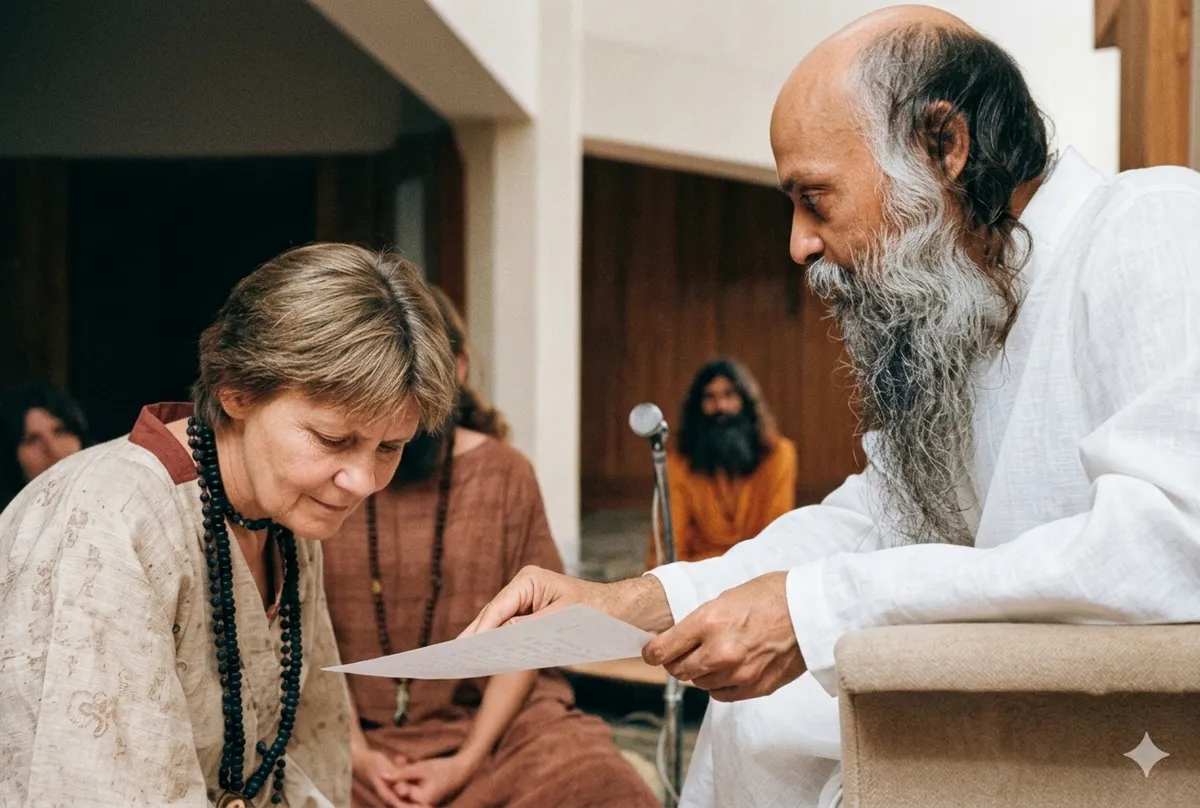
According to Osho, fear of science, or anything, is simply fear of the unknown, not of the thing itself. He urges entering exactly where fear arises, because the unknown contains life's mystery and serves as the bridge from the known to the unknowable. By repeatedly stepping into the unknown, one awakens to a new dimension: the unknowable, the ultimate experience.
We fear what we don’t know; gently step into it, and it becomes a doorway to deeper understanding.
From the Discourses
Passages where Osho speaks to this question — each links to the complete discourse.
Beloved Osho, is the fear that people have about science due to the fact that they have never really tried it?
All fear is of the unknown. Anything that you do not know you feel afraid of, naturally. Who knows what it will turn out to be? But this is one of the essentials of sannyas, that wherever you feel something unknown and a fear arises in you, that is the place to enter in spite of your fear, because the unknown carries the mystery of life. From the known one has to move into the unknown. And only the person who has become accustomed to entering into the unknown without fear becomes aware of a new dimension, the unknowable. The unknowable is the ultimate experience. The unknown is just the bridge between the known and the unknowable.
Whenever something great is going to happen, fear arises, because it has never happened before and the mind cannot comprehend it. The mind feels impotent before it and that's why fear arises. Fear is just because of the impotence of the mind encountering something vast, wild, something infinite. The mind recoils and wants to escape. That's what fear is. But we have to choose the unknown and not choose the mind. The mind means the known, and the whole search is for the unknown, for that which we have not known yet. And when we come to it, we escape. We run away from it. There is a poem of Rabindranath Tagore -- one of the greatest poets of India -- in which he says he was searching for God for many lifetimes.
Remember: the unknowable. Science only believes in two things -- the known and the unknown; it does not believe in the unknowable. That's the difference between science and religion. Science says the existence can be divided into two parts -- the known and the unknown. The unknown is that which we will know some day. It has no intrinsic quality of remaining unknown forever -- it is just uncharted, but we will chart it. All that has become known was unknown one day; it has become known. All that is unknown today will become known tomorrow... or some day! it is potentially capable of being known. Religion says there are three things: the known, the unknown... and up to this point religion agrees with science, there is no disagreement. But religion says there is something more too: that is the unknowable, which cannot be known ever, which will remain mysterious.
Let science do its work. That is science' work to demystify existence. Anything that is not known has to be made known -- that's the whole scientific approach. We will not leave anything unknown in existence. And it is possible to conceive one day perhaps we will have exhausted the unknown. But what about the unknowable? The scientist himself is unknowable. He knows everything. He does not know who is the knower. In fact, he denies the knower -- and that is so stupid that one of Indian scientists, Khorana , who got a Nobel prize, I asked him that, "You are a Nobel prize winner scientist. Have you ever bothered that you go on searching, discovering, new areas but who is the seeker and who is the searcher? Have you ever thought about yourself?" He said, "I don't have time for that.
It is just like when you dive deep into water and an urge arises to go back to the surface. This is a greater depth than that. No ocean is so deep as the inner reality. So one trembles, feels afraid, lost, uprooted. One feels unskillful because the new is so new and you have never practised it. But by and by if you go on with courage and you take the challenge of the unknown, that very challenge will create the capacity to encounter it. Once you accept a challenge, you start becoming capable of encountering it. Nothing else is needed because the capacity is lying there within you fast asleep because you have never used it. So whenever there is a challenge, never reject it -- welcome it. Challenge is life and life-giving.