
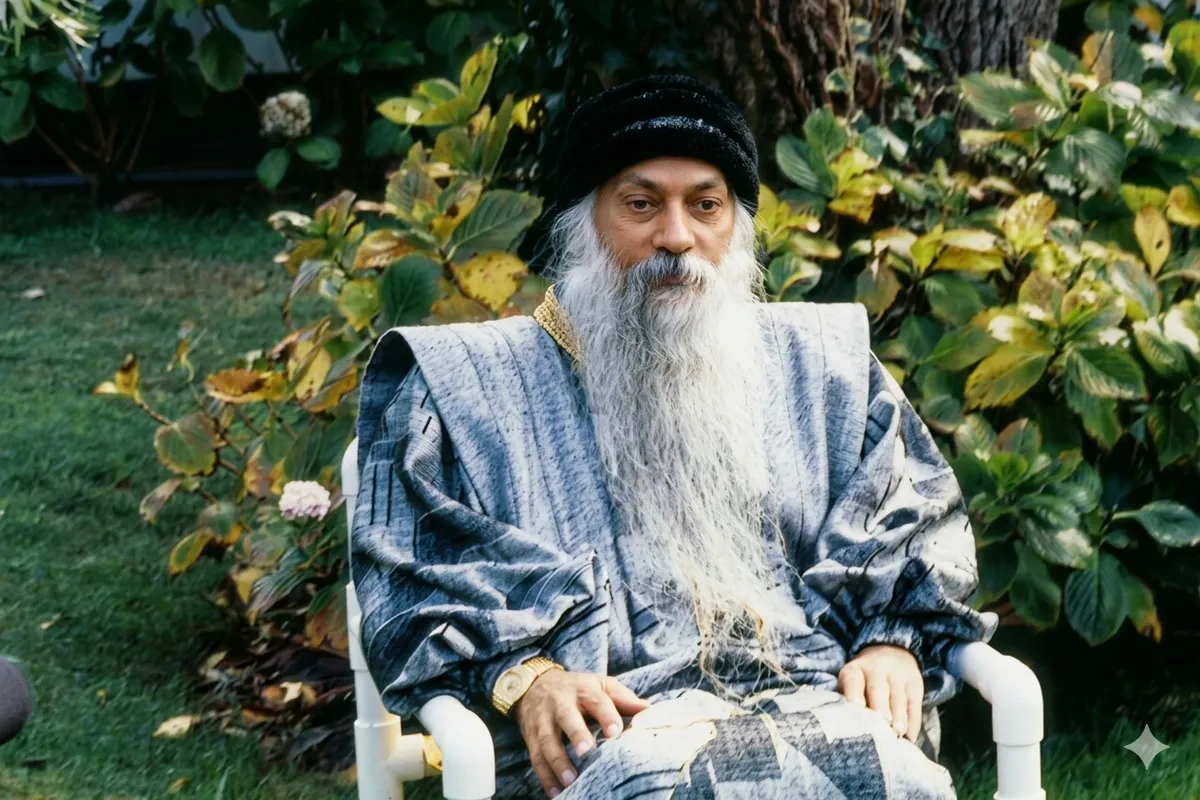
Stay calm and kind, keep meditating, and give others time to adjust instead of getting pulled back into old fights.
From the Discourses
Passages where Osho speaks to this question — each links to the complete discourse.
Osho, since I took sannyas there is peace inside, but outside there is great upheaval. I am at ease, yet others are getting very uneasy. What should I do?
It came to this: I would be sitting in the house; my mother would be sitting in front of me and say, “There is no one around to send for vegetables.” And I would be right there! She’d say, “No one is to be seen.” I’d say, “I don’t see anyone either.” A dog would wander into the house; I’d be sitting there; my mother would say, “There’s no one in the house and the dog has come in!” And I would be sitting right in front of her. Slowly they accepted it. What could they do? There’s a limit. For a while they pulled this way and that, dragged me here and there, sent me; but there’s a limit. You have become a sannyasin; now remain absorbed in your own inner mood. People will say this and that, pull you here and there. Don’t create quarrels, and don’t try…
This friend has asked: How can I find peace while living at home, in the world?
First thing: don’t try to attain peace—accept unrest. You will become peaceful. Then no one in this world can disturb you. If I am willing for disturbance, who can disturb me? If I am willing to be abused, who can insult me? It is because I am not willing for abuse that someone can insult me. It is because I am not willing for disturbance that anyone can disturb me. And the more we try to be peaceful, the more touchy we become. You see, this often happens in homes. If, by some accident, one “religious” man appears in a house, the whole house is thrown into turmoil. Because if he is praying, no disturbance may arise; children cannot play; no one can make a racket. At the slightest clatter he will raise an uproar. He is sitting there to become silent! Sitting there to worship, to pray, to meditate!…
Osho, to abide in oneself beyond the knower, knowledge, and the known—can one live in that state for an entire lifetime? Just as a lake is sometimes calm, sometimes playful, and sometimes stormy, does the self-realized one remain unaffected by worldly circumstances in the same way? Osho, dispel my ignorance!
Spring means harmony between season and mood. Meditation means harmony between you and the whole. You become harmonious. Whatever is, is perfectly okay—accepted. Nowhere any refusal, nowhere any opposition. Whatever is happening is auspicious. That is trust; that is meditation. Such meditation naturally takes you into an altogether new experience. Storms will rise; they will not stop because you meditate. Diseases will not stop coming to the body because you meditate. They will come. A thorn will sometimes pierce the foot. Raman had cancer; so did Ramakrishna—great storms came! Ramakrishna got cancer of the throat; he could neither eat nor drink. Vivekananda said to him, “What is not in your power! Why don’t you pray to the Lord at least to allow food and water to pass? We suffer watching you writhe.” Ramakrishna said, “Ah, it never even occurred to me to pray. How could it occur—to one whose prayer…
A friend has asked: Osho, if meditation brings peace to life, then why does it not spread across the whole country?
We teach children: anger is bad, anger is a sin, don’t be angry. The result is not that they stop being angry—that cannot happen. The anger only remains incomplete, never allowed to run its full course; they never fully experience the pain of anger; they never pass through its fire. And then the question of non-anger does not arise; the search for peace does not begin. One who has not even been truly unpeaceful—how can he become peaceful? One who lacks even the capacity to be fully unpeaceful—how will he have the capacity to be peaceful? These things may sound upside-down, but I tell you: only the one who can be thoroughly unpeaceful can truly set out on the path to peace. One who, by getting angry, lives anger through and through—who is pierced by all its thorns, who is singed in its flames—one who drinks anger to the dregs…
Its final touchstone is this: whatever is happening within—if peace is arising within—then that peace must begin to travel into your conduct. If you say, within I feel great peace, but outside you are angry—then your peace is imagination. If you say, great bliss is coming within, but your outer life is full of lust—then that inner news is false. Because a man full of bliss cannot have vasana. Vasana belongs to the man full of misery. Vasana means: I am unhappy, I want pleasure. If I am blissful, pleasure is not in question. That would be like one who has the Kohinoor begging for pebbles—why would he? Therefore the sutra says: 'In the outer life, advance with courage and search for the path.' What you have known within—now move outward with courage. Great courage will be needed.