
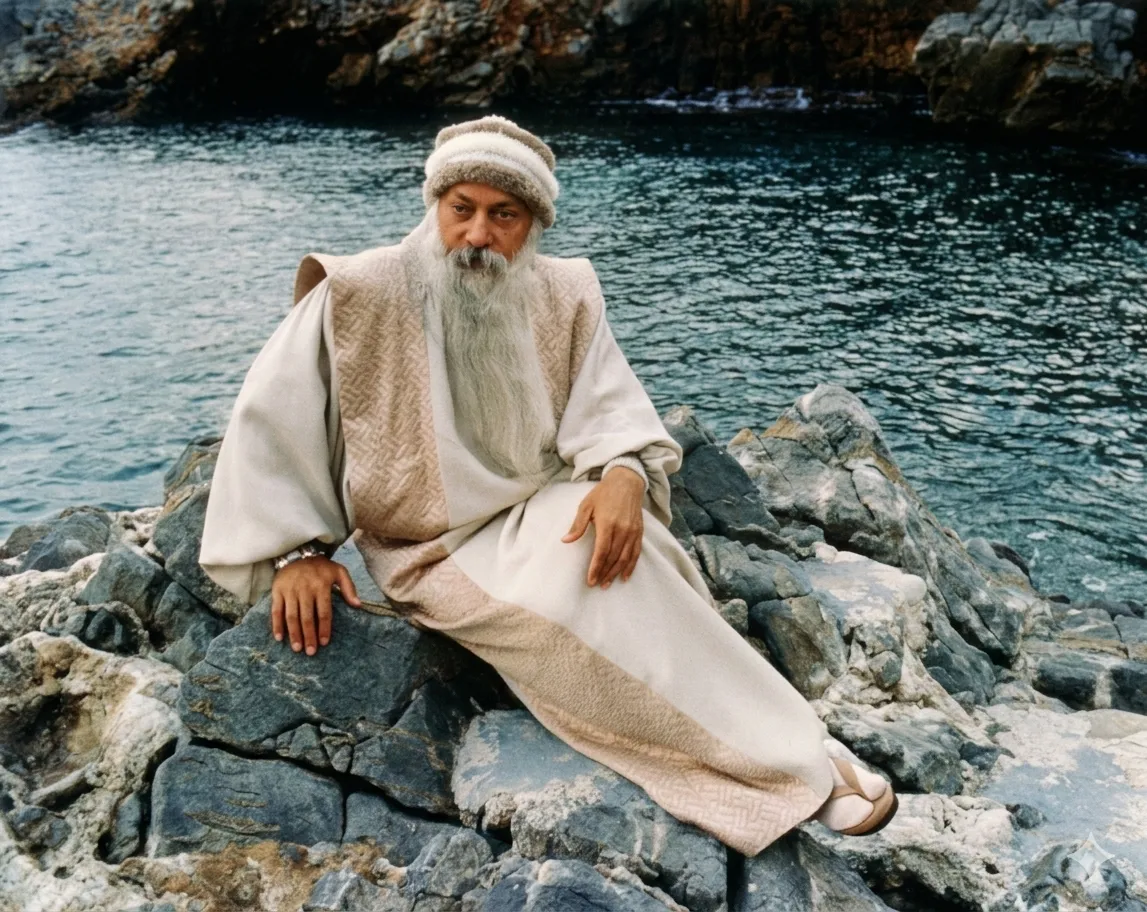
It’s like a quiet eye inside your forehead that feels truth and love without using your normal five senses.
From the Discourses
Passages where Osho speaks to this question — each links to the complete discourse.
Osho, what is inner sense?
God is not a person but the ultimate sense of well-being, the ultimate sense of being at home, the ultimate sense that "I belong to this world and this world belongs to me. I am not alien here, I am not an outsider." The ultimate sense -- existential -- that "This whole and I are not separate." This experience is God. But this experience is possible only if you allow your inner sense to function. Start allowing it! Give it as many opportunities as possible. Don't look always for outside authorities, and don't look for outside opinions. Keep yourself a little more independent. Feel more, think less. Go and look at the rose flower, and don't just repeat parrot like, "This is beautiful." This may be just opinion, people have told you; from your very childhood you have been hearing, "The rose flower is beautiful, is a great flower." So…
Beloved Osho, this morning, again you came to me and I wonder: I know how the sun touches me, how your face enters my eyes, your voice my ears. I know those five doors to the world. But I wonder what this sixth sense is that feels you. What door do you pass to reach me so deeply, and why is it always in the morning that you touch me the most? Is openness related to the rhythm of the day? Would you please speak on senses and openness?
The red color is significant. The psychology of color and the science of color is that whichever color you see -- if you see something red, then one thing is certain, that that thing is not red; it appears red. The sun rays have all the seven colors of the rainbow, and when the sun rays fall on anything, if all the rays are absorbed then you see the thing as black. If all the rays are reflected back and nothing is absorbed, then you see the thing as white. It is because of this reason that black has some connotation with the devil, with death, and white has become symbolic of renunciation, of simplicity, of purity. If the red ray is reflected back, is not absorbed, if the other rays are absorbed and only the red is not absorbed, then you see the thing as red. If blue is…
Take into account another aspect. The senses we have—all of them have an outer form we call bahir indriya. Mahavira has spoken of three states of the soul: the first he calls Bahir Atma—the soul that is still using the senses outwardly. The second Mahavira calls Antaratma—the soul that is now using the senses inwardly. And the third he calls Paramatma—the soul for whom outside and inside have dissolved; for whom nothing is outside, nothing inside; who is neither going out nor coming in; who is not going out is Bahir Atma; who is coming in is Antaratma; who now goes nowhere, is established in his own nature—that is Paramatma. The senses have an outer form; they join us to matter. Where they join us to matter, their manifestation is very gross. But those very senses also join us to ourselves.
… जितनी इंद्रियां हैं हमारे पास, उनका एक तो प्रकट रूप है जिसे हम बहिर इंद्रिय कहते हैं। महावीर ने आत्मा की तीन स्थितियां कही हैं--एक को वे कहते हैं: बहिर आत्मा। बहिर आत्मा उस आत्मा को कहते हैं जो अभी इंद्रियों का बाहर की तरफ उपयोग कर रहा है। दूसरी को महावीर कहते हैं: अंतरात्मा। अंतरात्मा वह आत्मा है जो अब इंद्रियों का भीतर की तरफ उपयोग कर रही है। और तीसरी को महावीर कहते हैं: परमात्मा। परमात्मा वह आत्मा है, जिसका बाहर और भीतर मिट गया। जिसको न अब कुछ बाहर है, और न कुछ भीतर है। जो न बाहर जा रही है, न भीतर आ रही है। …
Man’s subtle senses are powerful, far-reaching; time and space are no barrier. Imagine that in ancient times science too developed, but all science was based on subtle senses. Modern science is based on gross senses. The ancient man had discovered the art of long-distance communication as well. We have discovered it too, but ours is based on external senses. We have telephone, radio, television—these are extensions of outer senses. The ancient man had extended the inner senses and on that basis had accomplished many things beyond our grasp—just as our instruments are beyond theirs. Behind each gross sense of man there is a subtle sense. Behind the eye there is a subtle eye hidden within. It can be developed. Try a few small experiments and you will begin to sense it. And at least thirty in a hundred will easily succeed. So many are present here—many will succeed.
मनुष्य की सूक्ष्म इंद्रियां बड़ी शक्तिशाली हैं, बड़ी दूरगामी हैं; समय और स्थान की कोई बाधा नहीं है। अगर हम इसे ऐसा समझें कि प्राचीन समय में भी विज्ञान विकसित हुआ था, लेकिन सारा विज्ञान सूक्ष्म इंद्रियों के आधार पर था। आधुनिक विज्ञान स्थूल इंद्रियों के आधार पर है। तो प्राचीन समय के आदमी ने भी दूर-संवाद की कला खोज ली थी। हमने भी खोज ली है, लेकिन हमारा बाह्य इंद्रियों के आधार पर है। तो हमारे पास टेलीफोन है, रेडियो है, टेलीविजन है--ये सब बाह्य इंद्रियों का विस्तार है। प्राचीन आदमी ने अंतर-इंद्रियों का विस्तार किया था, और उनके आधार पर उसने बहुत से काम कर लिए थे, जो हमारी पकड़ के बाहर हैं। जैसा कि हमारे यंत्र उनकी पकड़ के बाहर हैं। मनुष्य की हर इंद्रिय के पीछे सूक्ष्म इंद्रिय है। आंख के पीछे एक सूक्ष्म आंख है, जो आपके भीतर छिपी है। उसे विकसित किया जा सकता है। आप थोड़े-से प्रयोग करें तो आपको खयाल में आ जाए। और हर सौ आदमी में से कम से कम तीस आदमी आसानी से सफल हो जाएंगे। …
Knowing oneself as unattached and indifferent as the sky, a yogi is not attached at all after that to any future actions.
JUST AS THE SKY PRESENT IN A POT FULL OF LIQUOR IS NOT AFFECTED BY THE SMELL OF THE LIQUOR, THE SOUL REMAINS UNTOUCHED BY ALL HAPPENINGS IN SPITE OF BEING PRESENT DURING ALL OF THEM. JUST AS AN ARROW RELEASED WILL NOT STOP BEFORE PIERCING THE AIMED AT OBJECT, THE ACTIONS DONE BEFORE THE HAPPENING OF ENLIGHTENMENT WILL NOT CEASE TO YIELD FRUITS AFTER ENLIGHTENMENT HAPPENS. AN ARROW RELEASED TAKING AN ANIMAL TO BE A TIGER, CANNOT BE STOPPED MIDWAY IF LATER ON THE UNDERSTANDING DAWNS THAT THE ANIMAL WAS INSTEAD A COW. THE ARROW WILL HIT THE TARGET WITH ITS FULL STRENGTH. SIMILARLY, ACTION ALREADY DONE COMES TO FRUITION EVEN AFTER ENLIGHTENMENT HAS HAPPENED. ONE WHO UNDERSTANDS THAT HE IS DEATHLESS AND EVER YOUNG REMAINS ONE WITH THE SOUL AND HAS NO RELATIONSHIP WITH THE FRUITS OF HIS PAST ACTIONS. ... Actions are like arrows released from the bow.