
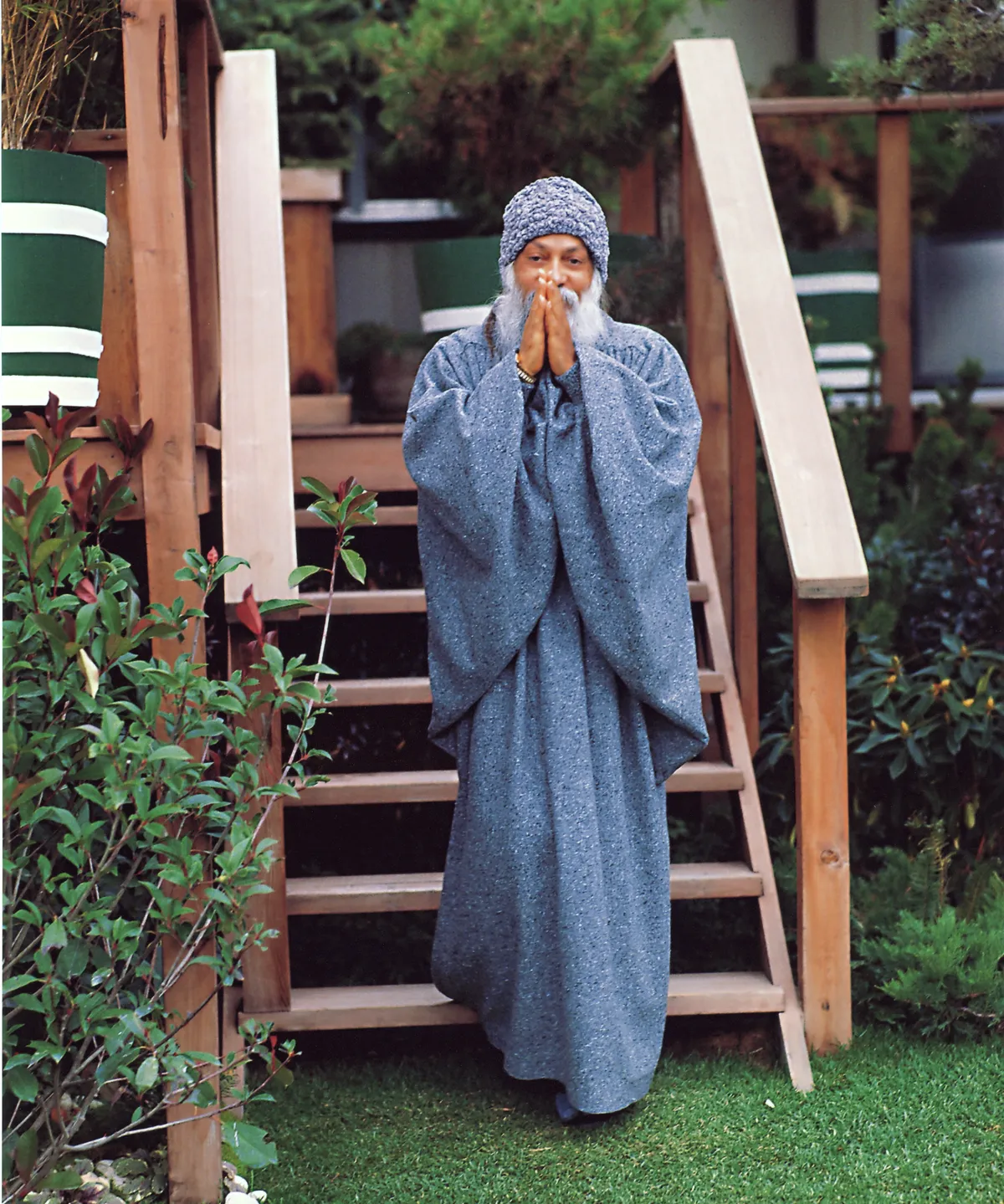
According to Osho, Vivek signifies the disciple closest to the master, bearing the heaviest responsibility and the sharpest transformative friction. By “killing her slowly,” he means dismantling the old ego so a new being can be reborn. Her proximity demands relentless “homework”—painful situations that integrate and mature consciousness. Thus, Vivek embodies crucifixion-as-transformation: growth is arduous, yet necessary for rebirth and deeper worthiness.
Vivek shows that being very close to a true teacher is tough work that breaks the old self so a wiser, new you can be born.
From the Discourses
Passages where Osho speaks to this question — each links to the complete discourse.
Chandrakirti is one of the greatest Buddhist philosophers. He is not only a philosopher but also a Buddha himself, part of that great chain that Buddha created, and one of the most important links in that chain. There are no traditions which have produced as many enlightened people as Buddhism. And Buddha's disciples have bloomed in such great numbers that it has never happened before or since. Jesus is lonely in that way; only once in a while an Eckhart or a Boehme or a Francis have attained. Jesus' disciples who have become enlightened can be counted on one's fingers; not so with Buddha -- thousands! He really created such a momentum for enlightenment in human consciousness, a tidal wave. Chandrakirti is one of those great disciples. Literally the name means chandra means moon and kirti means glory -- moon glory. That too is very significant.
It is like adopting a child. You can adopt a child and become a parent but in reality you are not the parent. To carry a child in the womb, to live with the child in a togetherness for nine months and then to suffer the pain of the birth of the child, the whole arduous journey of bringing up the child... that makes one a mother. You can simply go to an orphanage and adopt a child, but you have not suffered for it, you have not earned it. You will only be a mother for the name's sake. But motherhood is not possible this way. Motherhood cannot be borrowed -- it has to be attained. So is the case with wisdom: wisdom has to be attained. It is a pilgrimage into one's own being. Knowledge is adopted -- it is cheap.
Prem means love, bodhi means awareness, satva means in essence -- in essence, love and awareness. And this is the highest synthesis that is possible for human consciousness, the ultimate peak. There is nothing beyond it. There cannot be anything beyond it. It is very easy to be loving -- it is very difficult to be loving and aware. Vice versa is also true: it is easy to be aware but it is very difficult to be aware and still be loving. Loving needs as a requirement a kind of drunkenness. And love is extroversion -- you relate with the other; love is focussing on the other. Thou becomes more important than I. In love the arrow starts moving towards the other; in awareness the arrow starts moving inwards. The thou disappears and only I remains; it is introversion. Love is relating, communicating, communion; awareness is solitude, aloneness, meditation.
But for that moment to come, continue to be alone a little longer. And this is the criterion: if this mind of "I would like to be loved by others" continues then you still have to remain alone. One day this desire will disappear and another desire will take its place; that will be a transformation in you. From that moment onwards there is no need to be in seclusion; then start moving. You are no more dangerous; to others and to yourself you are no more dangerous. Your being alone has helped you. It has settled you -- it has made you calmer, quieter. Just a little more... a little patience. Veet means beyond, martyo means death. The really real within you is beyond death. The one that dies and is born is not your reality.
Veet means beyond, shankaro means conditionings. Man is born unconditioned, man is born as freedom... just an open sky, with no clouds, with no boundaries, with no adjectives, no definitions -- neither Hindu nor Christian nor Communist -- just pure existence, an emptiness. But immediately the society starts closing in on you, starts making boundaries; those boundaries are conditionings. Then one forgets one's original face. Slowly slowly one becomes identified with all that has been said, told, repeated again and again. This is a kind of hypnosis that is being practised on every child. It is a violation of the most fundamental human right, but it seems very difficult to know how to fight it because children themselves cannot fight it. Children's liberation is needed. It is the greatest need in the world because no other slavery is so deep and so dangerous and so destructive.