
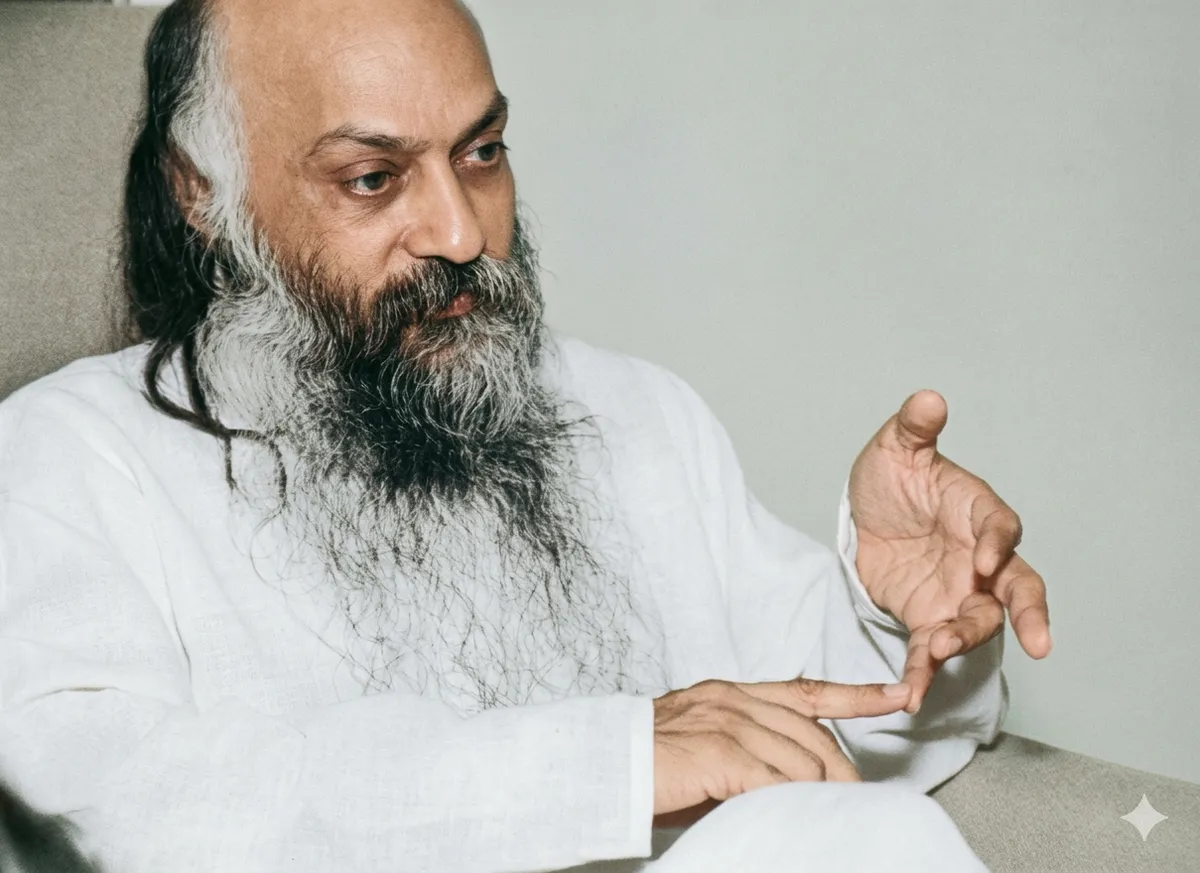
According to Osho, changing a sannyasin’s name severs identification with the past, inaugurating a new journey—like a symbolic cremation and rebirth—so the seeker is continually reminded to live from fresh awareness. The mala, with 108 beads, signifies the many meditation paths, and the large bead below represents the One they all reach, reminding humility, inclusivity, and constant remembrance of meditation.
A new name helps you drop your old story, and the mala reminds you there are many ways to meditate that all lead to the same truth.
From the Discourses
Passages where Osho speaks to this question — each links to the complete discourse.
Questioner: is there a special significance in changing one's name and wearing a mala given by you?
Yes, it has significance, great significance. The change of name has great significance for a sannyasin. It is an index, a symbol. Everything in our life is symbolic. You have a name; you are identified with this name. This name has become your symbol; it is identified with your individuality. Your name has an association with everything that you have been before yesterday. Changing the name of a sannyasin means we disconnect him from his old identity, from his old associations. We say to him, now you are not the same as you were before yesterday. Now you are starting on a new journey with a new name, a new identity. Since ancient times they have had a small ceremony at the time of one's initiation into sannyas. It is a kind of cremation ceremony. Exactly as we bathe a dead body and shave its head before putting it on…
Osho, do the mala and the renaming have any special significance?
Yes, they do; there is great meaning. Changing a sannyasin’s name has deep significance. It is symbolic. And in our lives, everything is symbolic. You have lived with one name; your identity is tied to it. A name has been your symbol. Your personality has become connected with it. Your name is associated with all that you were till yesterday; it is linked to that. The meaning of changing a sannyasin’s name is that we break him from his old identity. We say: now you are not who you were till yesterday. Now you set out on a new journey, carrying a new identity. In the old days, when initiation was given, they performed a small experiment. It was like this: just as we bathe a corpse before placing it on the bier, so they would bathe him. Just as we shave a corpse’s hair, shave the head, so they…
Question: OSHO, HOW DO YOU ALWAYS FIND NEW NAMES TO GIVE TO YOUR SANNYASINS? Hence I change the name -- to give you a break, to give you the idea that name is just a given thing. Your old name disappears, a new name becomes your reality, but now you will not get so much identified because you are now more mature. The first name was given when you were a small child; you were not aware. Now you are a little bit aware. And by becoming a sannyasin you are becoming committed to more and more awareness, to a life of witnessing in which all identities have to be dropped. A man is absolutely free only when there is no identity left.
Osho, you have said that sannyas is the realization of truth. Then are ochre robes and the mala also essential for sannyas? And can a person not walk on your path without initiation? Kindly guide.
The day before yesterday a friend asked—he has taken sannyas, a simple-hearted man—he asked, “What is the scientific reason for this mala?” How can a mala possibly have a scientific reason? Its reason is religious, inward—not scientific. I told him, “If you want something ‘scientific,’ ask Laxmi.” A scientific reason? Does love ever have a scientific reason? A young man fell in love with Mulla Nasruddin’s daughter. He came and said, “I am in love with your daughter; please permit me to marry her.” Mulla said, “First prove it—what is the cause of your love?” The young man replied, “There is no cause, sir! Love has happened. Where there is a cause, can there be love? Where there is a cause, there is business, a bargain. Love is causeless.” Your love has happened with me; mine with you. Now some symbol becomes necessary. Think of this mala as the seven…
We are brought up with such wrong notions: that one has to struggle for one's survival. We have been brought up with very poisoned ideologies. The idea of ambition keeps us in a state of constant tension; the idea of competition keeps us unrelaxed. And slowly slowly the tensions, the inner conflicts, the struggle outside and inside, is so much that it drives us crazy, mad. To be mad means that one has fallen very far away from the eternal harmony of existence. That's the definition of a madman: one who has completely forgotten that there is a way to enter into unity again, that one can be in a love affair with existence. There is no need to struggle, there is no need to go against the current -- one can go with it.