
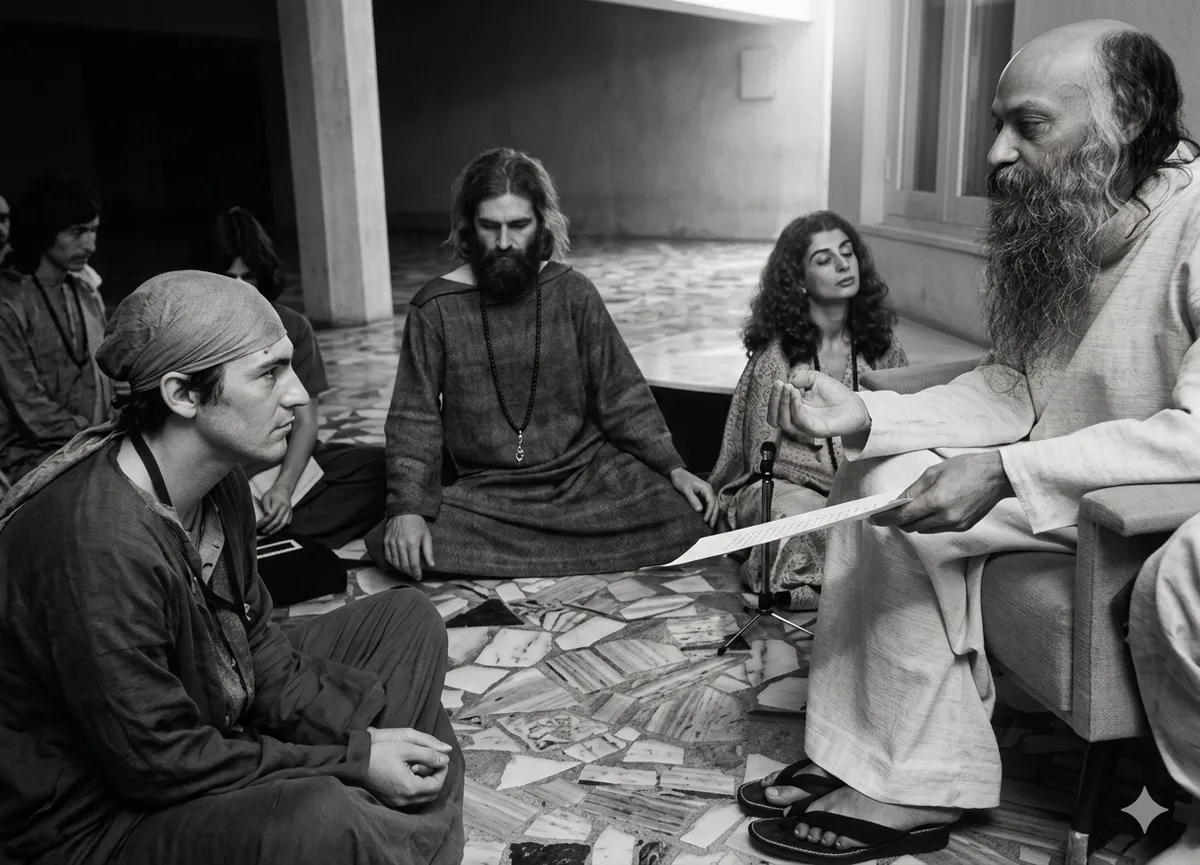
According to Osho, the right time for parenthood is neither in neurosis nor after enlightenment, but in the balanced middle—when you are mentally healthy, meditative, and a little aware. In this “twilight” state you can offer children unconditional love and a taste of awareness, rather than passing on your neurotic patterns; enlightened ones need not have children.
Have kids when you’re calm and aware enough to love without dumping your issues on them—not when you’re a mess, and not after you’ve outgrown worldly roles.
From the Discourses
Passages where Osho speaks to this question — each links to the complete discourse.
If enlightened beings don't have children, and we neurotic people are pronounced unfit for parenthood by you, when is the right time?
You go on unconsciously reproducing your own replicas. First think: are you in such a state that if you give birth to a child, you will be giving a gift to the world? Are you a blessing to the world, or a curse? And then think: are you ready to mother or to father a child? Are you ready to give love unconditionally? Because children come through you, but they don't belong to you. You can give your love to them, but you should not impose your ideas on them. You should not give your neurotic styles to them. Are you ready not to give your neurotic style to your children? Will you allow them to flower in their own way? Will you allow them freedom to be themselves? If you are ready, then it is okay. Otherwise, wait; become ready. With man, conscious evolution has entered into the world.…
Osho, if parents meditate before conception and during pregnancy, what effect does it have on the child?
And if, for the full nine months, the mother carries the child in meditation—does nothing contrary to meditation, and does everything that supports meditation—then certainly, in these nine months, a Buddha can be born. These nine months are the formative moments of the child. And in these nine months let him have only the experience of love, of peace, of light. If in these nine months he has only one experience—the experience of his own inner power—then at birth he will not be an ordinary child; he will be extraordinary. We will have laid the foundation of his life, and the temple that rises on that foundation cannot be different from it. Therefore whenever parents come to me with complaints about their children, I have told them: you may feel hurt, but you are responsible. You must have laid the wrong foundation. Today your child is a bandit; today your…
Beloved Osho, what is the right way to help a child grow without interfering in his natural potentiality?
The right way is not to help the child at all. If you have real courage then please don't help the child. Love him, nourish him. Let him do what he wants to do. Let him go where he wants to go. Your mind will be tempted again and again to interfere, and with good excuses. The mind is very clever in rationalizing: "If you don't interfere there may be danger; the child may fall into the well if you don't stop him." But I say to you, it is better to let him fall into the well than to help him and destroy him. It is a very rare possibility that the child falls into the well -- and then too, it does not mean death; he can be taken out of the well. And if you are really so concerned, the well can be covered; but don't help…
The German poet, Goethe, used to say again and again that man can tolerate only so much awareness; that's why every night he has to fall asleep and dream. The dreaming and the sleep help him to cope with reality again. Tomorrow he is awake, and again for a few hours he will be able to cope with reality. But this awakenedness is not much of awakenedness at all; it is again a kind of dream with open eyes. The awareness I am talking about is totally different. It is coming out of unconsciousness, coming out of the cell called the ego, coming out of your mechanical habits. It has to be slow; but it is happening, it will happen. And when it starts happening one becomes greedy, that I understand, because one wants to finish it soon, one wants to have the whole truth....
No painting has a beginning and no painting has an end. The beginning and the end are arbitrary: because we have to begin, we begin, and because we have to end, we end. Otherwise there is no beginning and no end to any painting. How can there be? You don't have any beginning, you don't have any end; everything is in the middle, always in the middle, and everything is incomplete. But remember, the incomplete paintings are far more beautiful than those which are thought to be completed. The incomplete songs are more beautiful than the ones which seem to be complete, because the incomplete thing has the quality of life. It still breathes because it is not complete. There is an ancient tradition in India that if you are going to make a great temple, never complete it. So all the great temples are incomplete.