
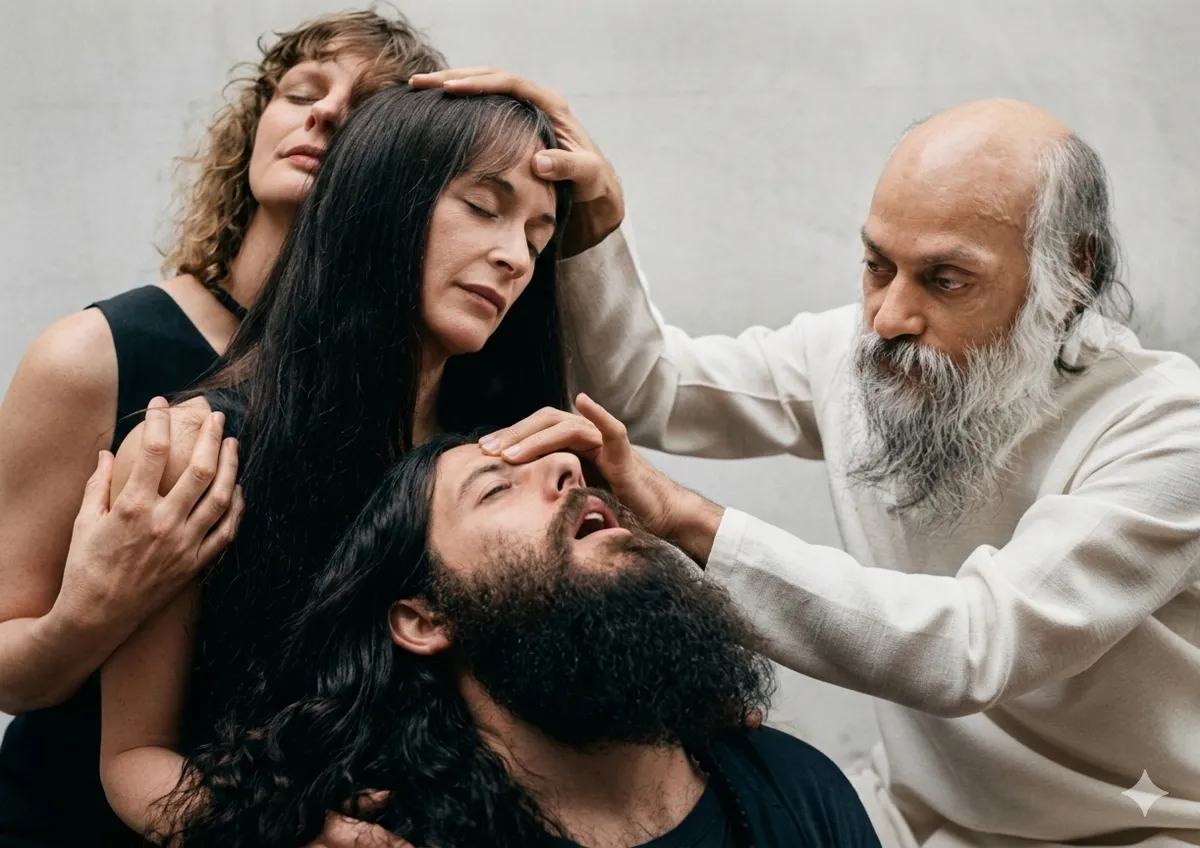
A liberated soul is like a quiet radio station you can still tune into if the signal (connection) is there; if the signal fades, you can’t.
From the Discourses
Passages where Osho speaks to this question — each links to the complete discourse.
Osho, in that timeless interval you have described what happens to the soul. But what is the soul’s disembodied form? Is it still or does it wander? How does it recognize other familiar souls? And is there any possibility of dialogue in that state?
Ask: in a dream are you still or moving? It is hard to say. Waking, you find you lay still in bed; yet within the dream there was great movement. Strictly speaking, even movement in dreams is not real. If you understand precisely, in dreams you are not a participant but only a witness. You can see yourself dying in a dream; you can see your own corpse. Even when you see yourself walking, what you see walking is only the dream; you remain the seer. Properly understood, in dream you are only the witness. Hence religion devised a maxim: one who comes to see the world as dream-like attains the supreme realization. Philosophies calling the world maya or dream arose for this reason: if we can see the world as a dream, we become the witness. In dreams there is never a participant; there is always a witness. You…
ओशो, उस समयातीत अंतराल में आत्मा पर क्या घटित होता है वह तो दर्शाया आपने, किंतु यह बात रह गई कि उस आत्मा का अशरीरी रूप क्या होता है? वह स्थिर होती है या विचरण करती है? और अपनी परिचित दूसरी आत्माओं को पहचानती कैसे है? और उस अवस्था में आपस में कोई डायलॉग की भी संभावना होती है?
अगर कोई आपसे पूछे कि स्वप्न में आप थिर होते हैं कि गतिमान होते हैं? तो कठिनाई होगी। स्वप्न में थिर होते हैं कि गतिमान होते हैं? स्वप्न से जाग कर तो यह अनुभव होता है कि अपनी जगह पर पड़े हुए हैं, थिर, स्वप्न के भीतर। लेकिन स्वप्न के बाहर आकर पता लगता है कि स्वप्न में तो बड़ी गति थी। स्वप्न में गति भी नहीं होती। अगर बहुत ठीक से समझें तो स्वप्न में आप भागीदार भी नहीं होते, बहुत गहरे में सिर्फ साक्षी होते हैं। इसलिए स्वप्न में अपने को मरता हुआ भी देख सकते हैं। स्वप्न में अपनी लाश को पड़े हुए भी देख सकते हैं। और स्वप्न में अगर आप अपने को चलता भी देखते हैं, तो भी जिसे आप चलता देखते हैं वह सिर्फ स्वप्न होता है, आप तो देखने वाले ही होते हैं। स्वप्न को अगर ठीक से समझें तो आप सिर्फ विटनेस होते हैं स्वप्न में। इसीलिए धर्म ने एक सूत्र खोज निकाला कि जो व्यक्ति जगत को स्वप्न-भांति देखने लगे, वह परम अनुभूति को उपलब्ध हो जाएगा। इसलिए जगत को माया और स्वप्न कहने वाली चिंतनाएं पैदा हुईं। …
Osho, do they have any separate entity now, in the liberated state?
They have no separate entity left. The moment moksha happens, no personality remains for a person. But we still have a personality, because we are not liberated; therefore, through certain methods—if we make use of them—answers can become available to us almost as though from a person. They have no personality left.
प्रश्न: ओशो, उनकी कोई सेप्रेट एंटाइटी इस समय है मुक्त अवस्था में?
उनकी कोई सेप्रेट एंटाइटी नहीं रह जाती। मोक्ष होते ही किसी व्यक्ति का कोई व्यक्तित्व नहीं रह जाता। लेकिन हमारा व्यक्तित्व है, जो हम अमुक्त हैं, इसलिए अगर इस तरह के उपाय हैं, जिनके हम उपाय करें, तो हमारे लिए करीब-करीब वे व्यक्ति की तरह उत्तर उपलब्ध हो सकते हैं। उनका कोई व्यक्तित्व नहीं रह गया है।
Osho, you have told us what happens to the soul during that timeless interval between two births. But some points remain unresolved, regarding the bodiless soul: in that bodiless state, does the soul remain stationary or can it move about? And how does it recognize other souls? In that state, is there any possibility of a dialogue between souls?
Sometimes different types of events may also happen, but these kinds of experiences will differ. Occasionally, it may so happen that souls which are neither stationary nor in movement will enter other bodies. But to say that the souls will enter is a linguistic fallacy. It would be better to say that some body may behave in such a way that it will cause a soul to enter into it. The world of such souls is not different from ours. That world exists also beside us, close by. We are all residing in the same world. Every inch of space that is here is filled with souls. The space right here which appears empty to us is also full. There are two types of bodies which are in a state of deep receptivity. One is of those that are in great fear. Those who are in great fear cause their…
In the realm of dharma, temples, mosques, gurudwaras, places of worship become important. The Gita, the Quran, the Bible become important. Satsang, listening to the truth, the company of the virtuous begins to taste sweet. A new veena starts humming. For the first time you sense that matter is not just matter; God is hidden in it. In every particle, you begin to get a little glimpse of him. Sometimes suddenly a window opens and you find that people are not ordinary; they are extraordinary. In everything—however ordinary—a great dignity is hidden. Everything is haloed. The world no longer feels alien; it is your home. Opposition drops, conflict fades, cooperation begins. The tone of a religious person’s life is cooperation. His language is no longer of conflict. Some cultures reach up to dharma. But the East does not stop there. It says: one step more—and that is moksha.
धर्म के जगत में मंदिर, मस्जिद, गुरुद्वारे, पूजागृह महत्वपूर्ण हो जाते हैं। गीता, कुरान, बाइबिल महत्वपूर्ण हो जाते हैं। सत्संग, सदवचनों का सुनना, सज्जनों का साथ रस देने लगता है। एक नई ही वीणा बजने लगती है। तुम पहली दफा अनुभव करते हो कि पदार्थ पदार्थ ही नहीं है, इसमें परमात्मा छिपा है। कण-कण में तुम्हें उसकी प्रतीति की थोड़ी-सी झलकें आनी शुरू हो जाती हैं। कभी-कभी अचानक वातायन खुल जाता है और तुम पाते हो कि लोग साधारण नहीं हैं, असाधारण हैं। यहां प्रत्येक वस्तु में, वह कितनी ही साधारण हो, बड़ी असाधारण गरिमा छिपी है। प्रत्येक वस्तु एक आभा से मंडित हो जाती है, एक गरिमा व्याप्त हो जाती है। यह जगत तुम्हें ऐसा नहीं लगता कि तुम किसी अजनबी जगह हो, यह तुम्हारा घर है। विरोध छूटता है, संघर्ष मिटता है, सहयोग शुरू होता है।
A friend has asked: Osho, if in the mother’s womb man and woman create the opportunity for a soul to be born, does that mean souls are separate and there is no all-pervading Soul? He also asked: I have said many times that truth is one, God is one, the soul is one—then don’t these two statements seem contradictory, opposed?
These two statements are not opposed. The Divine is one; in truth the soul is one. But bodies are of two kinds. One is what we call the gross body, which we can see; the other is the subtle body, which we cannot see. When death happens, the gross body falls away, but the subtle body does not die. The soul abides within two bodies, a subtle body and a gross body. At death the gross body drops. This body made of earth and water, of bone, flesh and marrow, falls. What remains is an extremely subtle body—of thoughts, subtle sensations, subtle vibrations, subtle filaments. That filament-woven body begins the journey again with the soul and takes birth anew by entering a new gross body. When a new soul enters a mother’s womb, it means the subtle body has entered. At ordinary death only the gross body falls, not the…
एक मित्र ने पूछा है कि ओशो, यदि मां के पेट में, पुरुष और स्त्री, आत्मा के जन्मने के लिए अवसर पैदा करते हैं, तो इसका अर्थ यह हुआ कि आत्माएं अलग-अलग हैं और सर्वव्यापी आत्मा नहीं है? उन्होंने यह भी पूछा है कि मैंने तो बहुत बार कहा है कि एक ही है सत्य, एक ही परमात्मा है, एक ही आत्मा है, फिर ये दोनों बातें तो कंट्राडिक्टरी, विरोधी मालूम पड़ती हैं!
ये दोनों बातें विरोधी नहीं हैं। परमात्मा तो एक ही है, आत्मा तो वस्तुतः एक ही है, लेकिन शरीर दो प्रकार के हैं। एक शरीर जिसे हम स्थूल शरीर कहते हैं, जो हमें दिखाई पड़ता है; एक शरीर जो सूक्ष्म शरीर है, जो हमें दिखाई नहीं पड़ता है। एक शरीर की जब मृत्यु होती है, तो स्थूल शरीर तो गिर जाता है, लेकिन जो सूक्ष्म शरीर है, वह जो सटल बॉडी है, वह नहीं मरती है। आत्मा दो शरीरों के भीतर वास कर रही है, एक सूक्ष्म शरीर और एक स्थूल शरीर। मृत्यु के समय स्थूल शरीर गिर जाता है। यह जो मिट्टी-पानी से बना हुआ शरीर है, यह जो हड्डी-मांस-मज्जा की देह है, यह गिर जाती है। फिर अत्यंत सूक्ष्म विचारों का, सूक्ष्म संवेदनाओं का, सूक्ष्म वायब्रेशंस का शरीर शेष रह जाता है, सूक्ष्म तंतुओं का। वह तंतुओं से घिरा हुआ शरीर आत्मा के साथ फिर यात्रा शुरू करता है और नया जन्म फिर नए स्थूल शरीर में प्रवेश करता है। जब एक मां के पेट में नई आत्मा का प्रवेश होता है, तो उसका अर्थ है सूक्ष्म शरीर का प्रवेश।