
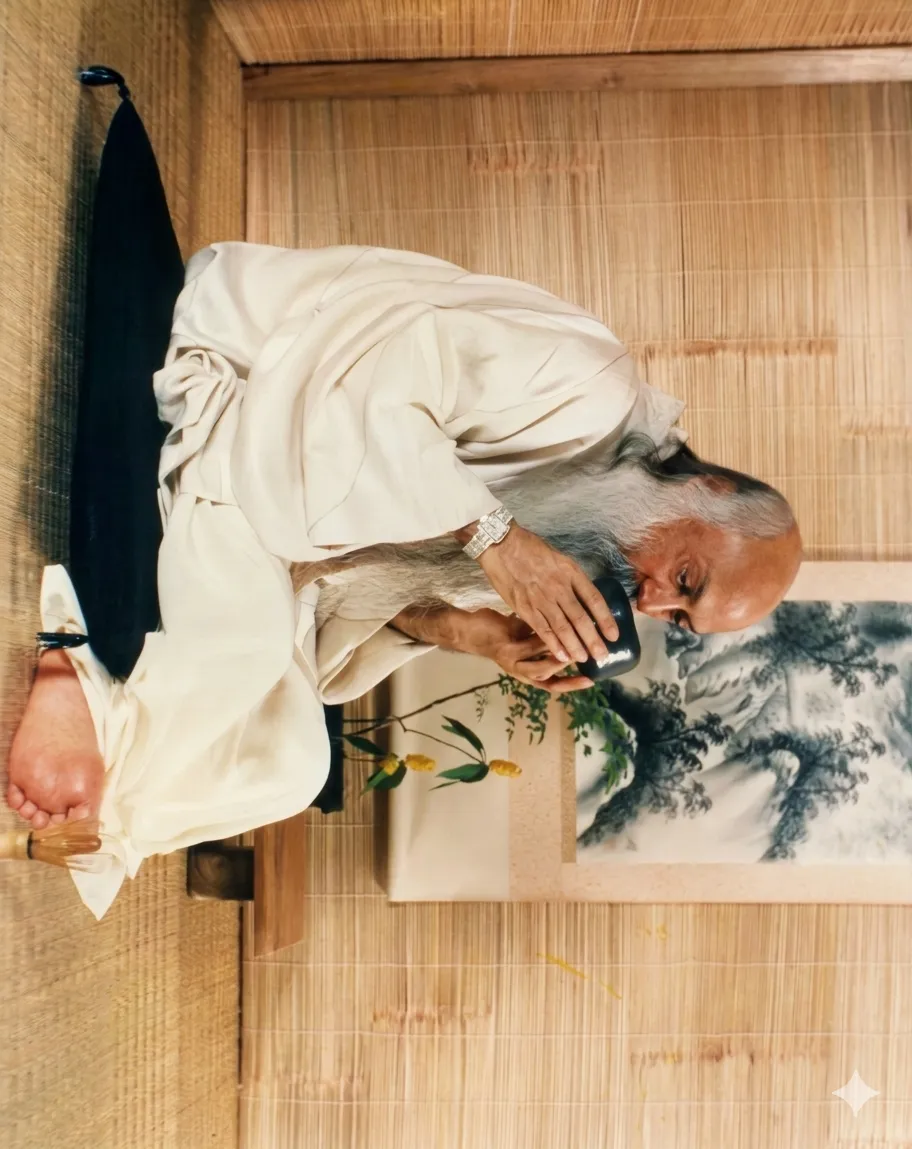
The world won’t improve by itself; only awakened people nudge it a little—so real change is you waking up.
From the Discourses
Passages where Osho speaks to this question — each links to the complete discourse.
On man's path of evolution is it possible that at some time in the future humanity as a whole can attain enlightenment? At what point of evolution is man today?
The conscious choice to evolve is a great adventure, the only adventure there is for a human being. The path is arduous; it is bound to be so. Errors are bound to be there, failures, because nothing is certain. This situation creates tension in the mind. You do not know where you are, you do not know where you are going. Your identity is lost. The situation may even reach such a point that you become suicidal. Suicide is a human phenomenon; it comes with human choice. Animals cannot commit suicide, because to choose death consciously is impossible for them. Birth is unconscious, death is unconscious. But with man -- ignorant man, unevolved man -- one thing becomes possible: the ability to choose death. Your birth is not your choice. As far as your birth is concerned, you are in the hands of unconscious evolution. In fact, your birth is…
Beloved Osho, from your talks I understand that there is some kind of evolutionary process that happens. But I have also heard you say that man has not evolved at all. Where are all the seekers who died enlightened?
Man as a collectivity has not evolved. Whatever little bit of humanity has happened to the collective mass is because of those few seekers who became enlightened. But you should understand the proportion. It is like a spoonful of sugar you drop in the ocean to make it sweet; it is not going to do much to the ocean. The ocean is too vast. A spoonful of sugar was perfectly good for a cup of tea, but it is not good for the ocean. An enlightened man is a cup of tea. Even his group -- those who become attuned with him -- are still so small that they cannot make much change in the collective mass, in its vast darkness, unconsciousness. But in thousands of years so many people have become enlightened that a little bit of change in humanity you can see. But the credit does not go…
Many western historians feel that humanity is constantly making progress. If this is the case, then how is it that human consciousness is so unevolved?
Mark and Luke are contradictory because they are writing history. But Tulsidas and Valmiki are not contradictory. They are not writing history, they are not concerned with history at all. They are reliving, in their imaginations. They say, "We cannot say much. We cannot say enough because we are not capable. All that is said is only a fragment. It is not the whole story." If you yourself see Krishna, you will see something else altogether. But you are at liberty to see it because the event is not historical. So the life of Krishna or of Ram, becomes very rich. Jesus' recorded life was very poor because his followers were obsessed with history. They could not write anything that was beyond history. The eastern mind could see that we cannot do justice to Krishna or Buddha if we limit ourselves to bare events. This will be an injustice because…
Osho, man's partial consciousness is a stage in the grand evolution of life. What could be the significance of his volitional efforts in its growth? Please also explain the role that the buddhas, the enlightened ones, play in the expansion of human consciousness.
Of course, obviously, a Buddha knows less than you, but that doesn't mean that you are more grown-up. A Jesus knows less than you. He knows less than any Catholic priest because he was never trained, never educated. He was just a carpenter's son -- uneducated, with no information of the world; but still, you are not more evolved than him. A Mohammed is just illiterate, a Kabir is just a nobody -- but they are more evolved. But then that evolution is something else: an evolution of consciousness, not just of things. You can substitute having for being. Being is a different dimension of growth -- a vertical one; having is horizontal. Things go on and on, and you have so many things -- so much information, so much knowledge, so much wealth, so many degrees, so many honours. But this is accumulation: it is horizontal. There is no…
Question: BELOVED OSHO, I HAVE JUST READ AN ARTICLE BY STEPHEN JAY GOULD, A WARM, AMUSING, OPEN-MINDED SCIENTIST WHOSE FIELD IS BIOLOGY, AND PARTICULARLY EVOLUTION. IT SEEMS PROBABLE THAT ABOUT FIVE TO EIGHT MILLION YEARS AGO THE CHIMP-HUMAN ANCESTRAL LINE SPLIT INTO WHAT WAS TO BECOME MODERN CHIMP AND MODERN MAN. Homo Erectus APPEARED ABOUT A MILLION OR SO YEARS AGO. THE INTEREST IN ALL THIS IS THAT IF TRUE, IT MEANS THAT MAN LEARNED TO STAND UP VERY FAST IN EVOLUTIONARY TERMS -- OVER ONLY ABOUT A MILLION YEARS. ELSEWHERE, IN TRYING TO EXPLAIN MISSING FOSSILS IT HAS BEEN SUGGESTED THAT EVOLUTION IS NOT NECESSARILY SLOW, BUT MAY OCCUR IN SUDDEN LEAPS. WHEN I THINK OF AN IMAGINARY CONVERSATION BETWEEN PRE-CHIMP AND PRE-HUMAN, AS THEY PARTED COMPANY SO LONG AGO, I THINK OF YOU TALKING TO MANKIND.