
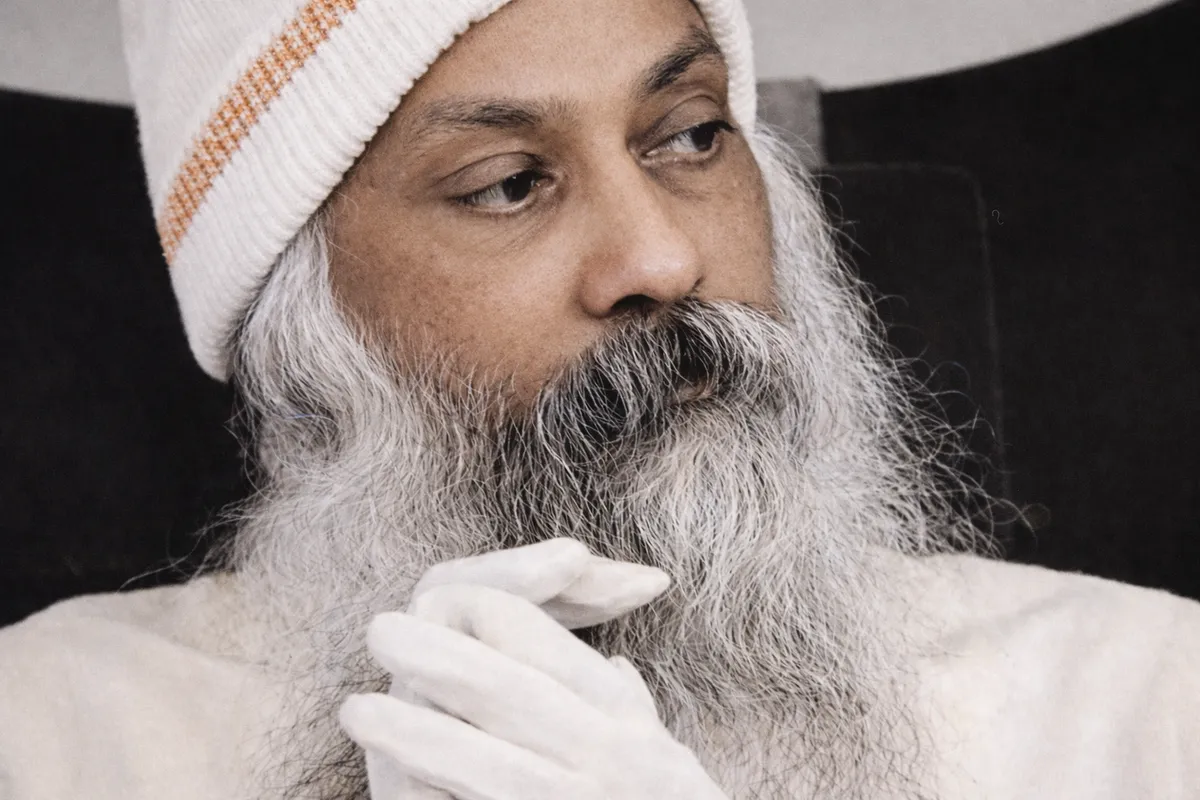
When you totally relax, a quiet, clear watching appears—and this relaxing and watching support each other to make life deeper and happier.
From the Discourses
Passages where Osho speaks to this question — each links to the complete discourse.
Osho: would you please say something about the relationship between spontaneity and working on oneself? Shouldn't we be loving as much as we can? If there are certain things to do or ways to be to increase our capacity for joy, shouldn't we do them? Shouldn't we let our egos drop? Many good men have written that love can begin as an impulse of the will, and trying to be spontaneous seems to be a contradiction. Would you comment on this?
You have forgotten what real love is. You fall in love with the color of the hair -- now, what has that to do with love? After two days you will not look at the color of the hair at all. Or you fall in love with a certain shape of nose or a certain kind of eyes, but after the honeymoon these things are just boring! And then you have to go on managing somehow, pretending, cheating. Your spontaneity has been corrupted and poisoned, otherwise you would not fall in love with parts. But you only fall in love with parts. If somebody asks you, 'Why do you love this woman or this man?" your answer will be, "Because she looks so beautiful," or, "Because of her nose, eyes, proportion of the body, this and that" -- and all this is nonsense! Then this love cannot be very deep…
Someone has asked, “Is there an inner relationship between shraddha and witnessing?”
Certainly. Shraddha is the door; the witness—the image enthroned in the temple. Without shraddha no one has ever reached the witness, nor reached truth. Without shraddha you can be a pundit, not a knower. Without shraddha you can be a believer, not one who has experienced. So there are two kinds of wanderers in the world. One we call atheists; the other we call theists. Both wander. Both are filled with belief—one for, one against. Neither the atheist knows that God is, nor the theist knows that God is. That is why I place the religious apart from both; he is neither atheist nor theist. He has slowly attempted to see. Your notions are not needed at all for seeing. Your notions become obstacles; your prejudices bring hindrances. You set out having assumed something in advance; because of that, seeing does not remain pure. If you have already assumed, you…
पूछा है, ‘श्रद्धा और साक्षित्व में कोई आंतरिक संबंध है?’
निश्चित ही। श्रद्धा द्वार है; साक्षी--मंदिर में विराजमान प्रतिमा। श्रद्धा के बिना कोई कभी साक्षी तक नहीं पहुंचा, न सत्य तक पहुंचा है। श्रद्धा के बिना तुम पंडित हो सकते हो, ज्ञानी नहीं। श्रद्धा के बिना तुम विश्वासी हो सकते हो, अनुभवी नहीं। तो दुनिया में दो तरह के भटकते हुए लोग हैं। एक, जिनको हम नास्तिक कहते हैं; एक, जिनको हम आस्तिक कहते हैं। दोनों भटकते हैं। दोनों विश्वास से भरे हैं--एक पक्ष में, एक विपक्ष में। न नास्तिक को पता है कि ईश्वर है, न आस्तिक को पता है कि ईश्वर है। इसलिए मैं धार्मिक को दोनों से अलग रखता हूं; वह तो न नास्तिक है, न आस्तिक है। उसने तो धीरे-धीरे देखने की चेष्टा की। तुम्हारी धारणाओं की कोई जरूरत ही नहीं है देखने में। तुम्हारी धारणाएं बाधा बनती हैं, तुम्हारे पक्षपात अड़चन लाते हैं। तुम कुछ मान कर चल पड़ते हो, उसके कारण ही देखना शुद्ध नहीं रह जाता।
Osho, in Ashtavakra’s entire scripture there is no mention of love anywhere. But in your Mahageeta, alongside the witness there is always a stream of love flowing. Why is that? Is there an inner relationship between witnessing and love?
Certainly. Love is the music of the witness. Love is the fragrance of witnessing. Only when one becomes a witness does love begin to shower. And certainly Ashtavakra did not speak of this love—deliberately. Knowing well that what you call love, you might mistakenly take to be the same. So Ashtavakra spoke of witnessing and left love aside. He spoke of the seed and the tree, and left the fruit out—the fruit will come. You sow the seed, tend the tree, water it, keep gardening—the fruit will come. When it comes, it comes; why talk about it beforehand? Deliberately he left love aside because there has always been a danger in speaking of love: you also believe you love; you have known a certain kind of love. Hearing the word “love,” you might assume your love and Ashtavakra’s love are the same. To save you from this danger, Ashtavakra kept…
दूसरा प्रश्न: ओशो, अष्टावक्र की पूरी संहिता में कहीं भी प्रेम का जिक्र नहीं है। लेकिन आपकी महागीता में साक्षी के साथ सदा प्रेम की धारा बहती मिलेगी। ऐसा क्यों? क्या साक्षी और प्रेम के बीच कोई आंतरिक संबंध है?
निश्चित ही। प्रेम है साक्षी का संगीत। प्रेम है साक्षी की सुवास। जब कोई साक्षी हो जाता है तो ही प्रेम झरता है। निश्चित ही अष्टावक्र ने इस प्रेम की कोई बात नहीं की-- जानकर। यह जानकर कि तुम जिसे प्रेम कहते हो, कहीं तुम भूल से उसी को न समझ लो। इसलिए अष्टावक्र ने साक्षी की बात कही, प्रेम की बात छोड़ दी। बीज की बात कही, वृक्ष की बात कही, फल की बात छोड़ दी--फल तो आएगा। तुम बीज बोओ, वृक्ष संभालो, पानी दो, बागवानी करते रहो, फल तो आएगा। जब आएगा तब आ जाएगा, उसकी क्या बात करनी है। इसलिए जानकर अष्टावक्र ने प्रेम की बात छोड़ दी। …
Osho does witnessing always bring joy? The moments that I call witnessing sometimes feel distant -- almost cold in their neutrality. Other times it is like sprouting wings and soaring in joy over the open sea.
THE STATE OF WITNESSING IS NEITHER COLD NOR hot. It is neither happiness nor unhappiness. It is neither dark nor light. It is neither life nor death. The Upanishads say NETI NETI -- neither this nor that. If you feel joy you have already become identified; witnessing is gone. If you feel sad you are no more a witness; you have forgotten witnessing, you have become involved. You are colored by your psychology of the moment. Joy, sadness, all these qualities, are part of your psychology. And witnessing is a transcendence; it is not psychological. The whole art of meditation consists in witnessing. Then what does it bring? At the most we can say it brings total peace; it simply brings eternal silence. You cannot define it as joy. The moment you define it as joy you have fallen into the world of duality again. Then you have become part…
Osho, witnessing and absorption appear mutually opposed. Are they really opposed?
And if you begin with absorption, at first it feels, “I am becoming absorbed. Ah, how I am descending into rapture!” But so long as the I is there, what absorption is there? You are only persuading yourself. The I will return again and again. Slowly, as absorption deepens, the I melts. Then absorption remains—you are drowned, but there is no one left who is drowned. The I-sense is gone. And where the I-sense is gone, witnessing is born; it cannot but be. Therefore, Jagdish Dave, choose one of the two and start. And remember, this is not an intellectual question; it is existential. The secret opens only through experience; it has always opened that way. Say what you like, explain as you wish—this is not a matter of explanation. Choose whichever is dear to you. Know yourself a little; observe your inclinations, your temperament. And whichever attracts you… If…
ओशो, साक्षीभाव और लीनता परस्पर-विरोधी दिखाई देते हैं। क्या वे सचमुच विरोधी हैं?
और अगर तल्लीनता से शुरू करोगे तो पहले ऐसा लगेगा, मैं तल्लीन हो रहा हूं। अहा, कैसी तल्लीनता में उतर रहा हूं मैं! शुरू-शुरू में लगेगा मैं तल्लीन हो रहा हूं; लेकिन जब तक मैं है, क्या खाक तल्लीन हो रहे हो! भुला रहे हो अपने को, समझा रहे हो अपने को। लेकिन मैं लौट-लौट आएगा। धीरे-धीरे जैसे तल्लीनता बढ़ेगी, मैं पिघलेगा। फिर तल्लीनता रह जाएगी। डूबे तो रहोगे, लेकिन कोई बचेगा नहीं जो डूबा है। मैं-भाव गया। और जहां मैं-भाव गया वहां साक्षी पैदा हो जाता है, साक्षी बच नहीं सकता। इसलिए जगदीश दवे, दो में से कोई एक चुन कर चल पड़ो। और खयाल रखो, यह प्रश्र्न बौद्धिक नहीं है, यह प्रश्र्न अस्तित्वगत है। अनुभव से ही राज खुलेगा, अनुभव से ही खुलता रहा है। कितना ही कहो, कितना ही समझाओ, कहने और समझाने की बातें नहीं हैं। दो में से कोई एक चुन लो, जो प्रीतिकर लगे। अपने को पहचानो थोड़ा; अपने लगाव, अपने रुझान परखो थोड़ा। और जो प्रीतिकर लगे...। …