
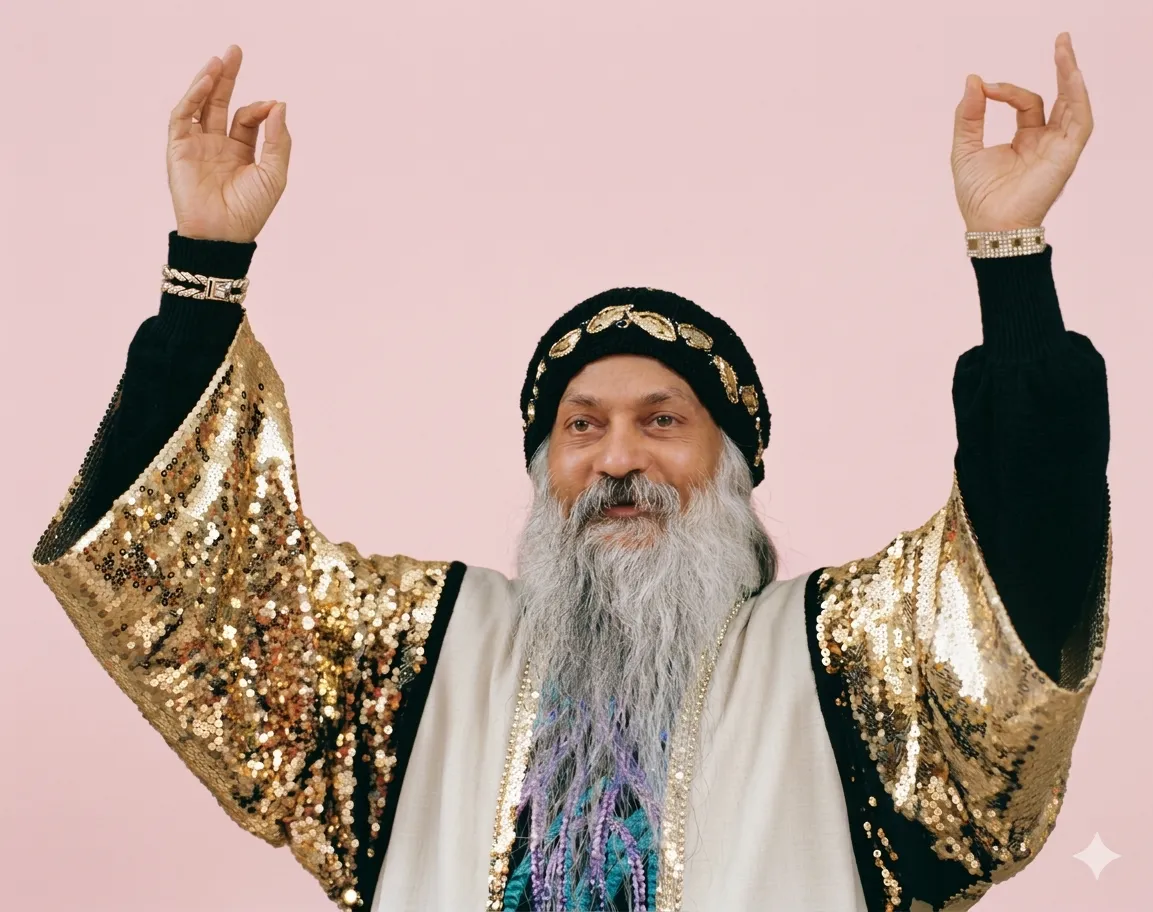
Enlightenment is waking up to who you are inside, not collecting science facts about the world outside.
From the Discourses
Passages where Osho speaks to this question — each links to the complete discourse.
Beloved Osho, socrates said, "all I know is that I know nothing." you say, "to know yourself is to know everything." I want to know what enlightenment has to do with knowing anything?
First, enlightenment has nothing to do with knowing anything. It is pure knowing; there is no object of that knowing. It is pure loving; there is no object as your beloved. It is pure rejoicing. Remember, enlightenment is a freedom from duality -- from the other, whatever the context may be. It is a clarity -- not that you are trying to know something, you are simply cleaning your glasses. You are trying to make your eyes perfect. You may know many things along the way, but that is never the goal. Socrates says, "I know only one thing, that I know nothing," but he knows at least one thing: that he knows nothing. His knowing is clear, absolutely clear. There is no object, but the clarity is there. I say, "To know oneself is to know everything." It is not different from what Socrates is saying, just a different…
The appreciation of objects and subjects is the same for an enlightened as for an unenlightened person. The former has one greatness: he remains in the subjective mood, not lost in things.
BELIEVE OMNISCIENT, OMNIPOTENT, PERVADING. So nothing is attracting you -- YOU get attracted. Be alert and the bridge will be broken and you will regain balance inside. Go on doing it more and more. The more you do, the better. And a moment will come when you will not need to do it because the inner power will give you such a strength that the attraction of things will be lost. It is your weakness which is attracted. Be more powerful and nothing will attract you. Only then for the first time are you master of your own being. That will give you real freedom. No political freedom, no economic freedom, no social freedom, can be of much help. Not that they are not desirable, they are good, good in themselves, but they will not give you the things which the innermost core of your being is longing for --…
Osho, what is the most significant thing about enlightenment?
People want definite answers to believe in: this way or that. Either be a Catholic or be a communist, but be clear. People want clarity because they are so confused, and this man brings all these seven categories; now their confusion is worse, they are even more confounded. First you were at least aware that you were confused. Now you will not be aware to which category you belong: yes, no, yes -- no both, neither yes nor no, or indescribable. Mahavira could not create a world religion for the simple reason that perhaps he had the deepest penetration into reality. If you ask about his enlightenment, he will answer in seven sentences. You will not be able to come to any conclusion -- and I feel this is something tremendously valuable. Why this urge to come to a conclusion? If existence is a continuum, an ongoing process -- never…
You have said that enlightenment is always total, never partial. Still you compare your state of no-mind with an orchestra while that of krishnamurti is compared with that of a single flute player. Has not the enlightened one access to all knowledge? Why that tunnel vision of krishnamurti?
I see the whole sky, all the stars, all the constellations; my vision is bound to be the most poetic. But the deeper you go into poetry, the less and less logical it becomes. The deeper you go into poetry, it becomes more and more love-like and less and less like logic. At the very rock bottom of poetry, all clarity disappears. Nothing is clear, but everything is beautiful, everything is mysterious. Nothing is clear but everything is simply fantastic. Krishnamurti has his way, and I am happy that he is in the world. He is at the other extreme. If he is gone, I will miss him more than anybody else in the world. But I can understand your question, Henk Faassen. This is not the only question; you have asked many more about the same thing. It seems it has hurt you deeply that I criticized Krishnamurti. You…
How is it that people who are not enlightened can talk with such apparent inside knowledge and so convincingly about the whole business?
Precisely because of that. Not knowing, they don't hesitate; not knowing, they have nothing to say really, so they can go on spinning; not knowing, they can use language more perfectly. If you know, language is always a barrier; rather than a help it is a hindrance. When you know, you have to be constantly aware because whatsoever you are saying is not that which you know -- there is great distance between the two. Sometimes that which you say goes directly opposite to that which you know. A blind man can talk very easily about light, there is no problem. He has no experience to put into words. Words are empty, so he can go on throwing them out. Of course, he can talk only to another blind man -- no man with eyes will be deceived. People who are not enlightened can go on talking to people who…