
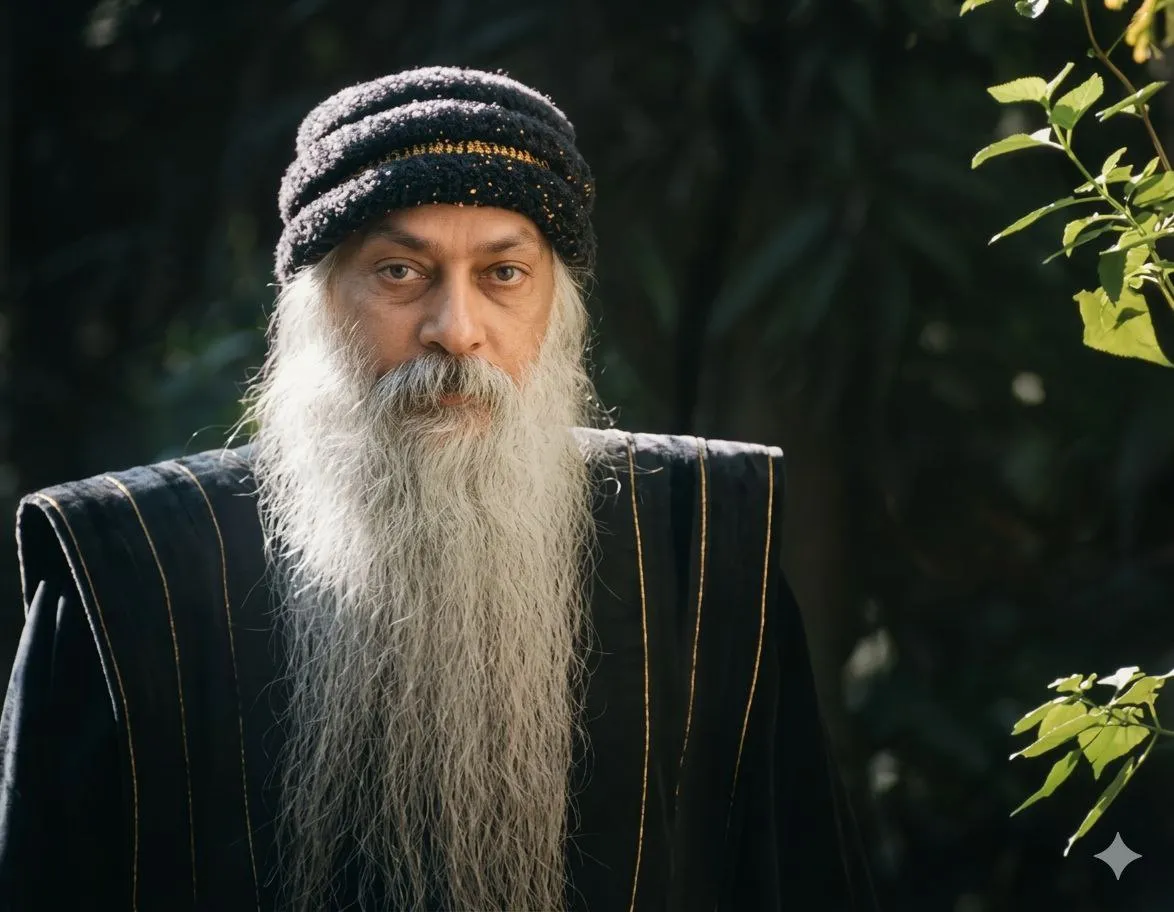
Until you're fully awake, pick peace and truth like using a walking stick; when awake, you just see the path and walk without choosing sides.
From the Discourses
Passages where Osho speaks to this question — each links to the complete discourse.
Beloved Osho, if enlightenment means to be beyond all dualities, not choosing, then why are you against wars, politics and other stupidities of mankind?
Yes, enlightenment means choicelessness -- but you are not enlightened yet. For me there is no choice. If the third world war comes, I will be just the same as I am. If the whole world is destroyed, it won't change anything in me -- neither my bliss, nor my peace, nor my love. But for you.... Because you are not enlightened, I have been talking against wars, against superstitions, against stupidities. I am not speaking to myself -- do you think I am crazy? -- I am talking to you. And for you there is at every step a choice. Till you come to the moment of enlightenment and choicelessness, you will have to choose; before that there is no other way. It is just as a blind man carries a stick in his hand, groping for his way. But if his eyes are cured, will he still grope…
Osho, the world is duality; all the laws of the world stand upon opposites. Then why are we instructed to be beyond duality? Are we outside the world?
You are not—but you can be. And no one is preaching to you to be outside the world. You yourself come asking, “I am surrounded by duality, there is great restlessness—what should I do?” If you remain in duality, restlessness will remain, because wherever there are two, there will be conflict. There is an old saying: where there are pots, there will be some clatter. Until only one remains, peace is not possible. No one is telling you, “Become beyond duality.” You come asking, “The mind is disturbed, tormented, unhappy—what should I do?” You ask; therefore I say: you are unhappy because you are still with two. Somehow the One has to be found. Find the One and the unrest will vanish. That is why Mahavira gave liberation the name kaivalya. He chose a very beautiful word. Kaivalya means utterly alone—only you, no other. Consciousness alone remains. Then with whom…
Osho, the play-acting I have to do for security—should I keep doing it or drop it? And now even the acting itself seems to be abandoning me. Please guide me to the right path.
The whole of life is a play—of relationships, of the marketplace, of the household. Life is acting. Where will you leave it and go? Where can you run? Wherever you go, there again you will have to enact some drama. So I am not in favor of escapism. Become a skillful actor. Do not run away. Act knowingly, not in unconsciousness; act with awareness. Awareness has to be cultivated. A thousand tasks will have to be done—and perhaps they are necessary. But doing them with awareness is essential. Slowly you will find that life is no longer “life” as you knew it; it has become sheer play, and you have become an actor. To be an actor means that there is a great distance between you and what you do. For example, someone who plays Rama in the Ramleela performs the role completely—perhaps better than Rama himself, because Rama never…
The one who has asked wants to know: when the supreme union is experienced, do the two poles of duality merge, or does one go beyond both dualities?
Both statements are the same. Where dualities meet, they cut each other off. As when debit and credit are brought together, both are canceled. Where the two opposites meet, their energies negate one another and duality becomes zero. That very zero-ness is the going-beyond; that is transcendence; that is where one crosses over. So long as you are attached to life, there will be fear of death. If attachment to life drops, the fear of death drops in the same instant. Where there is no clinging to life and no fear of death, you have crossed. You have reached the place where there is no duality. Yet even when we speak of God, the duality of our language intrudes. We say, “God is light.” We hesitate to say, “God is darkness,” because our craving manufactures our words. We want God to be light, so we discard the dark. We say,…
Question: ON THE SEA OF DEATH AND LIFE, THE DIVER'S BOAT IS FREIGHTED WITH "IS" AND "IS NOT". BUT IF THE BOTTOM IS BROKEN THROUGH, "IS AND "IS NOT" DISAPPEAR. THE MIND CANNOT BECOME THE BUDDHA; THE BODY CANNOT BECOME THE BUDDHA; ONLY WHAT CANNOT BECOME THE BUDDHA CAN BECOME THE BUDDHA. AS LIGHTNING WHICH DISAPPEARS LIKE DEW, WHICH VANISHES LIKE A PHANTOM -- THUS THINK OF YOURSELF. A MIND TO SEARCH ELSEWHERE FOR THE BUDDHA IS THE FOOLISHNESS IN THE VERY CENTER OF FOOLISHNESS. THE DEW ON THE LOTUS LEAF UNDYED BY ITS COLOUR, JUST AS IT IS, IS THE REAL FORM OF BUDDHA. To understand life, this is one of the very fundamentals to see, that each thing implies its opposite and each thing automatically turns into its opposite.