
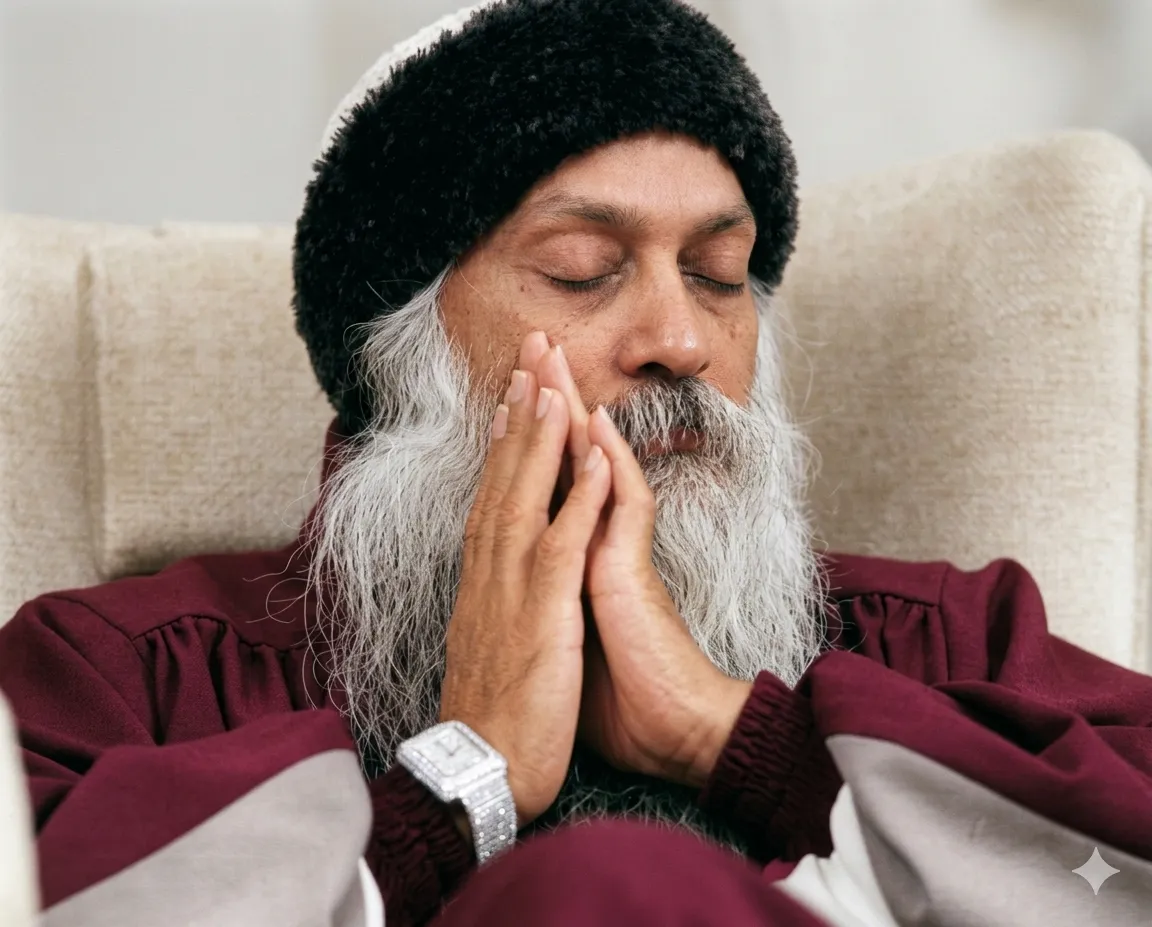
According to Osho, meditation is a device, not the destination: it dissolves inner repression and fear so that awareness can awaken. Awareness is the flowering; once it is alive, prescribed meditation is no longer needed. Forcing others to meditate is ego; honesty about one’s fear is already the beginning of meditation, and through such authenticity understanding ripens into awareness.
Meditation cleans the mess inside so your inner light (awareness) can shine; once it’s bright, you don’t need to keep scrubbing.
From the Discourses
Passages where Osho speaks to this question — each links to the complete discourse.
I am not saying to do anything. Meditation is not a doing at all, it is pure awareness. But a miracle happens, the greatest miracle in life. If you go on watching, tremendous and incredible things start happening. Your body becomes graceful, your body is no more restless, tense; your body starts becoming light, unburdened; you can see great weights, mountainous weights, falling from your body. Your body starts becoming pure of all kinds of toxins and poisons. You will see your mind is no more as active as before; its activity starts becoming less and less and gaps arise, gaps in which there are no thoughts. Those gaps are the most beautiful experiences because through those gaps you start seeing things as they are without any interference of the mind. Slowly slowly your moods start disappearing. You are no more very joyous and no more very sad.
Osho, you say that if there is awareness, then how are the two to be brought into harmony?
That is precisely the practice of active meditation: awareness. Awareness is the very means of going into emptiness in relation to all actions, to the movements of the mind as well. For example, if you lie there for half an hour—what will you do? In that half hour, whatever thoughts are moving in your mind, you are to be simply aware of them. Simply a witness—what else will you do? Just become a witness. Keep silently watching; let them move. But obstacles arise in our seeing. We become absorbed. We fail to remain a witness. We don’t even notice when we have become one with those very thoughts. That sense of awareness fades; a kind of stupor, a moorchha, comes in. A thought comes, a memory arises, and we stop being the watcher. We become part of that thought and of its flow. That is moorchha. And the opposite is…
[Meditation is a mother; through it you are reborn. And that is the meaning of her original name, Renate, Osho told the next person.] Meditation is synonymous with awareness. The English word 'meditation' gives a slightly wrong idea. The eastern word for it is "dhyana". Out of dhyana in China it became chana and in Japan it became Zen, but the root is dhyana. In English there is no real equivalent; the word that comes closest to it is meditation -- but something is missing in it because whenever you say meditation it gives you the idea of meditating on something. One immediately asks "On what to meditate?" Now that question cannot be asked about dhyana. "Dhyana simply means a state of mind where there is nothing to meditate upon, a state of consciousness without content, a contentless consciousness.
Meditation means becoming so aware, so intensely aware, now, this very moment, that all these stupidities are seen as stupidities, and the moment you see something as false you are free of it. Not only that, there is even more danger for the vested interests, for the establishment; the person who has come to know the false as the false and the true as the true does not remain hidden. He cannot remain hidden. He has to share his experience. He has to spread his fire. And that fire can burn all the temples and all the churches and all the mosques. The meditative person will not be Christian, will not be Hindu, will not be Buddhist, will not be Mohammedan. He will simply be human. Hence the Christians will be against him, the Hindus will be against him, all the organised religions will be against him.
When your consciousness starts reflecting your mind with all its ugliness and all its beauties, with all its pleasures and with all its pains; with no choice... when your mind is reflected in your consciousness in a choiceless way, you have started meditation. Choiceless awareness is meditation. And then you have to go on doing the same, slowly slowly deepening the process. And one day, the ultimate flowering happens: the inner lotus opens up. That's the state of the awakened one, the state of a Buddha, Christ, Lao Tzu. Unless we achieve it there is no possibility of rest. something inside will go on goading us. And it is good that something inside goes on goading us. If it stops goading us we will remain unfulfilled, immature, ungrown-up. There is an inner guide who goes on goading, who says 'This is not enough -- something has to be done.