
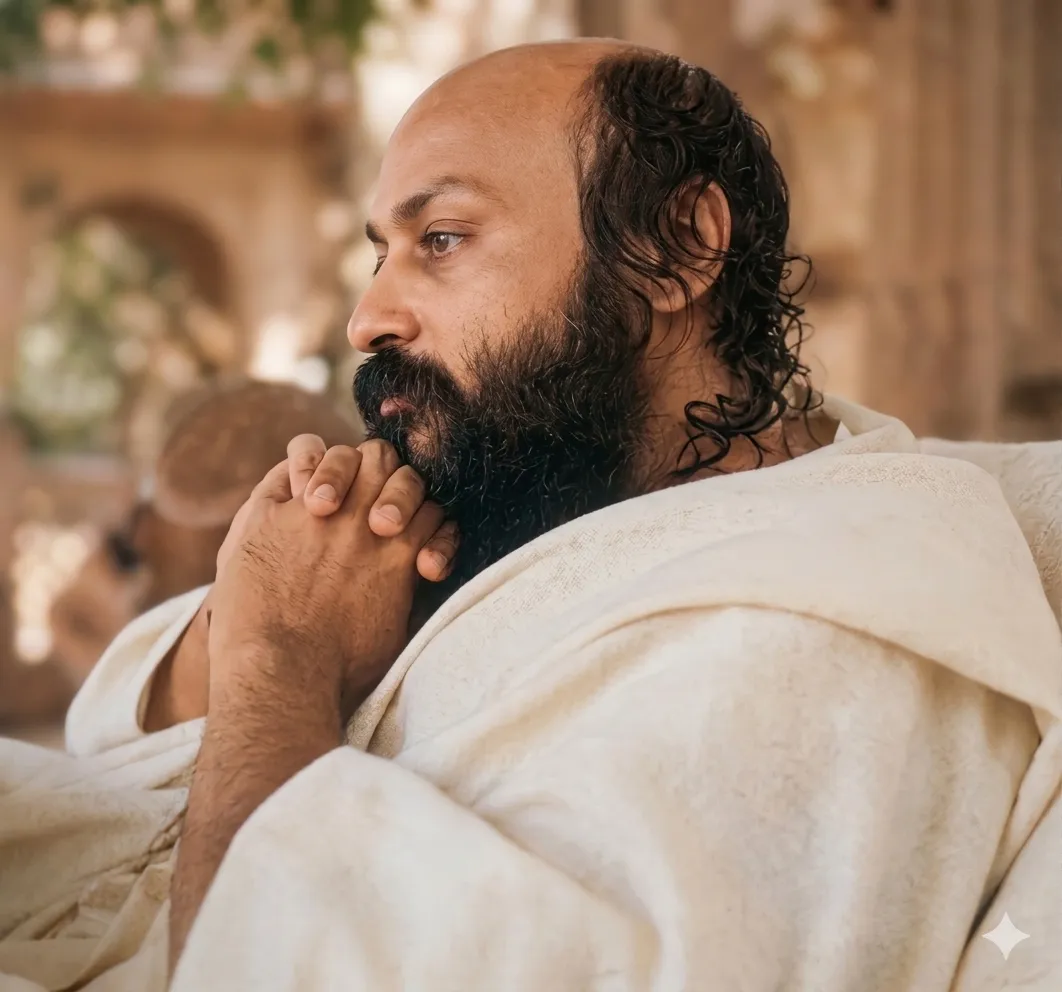
Awakening is when the small “me” disappears, and that emptiness lets your real, boundless self appear—some call it becoming a true person, others call it no-self.
From the Discourses
Passages where Osho speaks to this question — each links to the complete discourse.
You also asked that George Gurdjieff used to say the awakened man becomes crystallized. Individuation, the person, is born within him. Jung too speaks of individuation in the same way as Gurdjieff: the more a man awakens, the stronger his person becomes within. From this it is natural to ask: in the awakened one does the person become stronger, or does it end? Does the ego form, or is it dissolved?
Therefore Buddha, and all who want to be exact, will speak in the negative. It is not that Mahavira does not know, nor that Shankara does not know. But people are eager: even if a drop agrees to be lost, it will agree under the lure of becoming the ocean. The drop will consent to be lost only if it sees there is no real loss: “Only the drop is lost; I become the ocean.” But Buddha says: if a drop falls into the ocean with the greed to become the ocean, it will not become the ocean—because that very greed will keep it a drop. That very craving, that very thirst, will bind its personality on all sides. Therefore I have used the word shunya to mean that the Ultimate has no boundary. The person simply disappears. Gurdjieff says crystallization; I would say total decrystallization. I would say complete…Read the full discourse →
The crystallization of an awakened person happens when an individual takes birth in such a person. Jung also says the same thing which Gurdjieff says, when a person is a awake within, his individuality becomes stronger. So, it is natural to raise a question whether the individualization of an awakened person becomes strong or dies out. Is it transformed into ego or does it go away? This is merely the difference in language, nothing more. I call that as the birth of void -- emptiness which Gurdjieff calls crystallization. Really speaking 'an individual is born for the first time by being 'void', because by becoming void, he achieved that virat -- huge individual. By becoming void, by losing individuality, a person becomes 'an individual' for the first time, but this is difficult to understand. This is one of those contradictions of religion we fail to understand.Read the full discourse →
Would you please comment further on the differences between c. G. Jung's 'process of individuation' and the essence of the secret of the golden flower?
And if it goes on and on in this way, India will become many countries. Now, deep down, South India wants to separate from North India over the question of language. Now they say that they are a different race, Dravidian, and the North is a different race, Aryan. 'Our blood is separate, our ideal is separate, our language is separate.' So the idea of separating from the North is getting more and more powerful, because then they will have their own prime minister. Up to now all the prime ministers have been from the North. They take the president from the South just to console them, because the president in India is a nonentity. He is like the Queen of England: he is the nominal head of the country, without any power. Just to console the South, they take all the presidents from the South. And the prime minister…Read the full discourse →
Osho, you said last night that those who have become void, valley-like, do not react but they respond, and that the responses of these different enlightened ones will be different -- that the valley will reecho in its own unique and individual way. Now a question arises whether those who become absolutely void, nothingness, still have a personality and individuality. If so, then please explain how this becomes possible.
THIS is one of the paradoxes of spiritual life: the more one dissolves into the Divine, the more unique one becomes. The dissolution is not of the individuality but of the self. The dissolution is not of the uniqueness but of the ego. The more you are an ego, the more you are like others, because everyone is an egoist. The ego is the most ordinary thing in the world. Everyone is an egoist; even a newborn child is an egoist -- a perfect egoist. So it is not anyone's achievement; it is not extraordinary. Really, it can be said that to be just ordinary is the most extraordinary thing possible because no one feels just ordinary. So to feel oneself extraordinary is just the most ordinary thing. Everyone feels like that! So ego is not something unique. If you have an ego, it is not something unique. Really, egolessness…Read the full discourse →
You said enlightenment is individual, but does individuality remain after enlightenment?
No. Individuality does not remain after enlightenment, but enlightenment is individual. You will have to understand it. A river falls into the ocean. When it has fallen the river has disappeared -- there is no individuality of that river left, but only an individual river falls into the ocean. You fall into the ocean of enlightenment as an individual: you cannot take your wife with you or your friend with you -- there is no way. You go alone. Nobody can take anybody. How can you take anybody? When you meditate you meditate alone. The moment you close the eyes and you become silent, everybody has disappeared -- the wife, the friend, the children. The nearest are also no longer near; the closest are farthest now. In your deep silence, inner collectedness, you alone exist. This aloneness will fall into the ocean. So, enlightenment is individual. Of course after enlightenment…Read the full discourse →