
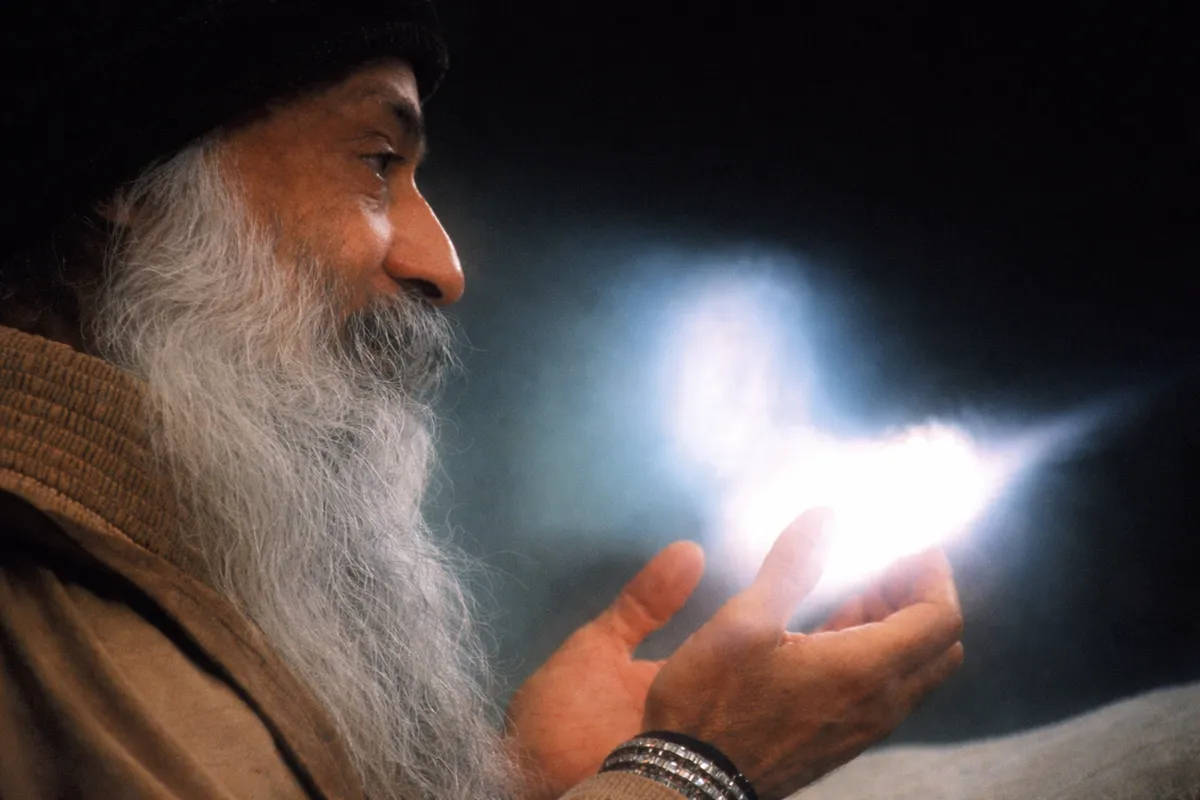
We pull silly faces because inside we aren’t a face at all, so we play with the mask.
From the Discourses
Passages where Osho speaks to this question — each links to the complete discourse.
Why do I make funny faces?
And, every child makes funny faces. Have you watched? Leave him in the bathroom and watch from the keyhole, and he will make funny faces. In fact he is enjoying having a face, trying to manipulate it in many ways, playing with it. And he can play because he is separate. When he is making a funny face, he knows "I am not this funny man. This face is only the face; I am behind it. This is just a mask." And even grown-up people do it in the bathroom. If nobody is watching, everybody is tempted to do a little.... In the mirror, one wants to make funny faces. Nothing wrong in it -- it simply shows that you cannot adjust yourself with the body, that the body is not all, that you are far beyond it, that you can play with the body like a mask. It is…
Osho, using the example of the onion you said that each person has many faces, masks—stolen masks. And these masks will be there, under all circumstances they will be there. One only needs to distinguish between good masks and bad masks. I hate someone, but when he comes to me I welcome him with a smile. This is an artificial face I present before him. Yet at the same time my mind is filled with immense pain, with sorrow, and still I smile. So this face, this mask, would be my good mask. A mask there will certainly be.
By “mask” I mean: the false faces we impose upon ourselves—do not impose them. That does not mean faces will not change in life. Your face will change every day, but it should be your own face. When darkness spreads, tears will come to the eyes; tomorrow a friend may die—tears will come. And tomorrow a long-lost companion may return—then the heart will throb with joy and songs will arise. Your face will change moment to moment; it should. One should be responsive. But the face must be your face. I am not saying keep one face fixed. That would be a stone face; life cannot move like that. Then you would need a single face of stone. I have heard that an American multimillionaire was approached by a man asking for a small donation. The millionaire said, “I have a rule: one of my eyes is artificial—made of stone—and…
Osho, Zen Master Hogen of Seiryo Monastery was just about to give his discourse before the evening meal when he noticed that the bamboo screen hung for meditation had not yet been put away. He pointed to it, and immediately two monks rose from the assembly and began to put it away. Observing that very moment, the Master said: “The first monk’s state is good, but the second’s is not.” Osho, please explain the purport of this Zen enlightenment story.
A Marwari, dying, told his lawyer: “To every servant who has served me for five years, I bequeath fifty thousand rupees.” The lawyer couldn’t believe it—he knew the man; he never gave five paise. Fifty thousand to each—and there were many servants. He asked, “Are you in your senses?” The Marwari said, “More than you. There is no servant in my house I let stay for five years! I’ll give nothing—but the news of my charity will spread.” Even at death, the relish is in reputation. The mask doesn’t drop, not even in the last moment. What people say after you die is important; what you are is not. You have no taste for being—only for others’ opinions. That is the mark of the householder. The sannyasin’s mark is: what I am is my relish. What people say—what is the use? That is their business. What I am—that is mine,…
Beloved Osho, the other morning in discourse, for a few moments I felt as if my face were disappearing. It was a very pleasant sensation, and, at the same time, a feeling of astonishment and surprise arose. Would you please say something about this?
Prem Gatha, it was not your original face that was disappearing; what was disappearing was your mask. Only the mask can disappear. The original face can be covered, but it cannot by any means be made to disappear. The mask is used to cover your face; we have many masks and we go on changing them as the situation requires. If you are seeing your servant, you have one kind of mask. You are the master. When you are facing your boss, you have a different mask; although he is humiliating you, you are still smiling. The original face cannot smile, so it is only a mask; deep down you are cursing but you have to smile; otherwise your job is in danger. I heard of an office where the boss used to come only for one hour, but when he came, he would gather the whole office, the clerks,…
Deva means God, Gulam means a slave -- a slave of God. And that is the highest peak of freedom. When one disappears into God, one becomes a slave on the one hand and on the other one becomes God Himself. Looked at from the human standpoint it is a slavery because you don't have a will of your own any more. God's will is all: 'Thy kingdom come, Thy will be done.' Now you don't feel any stirring of will within you. You become just a hollow passage -- He flows through you. This is slavery but this is freedom too, freedom from the self. Looked at from the divine standpoint, this is the ultimate in freedom, because unless you disappear something of the slavery remains. When you are not, how can you be a slave? Who can be a slave? You are just emptiness.