
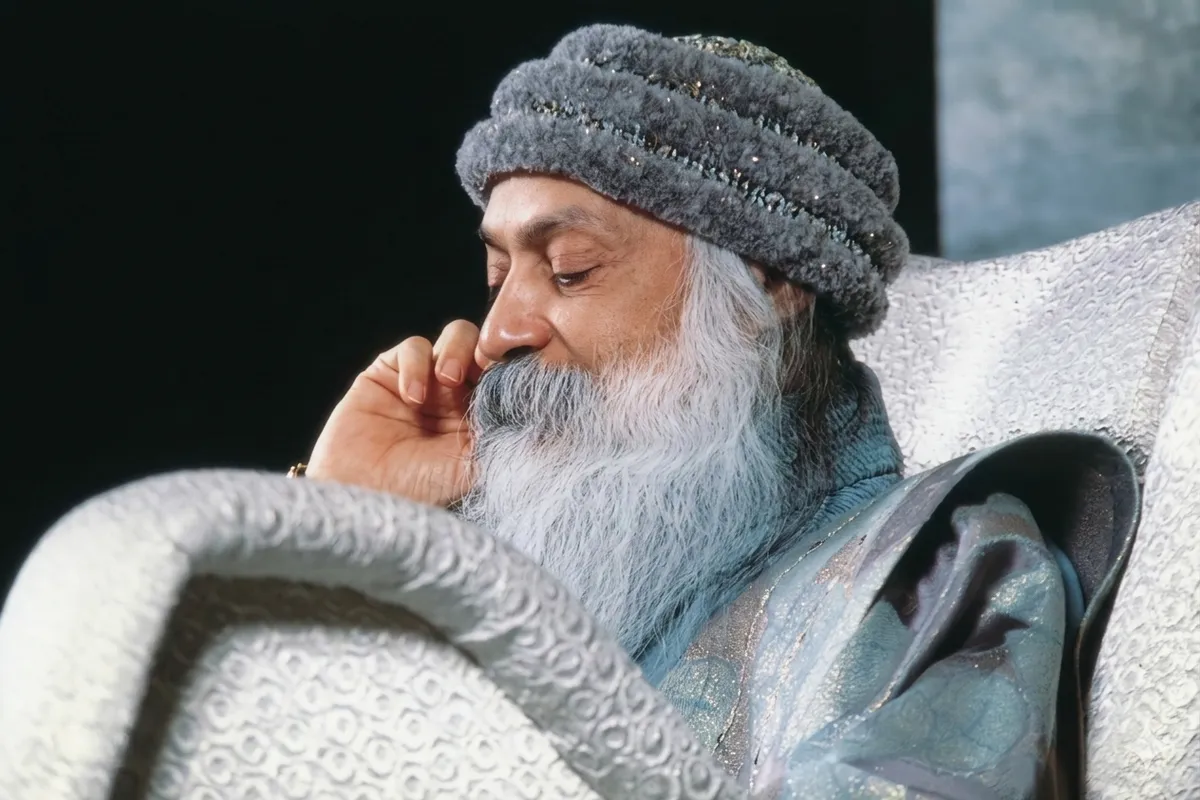
Your mind is like a talkative machine stuffed with borrowed words that keeps babbling on its own, and you can’t just flip it off.
From the Discourses
Passages where Osho speaks to this question — each links to the complete discourse.
Beloved Osho, what is the nature of this chatterbox mind of mine? It has been going on and on now for as long as I can remember. What are its origins? Is its source somewhere in the vast silence it dissolves into when I am in your presence?
There is an idea prevalent in scientific circles: It is a great wastage that a man like Albert Einstein dies and his brain also dies with him. If we could save the brain, implant the brain into somebody else's body, then the brain would go on functioning. It doesn't matter whether Albert Einstein is alive or not; that brain will continue to think about the theory of relativity, about stars and about theories. The idea is that just as people donate blood and people donate eyes before they die, people should start donating their brains too so that their brains can be kept. If we feel that they are special brains, very qualified -- and it is sheer wastage to let them die -- then we can transplant them. Some idiot can be made an Albert Einstein, and the idiot will never know -- because inside the skull of man…
Beloved Osho, often while sitting with you or when first waking in the morning, I am in a very silent space. It is like having a secret twinkling smile inside. And with it is the awareness that problems do not exist and this space is always available. I watch the mind surfacing with thoughts and for some beautiful moments it is very easy to not get engaged. But then as the discourse ends or I begin some activity I seem to go completely unconscious, unable to stop the momentum of my mind and my doing. There is just a nagging memory of the silence and a feeling of being uncentered again and miss
There is no need to worry -- and don't be greedy! Whatever is happening is so much. If listening to me a silence descends on you, thoughts disappear, and you feel a center, a new space, and you also feel that this space is always available... it is true. The moment you feel your center, the feeling that this center is always available is part of it. It is part of the experience, an essential part; hence it has an authority. Or, in the morning when you wake up and the mind is silent... and now that you have become aware of silence, you can recognize it. Everybody wakes up in the morning with a silent mind, but that remains for only a few seconds. And even in those few seconds he does not realize that he is without any thought, because he has had no taste of it, no…
Osho, you always praise a simple, innocent consciousness. What is this simplicity, this innocence?
The man said, “Then send me to the Indian one; I don’t want the German.” That difference was enough. The Germans refined it further—they read your scriptures and perfected them. German intellect knows how to refine things, arrange them, run everything by the clock. Even in the ashram I have given the electricity work to Haridas—a German sannyasin. However many times Pune’s electricity fails, the ashram’s does not. Let Pune fail, but not the ashram. Haridas takes great care; he has arranged everything—automatic generators: the moment the power fails, they kick in; you can’t even tell there was a failure. Where has this been learned? This much evil in the world—your saints had already arranged for it in the scriptures. Hell for others, heaven for themselves. These are not marks of simple-hearted people. A simple person—why would he think of hell and heaven? He has no such notions, no such…
Why is it so difficult to be silent? My words are so mechanical and used, a continuous repetition of histories, the same old past which doesn't exist any more. How am I still not tired of it?
"What," asked the mother, "are you going to do when you have children?" "Well," the little boy replied, "touch wood -- so far we have been very lucky!" That innocence is still somewhere in you. That totality, that beautiful ignorance, is still somewhere in you, hidden behind so many layers of the personality. And those layers go on repeating themselves. Watch the repetitiveness of your mind. Even if sometimes it changes words, it goes on repeating the same thing. Even if sometimes it changes habits -- you may stop smoking, then you start chewing gum. It is the same thing, the same game played with different toy. Watch the utterly unoriginal nature of your mind. Consciousness is original, mind is always repetitive and unoriginal. A telegram arrived at the army barracks. Corporal Jones' mother had died. That evening on the parade ground the sergeant-major bellowed at the men, "Attention! Jones,…
Take work as a game and enjoy it. Everything is a challenge. Just don't go on doing it, dragging yourself because it has to be done. Then you will become ill. If you have to work for four, five hours a day and those hours are a continuous sub-current of avoiding it, then you are dividing your being. It is not a question of work. It is a question of your whole inner well-being. You will become divided doing something for four or five hours which you cannot like or don't like. So there are only two possibilities: either find work you like or become capable of liking the work, whatsoever it is. The second is the best alternative because it is very difficult to find work that you like. Sooner or later you will dislike it. In the beginning, maybe you like it.