
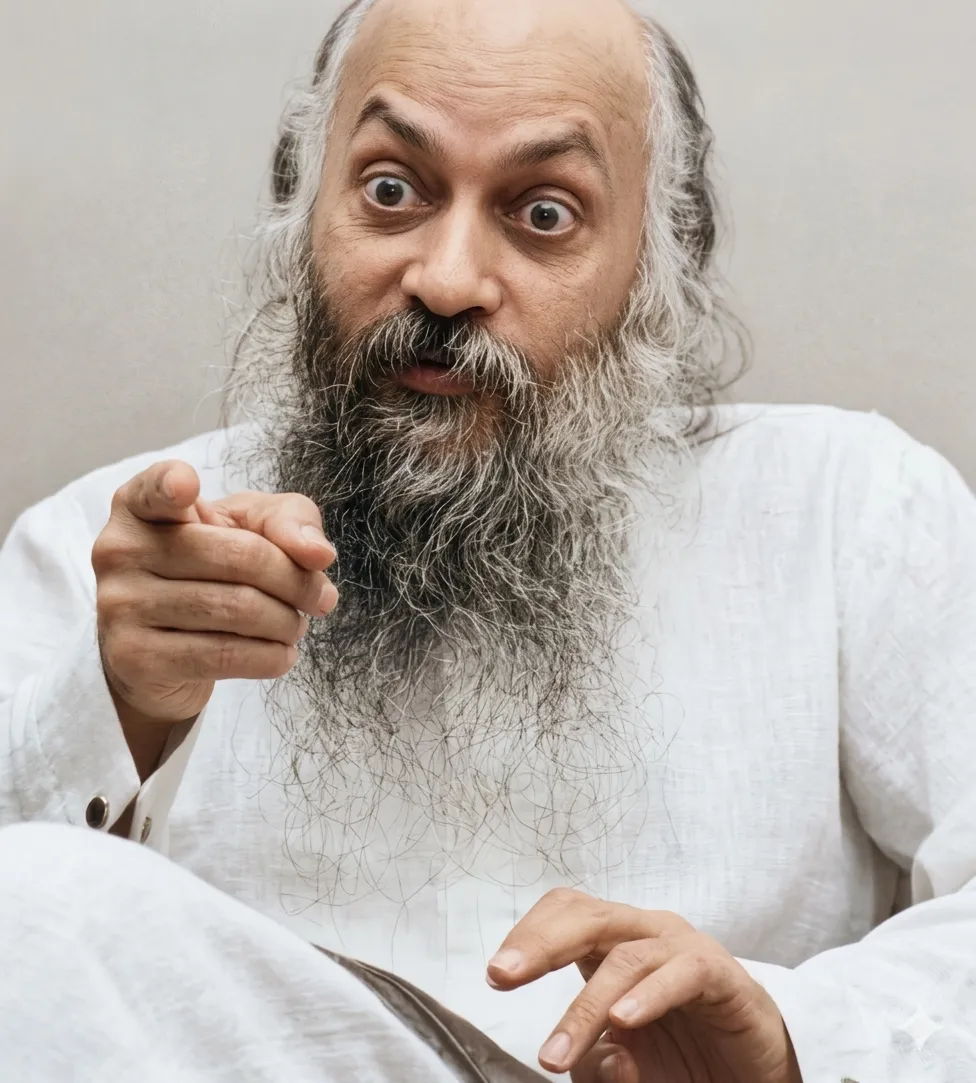
Hate isn’t really inside you; it’s just a loud way of saying you don’t like something because old memories made it seem bad.
From the Discourses
Passages where Osho speaks to this question — each links to the complete discourse.
Osho, you say that love and hate are one; but I see more hate in the world than love. At the same time, you say that enlightenment is neither love nor hate. Are you speaking of two different qualities of love? How does this fit with your message of love?
And it is only you who can find what is right for you and what is wrong for you. Then keep the thread of awareness running through all your actions, and in your life you will not find any hate, any anger, any jealousy. Not that you have dropped them, not that you have repressed them, not that you have somehow got rid of them, not that you have practiced doing something against them. No, you have not done anything, you have not even touched them. This is the beauty of awareness: it never represses anything; but there are things which simply melt in the light of awareness and change. And there are things which become more solid, more integrated, more profound, more strong: love, compassion, kindness, friendliness, understanding. All the religions up to date have been focusing people's minds on actions; and labeling -- this is bad, this is…
Beloved master, you have always pointed out that most things and states are two extremes of one state, polar opposites. Then hate is the other end of love. Does this mean it is as easy to hate as it is to love? Love is so beautiful. Hate is so ugly, and yet it happens too.
Love sharpens intelligence, fear dulls it. Who wants you to be intelligent? Not those who are in power. How can they want you to be intelligent? -- because if you are intelligent, you will start seeing the whole strategy, their games. They want you to be stupid and mediocre. They certainly want you to be efficient as far as work is concerned, but not intelligent; hence humanity lives at the lowest, at the minimum of its potential. The scientific researchers say that the ordinary man uses only five percent of his potential intelligence in his whole life. The ordinary man, only five percent -- what about the extraordinary? What about an Albert Einstein, a Mozart, a Beethoven? The researchers say that even those who are very talented, they don't use more than ten percent. And those whom we call geniuses, they use only fifteen percent. Think of a world where…
I feel a lot of hate inside me. What can I do about it?
This duality is a natural thing. If you love, then you have to hate. There are people who go on preaching: "Love the whole world!" But you cannot love the world unless you discover another world to hate. I don't think this planet Earth can become one until we discover enemies on some other planet. The moment we discover an enemy somewhere -- and we are trying very hard to find one -- then the whole world can become one. When India is fighting Pakistan, there is no fighting within India; India becomes one. There is a very deep patriotic feeling for India because now that love balances the hatred toward Pakistan. But when there is no war, then Hindus fight Mohammedans, and Brahmins fight Sudras, one state fights another state, one party fights another party... and the thing goes on. But if there is an enemy somewhere, then the…
A friend has asked: Osho, you said that love is necessary for hatred. But many times, just on seeing a man with whom we have no acquaintance, we feel hatred; we don’t even feel like meeting him or talking to him. So in such moments, is hatred possible without love?
And there is another reason, deeper than this; keep it in mind. You often hate precisely those things—those qualities in others—which you hate in yourself. This is a little deeper; it is a layer even deeper than the previous one. When, suddenly on seeing a man, hatred arises in your mind, investigate whether this is not a part of self-condemnation. For what you find bad in yourself you will also find bad in the other. This is projection. What you wish were not in you—when you see it in another—hatred arises. Hence every expansion of hatred is, somewhere deep down, a part of self-hatred. Understand this. You do not want to be angry, yet anger happens. And you hate anger. So whenever you see a glimmer of anger in someone, hatred will arise. You do not want to steal, and yet you steal. So whenever you see a thief somewhere,…
Beloved Osho, some young people in germany often use this motto: "god does not exist, but still I hate him."
The experience of hate is not very far away from love. It is love standing on its head. The people who say, "God is dead but still I hate him," do not understand what they are saying, and where they are going. In the first place, God has never been, so he cannot be dead. In the second place, if you have not loved God, you cannot hate him. In your hate, love still survives, it can reassert itself. Love reasserts out of hate that God will become alive again. It is your mind again. God is your projection. Whether you love him or hate him, whether you believe in him or disbelieve in him does not matter -- he will dominate your life. Through love he will dominate your life; through hate, perhaps more. Just be free of the projections. When you are free of the projection, the fiction,…