
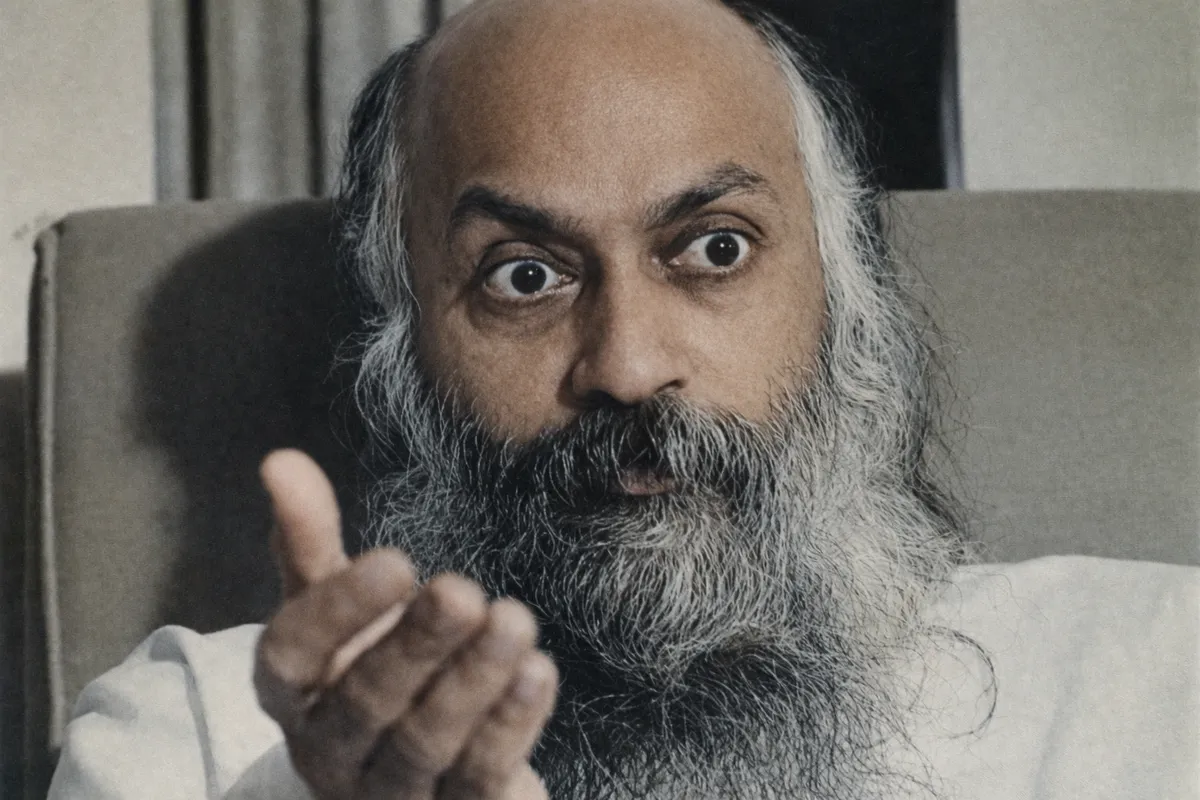
Smile from your real, quiet center and join your hands so no one feels offended—never fake it.
From the Discourses
Passages where Osho speaks to this question — each links to the complete discourse.
Daily you come folded-handed, smiling, and the same way you go back after the lecture. What is the meaning of this gesture?
I am saying, come smiling, go smiling. That is the meaning of tathagatha: thus come, thus gone. Let this coming and going be just a smile, nothing more substantial than a smile. A smile is the most non-substantial thing in the world. You cannot catch hold of it; it slips, it is elusive, ineffable. Let your life be just a smile. Come smiling, go smiling. And, of course, folded-handed, otherwise somebody can get hurt. If you smile without your hands folded, somebody's ego can get hurt. He can say, 'What do you mean? Smiling at me?' So just to protect any misinterpretation.... But don't try to make it an empty gesture, because a smile which is false is one of the most dangerous things to learn. Never smile falsely, because once you start smiling falsely, you will forget how to smile authentically. Never corrupt your smile. Otherwise it is just…
Osho, when you arrive at the morning discourse site, seeing you stand for a long time with your hands joined in pranam gives me great pain. It feels as if you should just come out and sit down straightaway. For us who are blind, seeing your joined hands causes me distress. Sambodhi has asked this question. This pain is auspicious. It is the beginning of the eyes opening. If even this much has come into your sight—that you are blind—that is plenty to see! The moment one sees, “I am blind,” the eyes have begun to open.
They say: when a madman begins to understand, “I am mad,” he has begun to get well. A madman never understands that he is mad. Call a madman mad and he will prove you mad. He will say, “Me, mad? You are mad. Whoever calls me mad is mad.” The madman does not accept himself as mad. How could there be so much intelligence in madness that it accepts itself! The day the madman begins to admit, “I am mad,” the first ray of intelligence has descended. The day you know, “I am ignorant,” the first light of wisdom has dawned. It is auspicious, Sambodhi, that it hurts. This pain is good. This pain is beneficial; it is salutary. And you say, “For us who are blind, you should not fold your hands”—that this is not right. You are not blind; you are only sitting with your eyes closed. The…
Another friend has asked something related. He says, Osho, when you get up—someone folds their hands to you, someone touches your feet—I feel very puzzled. He has written that he feels very surprised. Why should anyone touch someone’s feet? Why should anyone fold their hands to someone?
And then it is worth asking: someone else is bowing, and some third person is getting upset! If they were bowing and they themselves were troubled, it would be understandable. But one person bows at someone’s feet and another person gets disturbed. What a strange disturbance! Why are you disturbed? Why should I be disturbed? Two people are loving—and I become disturbed! I grow restless: why are two people loving? What does my restlessness reveal? One person is giving another respect, reverence, thanks—and I get upset. Why am I disturbed? There can be two or three reasons. One: seeing others bow, my inner ego, which never knows how to bow, gets badly hurt. If no one bows, it relaxes. If someone bows, it feels wounded. Like this: three men are walking and a beggar stands before them. One of the three takes out money and gives it, and the other…
Osho, my hand just won’t leave my heart—how are we to salute you?
So I said to that man, “Do not say this again. I understand why you are saying it: so that the people of your village will recognize that although you have come for the darshan of a non-Muslim, you are still a Muslim. If even in a moment of love it still occurs to you that I am a Muslim, I am a Hindu, I am a Jain, I am a Christian, then that love is not worth two pennies.” It is enough that your hand has reached your chest. And the hand has reached the chest only because the feeling has arisen in the heart. The salaam has happened, the pranam has happened, the prayer has happened, the meditation has happened. All the mantra-like, mysterious experiences of life happen in that small instant. Now do nothing more. Because if you do something more, then you will be the doer.…
Osho, you constantly tell your sannyasins to keep laughing. But in the locket of the mala you give at initiation, your picture shows a serious expression. Why this seriousness?
Ashtavakra says: to know that state, one needs the same state. Christians say Jesus never laughed. That is false. Yet the Christians are also right, because on the plane on which they can understand laughter, Jesus never laughed. On the plane on which I understand laughter, I know Jesus was bubbling with laughter—he was laughing even on the cross. Have you seen a laughing statue of Buddha? Impossible. Have you heard Mahavira’s titter? Impossible. If you make a laughing statue of Mahavira, the Jains will sue you and drag you into court, saying you have disfigured our Mahavira’s face. Mahavira—and laughing? It cannot be! In one sense they are right too: a Mahavira like you would never laugh. Your laughter bears the imprint of tears. Mahavira’s laughter is very silent, serene—serene like Mahavira himself, without any disturbance. Perhaps there is no giggling in it—there cannot be. It rises from emptiness;…