
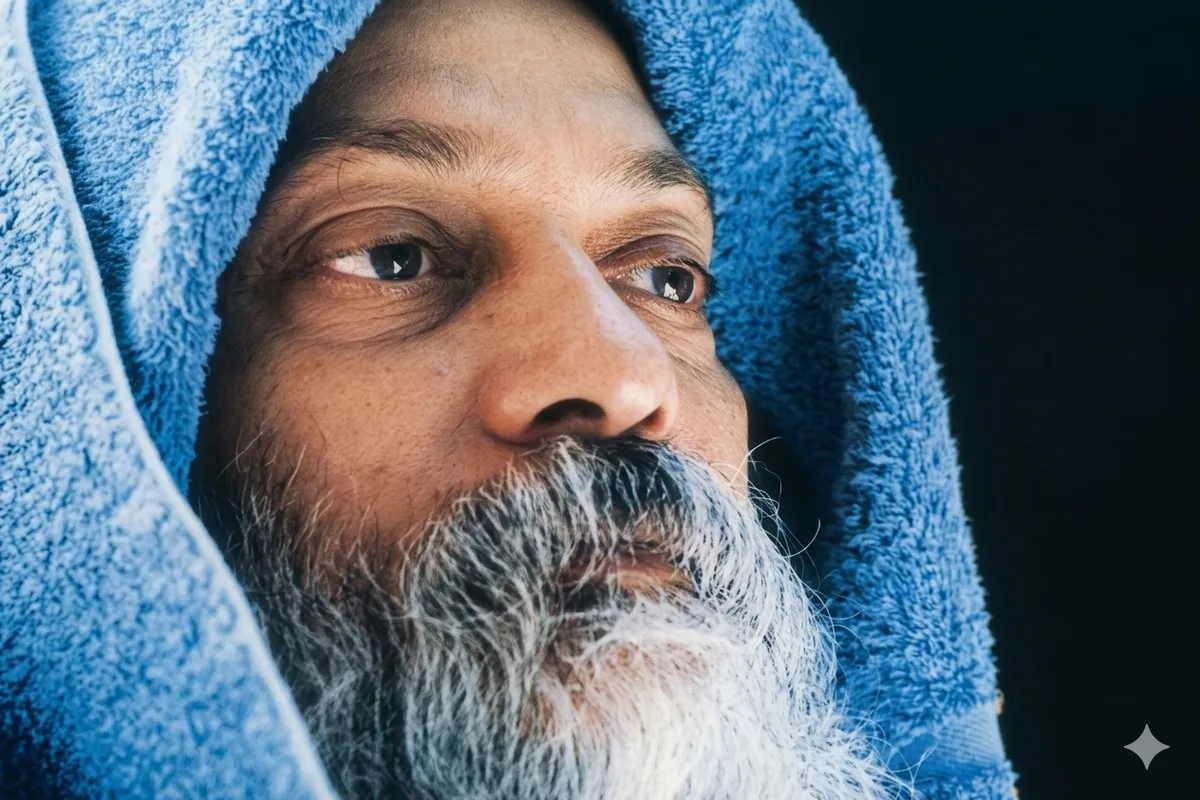
God can’t be put into a picture or a word—you feel it by being quiet and aware, not by thinking.
From the Discourses
Passages where Osho speaks to this question — each links to the complete discourse.
What is the form of the Supreme, the one to which you have given a name? What is it like, and which name do you wish to give it?
Certainly. If you try to understand the Divine, you will never be able to understand. It is not a matter of understanding.
Osho, what is the definition of God?
Words are very small. If you say God is light, then what of darkness? The scriptures have said that God is light. Suppose we accept this as a definition—then what about darkness? Where will darkness go? Darkness is too; in fact it is far more than light. Light sometimes is and sometimes is not; darkness is always, eternal. Where will you place darkness? If you say God is light, darkness is left out. If you say God is darkness, then light is left out. If you say God is both darkness and light, a contradiction arises: they cannot be together. Try to have both darkness and light in the same room. If you bring in light, darkness disappears; if you preserve darkness, you cannot have light. Then how can both be together? That becomes an impossibility. So you cannot say “both” either. Then the fourth device is to say: it…
पहला प्रश्न: ओशो, परमात्मा की परिभाषा क्या है?
शब्द तो बड़े छोटे-छोटे हैं। अगर कहो परमात्मा प्रकाश है, तो फिर अंधेरे का क्या होगा? ऐसा कहा है शास्त्रों में कि परमात्मा प्रकाश है। चलो मान लें इसे परिभाषा, फिर अंधेरे का क्या होगा? फिर अंधेरा कहां जायेगा? अंधेरा भी है, प्रकाश से कहीं ज्यादा है। प्रकाश तो कभी होता है कभी नहीं भी होता; अंधेरा सदा है, शाश्वत है। अंधेरे को कहां रखोगे? अगर कहा परमात्मा प्रकाश है, तो अंधेरा बाहर पड़ गया। अगर कहा परमात्मा अंधेरा है, तो प्रकाश बाहर पड़ गया। अगर कहो परमात्मा अंधेरा प्रकाश दोनों है, तो विरोधाभास होता है। दोनों एक साथ हो नहीं सकता। एक ही कमरे में अंधेरा और प्रकाश करके दिखाओ। प्रकाश करोगे, अंधेरा खो जायेगा; अंधेरा बचाओगे, प्रकाश न कर सकोगे। तो दोनों साथ कैसे होंगे? तब एक असंभव बात हो गई। तो यह भी नहीं कह सकते कि दोनों है।
Osho, it is said, “bhaktya anuvritya.” Then devotion must be to a form. The sun is manifest with form in the sun realm; in the same way, why is God not with form?
Who said God is not with form? All forms are his. God has no form of his own. You are looking for God’s own form; that is why the question arises as to why God is not with form. In the tree, God is a tree; in the bird, a bird; in the waterfall, a waterfall; in a man, a man; in a stone, a stone; in a flower, a flower. If you look for God’s particular form, you will go on missing. The one to whom all forms belong cannot have a form of his own. Now this is quite a curious thing. It means: the one of whom all forms are, he himself can only be formless. It sounds a bit upside down: the one who has all forms is formless! How could the one of whom all names are, have a name of his own? The one…
तीसरा प्रश्न: ओशो, ‘भक्त्या अनुवृत्या’ ऐसा कहा है, तो भक्ति साकार ही होनी चाहिए। सूर्य सूर्यलोक में साकार ही है, वैसे ही भगवान भी साकार क्यों नहीं है?
किसने कहा भगवान साकार नहीं है? सभी आकार उसी के हैं। भगवान का अपना कोई आकार नहीं है। तुम भगवान का आकार खोज रहे हो, इसलिए सवाल उठता है कि भगवान साकार क्यों नहीं है। वृक्ष में भगवान वृक्ष है, पक्षी में पक्षी है, झरने में झरना है, आदमी में आदमी है, पत्थर में पत्थर है, फूल में फूल है। तुम भगवान का आकार खोज रहे हो, तो चूकते चले जाओगे। सभी आकार जिसके हैं, उसका अपना कोई आकार नहीं हो सकता। अब यह बड़े मजे की बात है। इसका अर्थ हुआ, सभी आकार जिसके हैं, वह स्वयं निराकार ही हो सकता है। यह जरा उलटी लगती है बात, सभी आकार जिसके हैं वह निराकार! सभी नाम जिसके हैं उसका अपना नाम कैसे होगा? जिसका अपना नाम है उसके सभी नाम नहीं हो सकते। सभी रूपों से जो झलका है उसका अपना रूप नहीं हो सकता। जो सब जगह है उसे तुम एक जगह खोजने की कोशिश करोगे तो चूक जाओगे। सब जगह होने का एक ही ढंग है कि वह कहीं भी न हो। अगर कहीं होगा तो सब जगह न हो सकेगा। कहीं होने का अर्थ है: सीमा होगी। सब जगह होने का अर्थ है: कोई सीमा न होगी। …
And in rest is all, because when you are totally restful God is available to you. You enter into the kingdom of God only when you are totally relaxed -- no tension, no desire, no mind -- just like a small child, a nobody, and totally relaxed. Let that be your work on yourself. Arihant means one who has killed the real enemy. Self-ignorance is the real enemy, unconsciousness is the real enemy. To live like a somnambulist is to be one's own enemy. The enemy is not outside you, it is hidden in your own mind. It is your mind -- and one has to go beyond it. The only way to go beyond the enemy, to kill the enemy, is to be more and more alert, more and more conscious of your thoughts, of your acts, of your desires, of your feelings.
Osho, whenever the feeling of remembering God wells up within, some form or other also rises—mostly Sri Krishna or Sri Vishnu or Shiva. But I am assured by your saying that all forms lie within the limits of the mind and are imaginations. So please tell me: during the day, or at the time of meditation, whenever a strong urge for the remembrance of the Lord arises, what should be its form? They are—so in what form should I experience them?
“I had thought the ruins of love were all in vain; They turned out to be towns I had taken for desolations. I had taken every glance as too heavy for a tender nature; It was right before my eyes—yet how could I understand? Little did I know He himself would emerge as an equal partner; I had taken every heartbeat to be my own tale. Life turned out to be exam upon exam unending; I had thought life to be nothing but stories. The chronicle of my own being stood before me, Which till today I had taken for the tales of others.” What you have taken as “the other” is not other. But since you do not yet know yourself, the other appears as other. When you come to know yourself, the other is no longer other. “The chronicle of my own being stood before me, Which till…
तीसरा प्रश्न: ओशो, जब भी कभी ईश्वर-स्मरण की भावना भीतर उमड़ती है, तब कोई न कोई रूप उमड़ आता है। अधिकतर श्री कृष्ण अथवा श्रीविष्णु अथवा शिव। किंतु आपके कथन से आश्वस्त हूं कि सब आकार मन की सीमा के भीतर हैं और कल्पनाएं हैं। तो कृपया बताएं कि दिन भर में या ध्यान के समय जब भी प्रभु-स्मरण की प्रबल भावना उमड़े, तब उसका क्या स्वरूप हो? वे हैं, इसे किस रूप में अनुभव करूं?
सामने की बात थी, लेकिन कहां समझा था मैं क्या खबर थी खुद वो निकलेंगे बराबर के शरीक दिल की हर धड़कन को अपनी दास्तां समझा था मैं जिंदगी निकली मुसलसल इम्तिहां-दर-इम्तिहां जिंदगी को दास्तां ही दास्तां समझा था मैं मेरी ही रूदादे-हस्ती थी मेरे ही सामने