
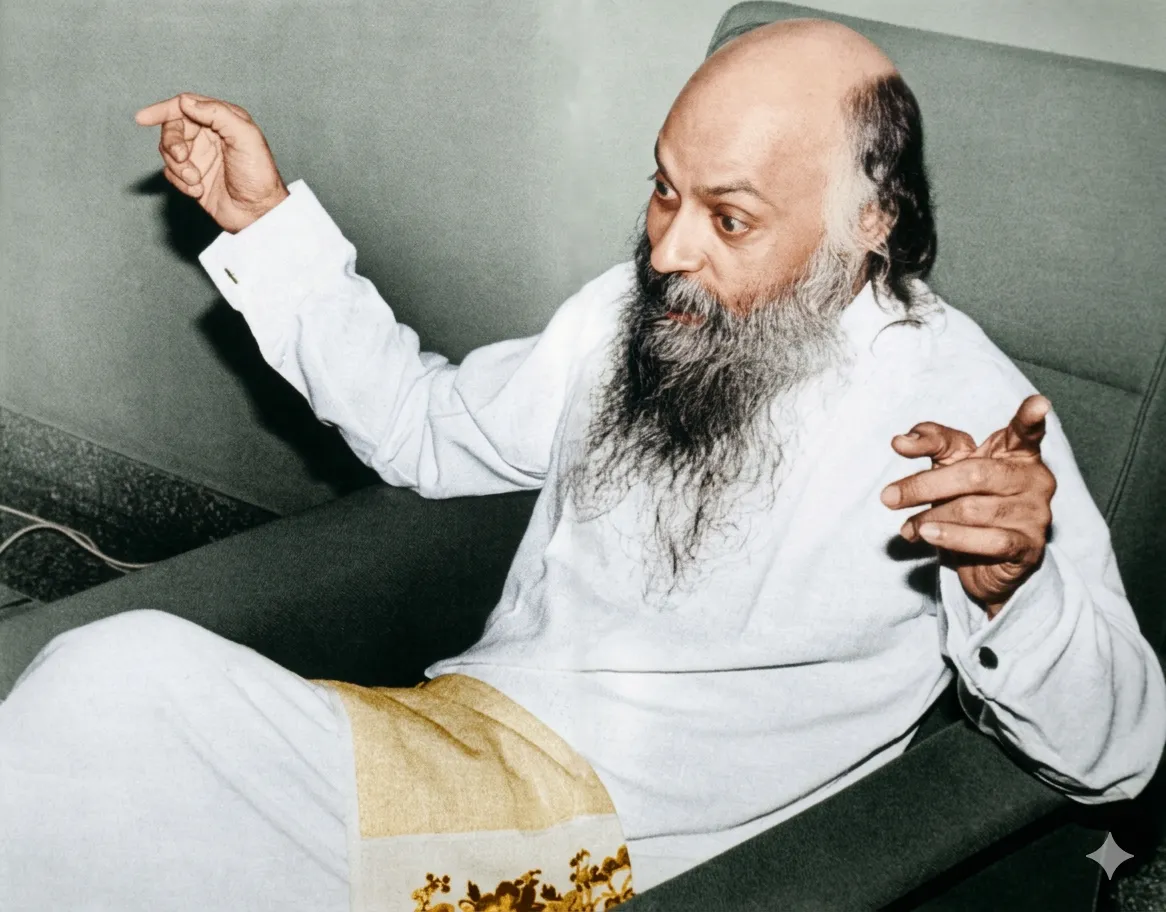
According to Osho, morality is a socially imposed, fear-based rehearsal of “don’ts”—a fence without roses—while religion is an inner, God-rooted awakening that affirms, creates, and sees. Morality imitates and secures; religion explores and flowers. True religion sows roses; natural protection (morality) follows. Morality gropes by practice; religion moves with fearless, spontaneous vision, one in taste across cultures.
Morality is following others’ rules to avoid wrong, while religion is waking up inside so real goodness grows by itself—like planting roses and then adding a fence.
From the Discourses
Passages where Osho speaks to this question — each links to the complete discourse.
Dariya Kahe Sabad Nirvana · Discourse 6
1979-01-28 · Pune · Hindi
Osho, what is the first experience of samadhi like?
You will know only when it happens. It cannot be said; at most a few hints can be given. It is as if, in the dark, a lamp is suddenly lit. Or as if a dying patient, right at the edge of death, suddenly finds a medicine that works; life’s wave, life’s thrill spreads again—so it is. As if a corpse becomes alive—such is the first experience of samadhi. It is the taste of nectar. The experience of the ultimate music. But it will be only when it happens; and only then will you understand. You will not understand by my saying it. It is as with love. How can anyone explain it? To someone who has never loved, never known love, no matter how many explanations you offer—he will hear it all and still ask, “I haven’t understood; please explain a little more.” It is like explaining light to…Read the full discourse →
Question: TZU-HSIA ASKED THE MASTER. 'WHAT SORT OF MAN IS YEN HUI?' 'FOR KINDNESS HE IS A BETTER MAN THAN I AM.' 'WHAT ABOUT TZU-KUNG?' 'FOR ELOQUENCE HE IS A BETTER MAN THAN I AM.' 'TZU-LU?' 'FOR COURAGE HE IS A BETTER MAN THAN I AM.' 'TZU-CHANG?' 'FOR DIGNITY HE IS A BETTER MAN THAN I AM.' TZU-HSIA ROSE FROM HIS MAT AND ASKED: 'THEN WHY DO THESE FOUR SERVE YOU?' 'SIT DOWN, I WILL TELL YOU. YEN HUI CAN BE KIND BUT CANNOT CHECK THE IMPULSE WHEN IT WILL DO NO GOOD. TZU-KUNG CAN BE ELOQUENT BUT CANNOT HOLD HIS TONGUE. TZU-LU CAN BE BRAVE BUT CANNOT BE CAUTIOUS. TZU-CHANG CAN BE DIGNIFIED BUT CANNOT UNBEND IN COMPANY. EVEN IF I COULD HAVE THE VIRTUES OF THE FOUR MEN ALL TOGETHER I SHOULD BE UNWILLING TO EXCHANGE THEM FOR MY OWN. THAT IS WHY THEY SERVE ME WITHOUT MISGIVING.Read the full discourse →
Osho, can society get by with an imposed, showy morality? Then does it no longer need morality arising from religion, nor the presence of saints?
Hence society says: become moral; we have no use for religion. Be religious if you wish—that’s your business; we won’t get into that mess. Be atheist if you like; don’t believe in God if you don’t want to—only be well-behaved. So society has no need of religion. Religion is a personal necessity—an inner need—an individual’s need. Society can run without religion. The individual will not be able to. He will stagger, perish, break. For society, makeshift, behavioral morality is enough; nothing more is needed. But if you too are satisfied with that, your inner world will remain a desert. No trees will ever turn green within you, no flowers will bloom. The possibility of an oasis will vanish. However skillful you become in dealing with others, with yourself you will remain foolish. Your self-ignorance will remain deep. Therefore I say: morality is social skill; religion is the hunger of your…Read the full discourse →
Morality is social; religion, entirely personal. Morality is behavior; religion, the inner being. Morality is the periphery; religion, the center. Morality is personality; religion, the soul. Religion does not follow on the tail of morality but morality invariably follows religion. Morality cannot even succeed in making a man moral, so how then can it make him religious? Morality begins with suppression, with piling things on oneself, whereas religion starts with knowledge. In life we find evil, impurity and untruth. We must find their roots. Where and how is evil born? Where is the center from which these poisons come and make one's behavior venomous? Even when one thinks of virtue, of good, why does evil drive away all these thoughts and engulf one, surrounding one's life, permeating one's conduct? Why does passion always re-route one's thoughts? We must be observant and find this out for ourselves.Read the full discourse →
Athato Bhakti Jigyasa · Discourse 32
1978-03-22 · Pune · Hindi
Osho, what is the definition of God?
Words are very small. If you say God is light, then what of darkness? The scriptures have said that God is light. Suppose we accept this as a definition—then what about darkness? Where will darkness go? Darkness is too; in fact it is far more than light. Light sometimes is and sometimes is not; darkness is always, eternal. Where will you place darkness? If you say God is light, darkness is left out. If you say God is darkness, then light is left out. If you say God is both darkness and light, a contradiction arises: they cannot be together. Try to have both darkness and light in the same room. If you bring in light, darkness disappears; if you preserve darkness, you cannot have light. Then how can both be together? That becomes an impossibility. So you cannot say “both” either. Then the fourth device is to say: it…Read the full discourse →