
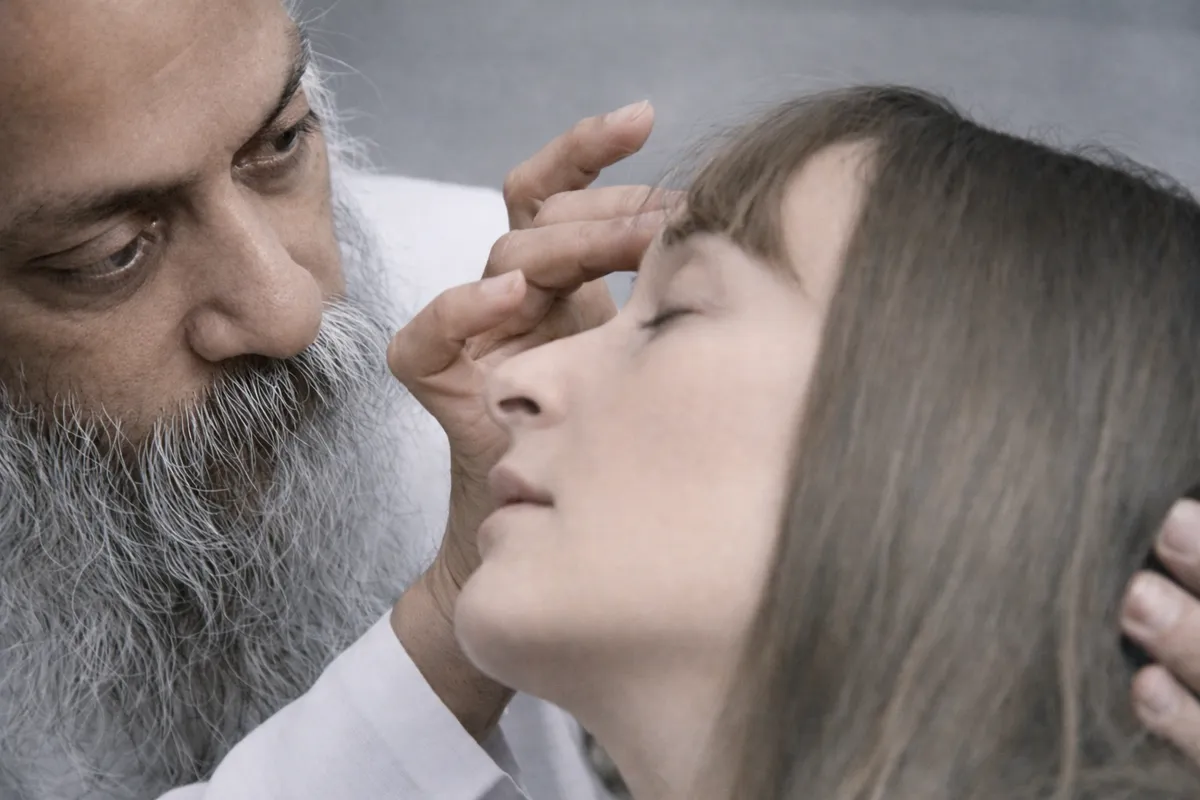
According to Osho, knowledge is borrowed belief—the accumulated experiences of others stored in the brain; wisdom is your own accumulated experience, nearer but still of the past; understanding is non-accumulative, a present-moment clarity of being. Knowledge and wisdom can be replaced or brainwashed; understanding cannot. If living increases your store, it’s knowledge or wisdom; if living deepens presence, it’s understanding.
Knowledge is what you’re told, wisdom is what life has taught you, and understanding is seeing clearly right now without clinging to the past.
From the Discourses
Passages where Osho speaks to this question — each links to the complete discourse.
What is the difference between waiting for godot and waiting for god?
It is as if the sun has risen in the morning and you are sitting in your room with closed doors and windows, in darkness. Open the doors, you become available to the sun. The sun was already available -- just the meeting happens. You cannot wait for God. All waiting is for Godot. Godot means the one who never comes, who CANNOT come, whose arrival is impossible. And the only impossible thing is that which has already happened -- how can it happen again? You are alive, and you are waiting for life, Now, this is ridiculous. The real man of religion does not think in terms of God. He thinks in terms of life or, even better, of living -- because life can again become an abstract idea. Living, moment-to-moment living. In that very living, one knows what God is, because one knows who one is. Your idea…
My understanding is that knowledge is understanding. The wisdom of the sages is the wisdom of the ages.
In one question there are three questions. First: MY UNDERSTANDING IS THAT KNOWLEDGE IS UNDERSTANDING. No, sir. Knowledge is never understanding. Knowledge is a deception of understanding. Knowledge is a pseudo-coin, a substitute; it is not understanding. Knowledge is borrowed, understanding is never borrowed. Understanding is yours, knowledge is always of others. Understanding arises out of your awareness, knowledge arises out of your learning. And the process are totally different, diametrically opposite. If you want to understand you will have to unlearn all that you have learned. Knowledge functions as a barrier, knowledge has to be dropped. The known has to cease for the unknown to be. Understanding is of the unknown, knowledge is of the known. Knowledge is your memory, understanding is your very being. Knowledge is borrowed light. Knowledge is like the moon, understanding is like the sun. The moon lives on the borrowed light; it reflects sunrays,…
Osho, what is wisdom?
Stephen Crane writes: I met a seer, he held in his hands the book of wisdom. "Sir," I addressed him, "let me read.""Child..." he began. "Sir," I said, "think not that I am a child, for already I know much of that which you hold." "Ah, much!" he smiled. Then he opened the book and held it before me. Strange, that I should have gone so suddenly blind. Wisdom is not knowledge. The knowledgeable person cannot see it, he is blind. Only the innocent person can see it, only a child, one who knows nothing, one who functions from the state of not knowing, can know what wisdom is. Wisdom has nothing to do with knowledge, not at all; it has something to do with innocence. Something of the purity of the heart is a must, something of the emptiness of being is needed for wisdom to grow. "Only those…
Question: BELOVED OSHO, WOULD YOU SAY SOMETHING TO US ABOUT WISDOM? Raso, wisdom is one of the most misunderstood words in any of the languages of the world. Mostly, the misunderstanding has arisen because of the word `knowledge'. People think both are identical, synonymous. In reality, they are just the opposite of each other. The knowledgeable man is not the wise man; the knowledgeable man is simply covering up his ignorance by collecting all kinds of information from the outside. His scholarship is great, his information is vast, his memory may be very rich, but he is still not wise -- because wisdom has nothing to do with scholarship, nothing to do with scriptures, nothing to do with memory either. Wisdom is the name of pure intelligence. It is the spontaneous flowering of your being. Knowledge comes from outside. Wisdom comes from your innermost core.
Osho, what is true wisdom?
WISDOM CANNOT BE TRUE OR UNTRUE. Wisdom is simply wisdom. It is truth. There is no possibility of there ever being an untrue wisdom. All knowledge is untrue: all wisdom is true. Knowledge is borrowed, hence it is untrue. It is yours, that's why is it untrue. It may have been true to the person who imparted it to you. The Buddha talking to his disciples is talking wisdom, but the moment it reaches the disciples it becomes knowledge. Wisdom falls from its heights to the level of the listeners and becomes knowledge. Hence Buddhas have always been very much aware that they impart something of their presence, something of their silence, something of their joy, rather than imparting their wisdom. Even if they have to talk, they talk only in order to persuade you to be silent. Even if they use words, those words are used to create a…