
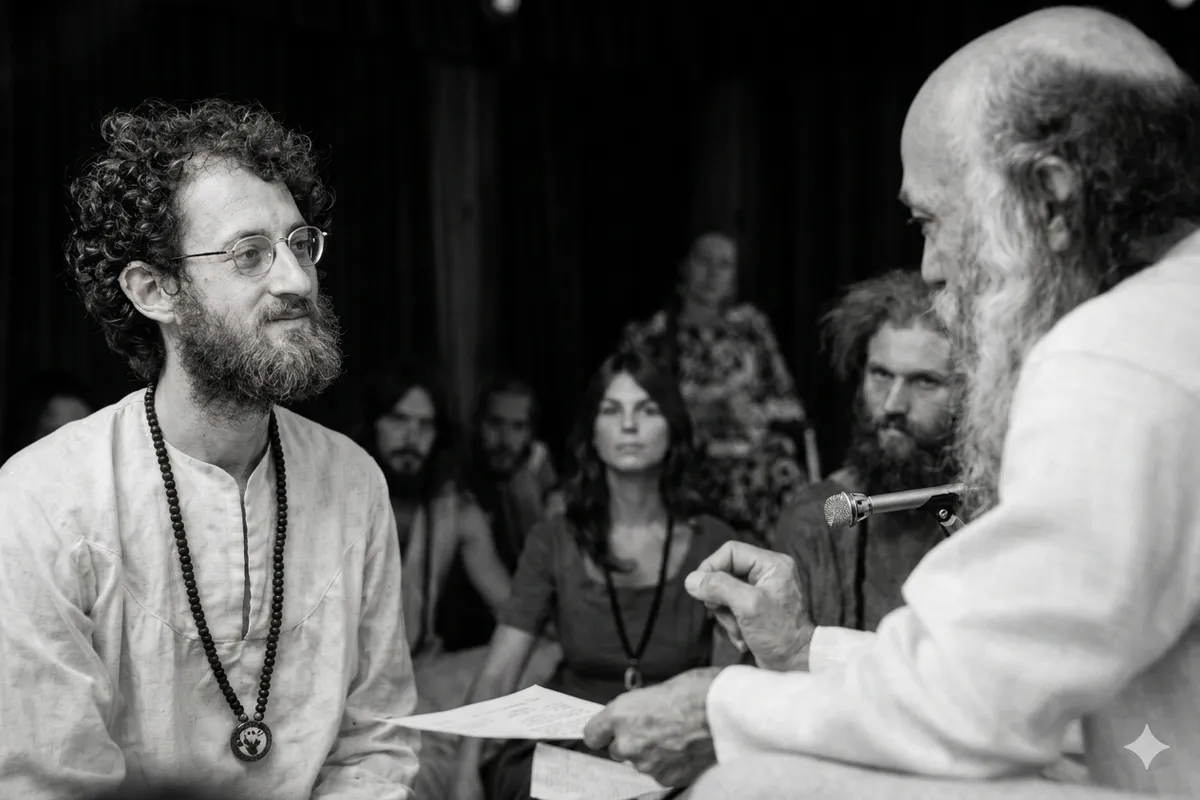
A psychologist fixes mind problems from inside the mind; a satguru helps you step outside the mind to discover who you really are.
From the Discourses
Passages where Osho speaks to this question — each links to the complete discourse.
Osho, why does there seem to be so much conflict between the world and God?
It is as if someone were sleeping deeply in this garden. The cuckoo comes and sings, birds are chattering, the sun rises, breezes dance through the trees; but someone is fast asleep. The breezes touch him, the birds’ songs echo at his ears, the sun’s rays play on his face, but he knows nothing. Then someone comes and shakes him awake. His eyes open—the glory of the sun is revealed, the song of the passing breeze is heard, suddenly the cuckoo’s call, the fragrance of flowers. Do you think something new has happened? Everything was already there, just as it is. Only this man has become new—nothing else has changed. The same garden, the same sun, the same flowers, the same birds—everything the same; only a small difference: he was asleep; he is awake. The meaning of “world” is: you are asleep in God. The meaning of “God” is: you…
पहला प्रश्न: ओशो, संसार और परमात्मा में इतना विरोध क्यों लगता है?
फिर कोई आए और उसे झकझोर कर जगा दे। आंख खुले सूरज की महिमा प्रकट हो, पास से गुजरती हवा का गीत सुनाई पड़े, अचानक कोयल की आवाज आए, फूलों की सुगंध आए, क्या तुम सोचते हो कुछ नया हो गया? सब था, सब वैसा का वैसा है, सिर्फ यह आदमी नया हो गया और कुछ नया नहीं हुआ है। वही बगीचा, वही सूरज, वही फूल, वही पक्षी, सब वही है, सिर्फ इस आदमी में थोड़ा फर्क पड़ा है, यह सोया था, यह जाग गया।
Beloved Osho, what do you mean by "the psychology of the buddhas?" how is it different from the present psychology that prevails in the world?
It has to be understood; the people who came to Sigmund Freud, the founder of modern psychology, were all sick people -- obviously, otherwise why should they come to the psychoanalyst? They were seriously sick, their minds were falling apart. Sigmund Freud came in contact only with sick people -- that gave him the impression that man himself is sick. In a way he is logical because everybody he examined, everybody he analyzed, everybody he treated was sick. And these were high-class people, bourgeois -- professors, scientists, very rich people -- because a psychoanalyst's time is the costliest thing in the world today. All these people were basically living an insane life, but because everybody else is also living the same insane life you don't become aware of it. If Sigmund Freud denied that there is any possibility of a soul in man he cannot be blamed. He never came…
Beloved master, please explain whether the techniques you have discussed so far from vigyana bhairava tantra belong to the science of yoga instead of to the actual and central subject matter of tantra. What is the central subject matter of tantra?
This question arises to many. The techniques that we have discussed also belong to yoga. They are the same techniques, but with a difference: you can use the same techniques with a very different philosophy behind them. The framework, the pattern differs, not the technique. You may have a different attitude toward life, just the contrary to tantra. Yoga believes in struggle; yoga is basically the path of will. Tantra does not believe in a struggle; tantra is not the path of will. Rather, on the contrary, tantra is the path of total surrender. Your will is not needed. For tantra your will is the problem, the source of all anguish. For yoga your surrender, your will-lessness is the problem. Because your will is weak, that is why you are in anguish, suffering - for yoga. For tantra, because you have a will, because you have an ego, an individuality,…
Osho, you call belief superficial and wrong. You say that truth is not to be believed but to be known. But psychologists say that a person becomes what he thinks. In this light, can thought and belief be used in spiritual practice?
Anand Maitreya! What the psychologists say is right—and that is precisely the danger. A person does become what he thinks, but only on the surface, in conduct; not in the depths, not in being. The foundation-stone does not change so easily. As when you see a hypnotist’s experiment: if he tells a man in a hypnotic trance, “You are a woman,” the man starts walking like a woman—but he does not become a woman; he remains a man, only a veil of delusion descends. If someone keeps imposing a certain idea upon himself, that is self-hypnosis, auto-hypnosis. He will feel it has happened; others will also feel it has happened. Naturally others will, because they can only see your exterior; your interior only you can see. But if someone were to look within, he would find that everything has changed only on the surface, all the coloring is superficial; and…
पहला प्रश्न: ओशो, आप विश्वास को सतही और गलत कहते हैं। आप कहते हैं कि सत्य को मानना नहीं, जानना है। लेकिन मनस्विद कहते हैं कि मनुष्य जैसा सोचता है वैसा ही हो जाता है। इस दृष्टि से क्या साधना में विचार और विश्वास का उपयोग किया जा सकता है?
आनंद मैत्रेय! मनस्विद जो कहते हैं, ठीक ही कहते हैं और वही खतरा है। मनुष्य जैसा विचार करेगा वैसा ही हो जाएगा लेकिन ऊपर-ऊपर ही, आचरण में ही; अंतस में नहीं, व्यवहार में; व्यक्तित्व में नहीं। आधारशिला इतनी आसानी से नहीं बदलती। जैसे तुमने किसी सम्मोहन-विद को प्रयोग करते देखा हो, वह किसी पुरुष को सम्मोहित अवस्था में कह दे कि तुम स्त्री हो तो वह पुरुष स्त्री की तरह चलने लगता है, लेकिन इससे स्त्री नहीं हो जाता; रहता तो पुरुष ही है लेकिन एक भ्रांति का आवरण छा जाता है। अगर कोई व्यक्ति निरंतर किसी बात को अपने ऊपर आरोपित करता रहे तो वह आत्म-सम्मोहन है, ऑटो-हिप्नोसिस है। उसे भी लगेगा वैसा ही हो गया, दूसरों को भी लगेगा वैसा ही हो गया। दूसरों को तो स्वभावतः लगेगा क्योंकि दूसरे केवल तुम्हारे बहिरंग को ही देख सकते हैं, तुम्हारे अंतरंग को तो केवल तुम ही देख सकते हो। लेकिन भीतर अगर कोई जरा झांकेगा तो पाएगा ऊपर-ऊपर सब बदल गया, सब रंग ऊपर-ऊपर है; और भीतर? …
What is the difference between waiting for godot and waiting for god?
It is as if the sun has risen in the morning and you are sitting in your room with closed doors and windows, in darkness. Open the doors, you become available to the sun. The sun was already available -- just the meeting happens. You cannot wait for God. All waiting is for Godot. Godot means the one who never comes, who CANNOT come, whose arrival is impossible. And the only impossible thing is that which has already happened -- how can it happen again? You are alive, and you are waiting for life, Now, this is ridiculous. The real man of religion does not think in terms of God. He thinks in terms of life or, even better, of living -- because life can again become an abstract idea. Living, moment-to-moment living. In that very living, one knows what God is, because one knows who one is. Your idea…