
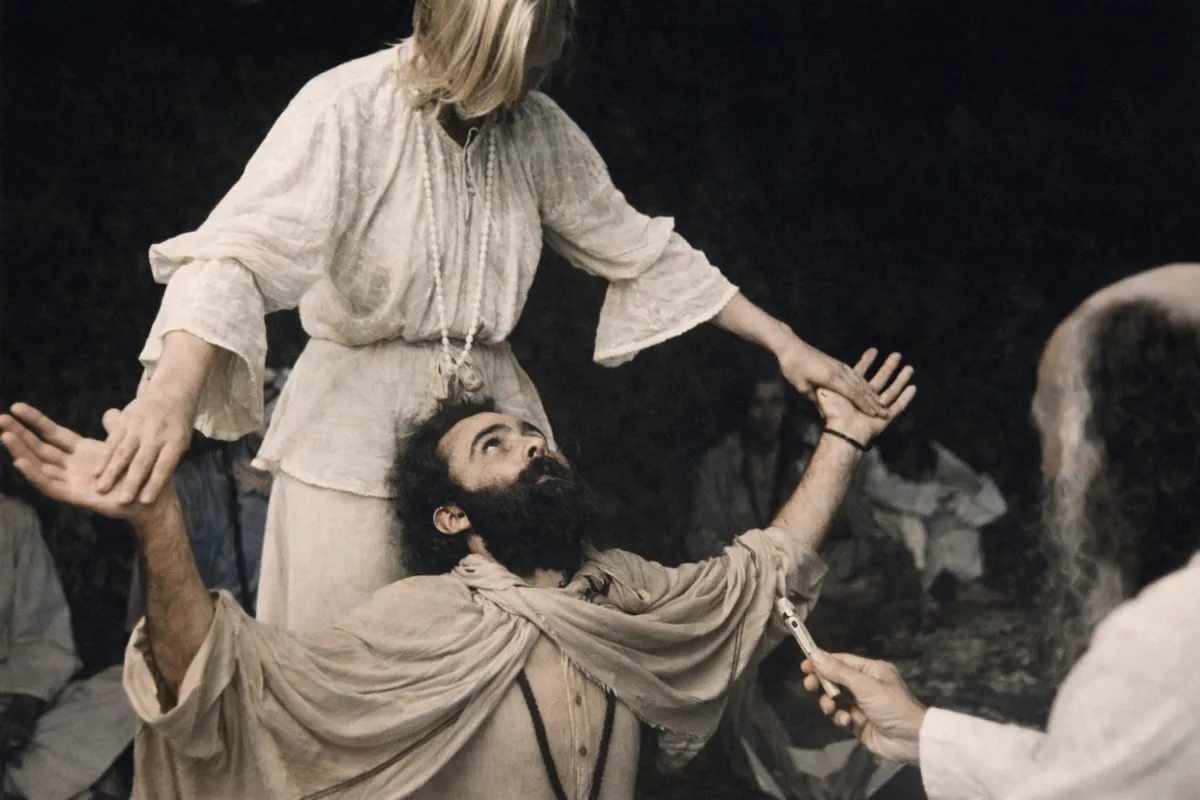
If your heart truly feels love, bowing to a statue is real; if you bow just to please others or out of habit, it’s pretend.
From the Discourses
Passages where Osho speaks to this question — each links to the complete discourse.
A friend has asked: “You oppose hypocrisy, yet here people are bowing their heads before your chair! This is sheer hypocrisy! Then what is the difference between this hypocrisy and bowing before the idol in a temple?”
It is a question of the mind. If someone bows before an idol in the temple with the same feeling with which they bow here, then that too is not hypocrisy. Hypocrisy is not in bowing before an image; hypocrisy is when only the mind is bending and the heart feels no experience. If even a stone is worshiped with love, the stone is divine. And if even God is worshiped like a stone, then it is all hypocrisy. But the one who has asked thinks he is asking a very intelligent question. He imagines he has asked something that cannot be answered. I am certainly an opponent of hypocrisy. Do you understand what hypocrisy means? Hypocrisy means bowing where the heart is not, where there is no attunement with the heart, where no duet of the heart has been struck. Because mother said, father said, the family said—so you…
Osho, all the wise ones have strongly opposed hypocrisy. Yet there is something about hypocrisy that it keeps slipping into the very sects that follow them and finds a life there. What gives hypocrisy so much force and attraction?
Hypocrisy is utterly weak; there isn’t a trace of strength in it. And there is no attraction in hypocrisy—there is great repulsion in it. But hypocrisy does not walk on its own feet; in fact, it has no feet of its own. Hypocrisy moves under the cover of ideals. Wherever ideals are handed out, hypocrisy will inevitably arise. Hypocrisy is the shadow of ideals; as in the blazing noon, if you walk, your shadow appears. Whoever moves through life with ideals will leave behind the shadow of hypocrisy. And yes, this is hard to grasp, because we assume ideals and hypocrisy are opposites. They are not opposites; they are companions. Inevitably companions. Create any ideal and, instantly, hypocrisy is born. What is needed is a religion that is not idealistic but realistic. That is exactly what I am telling you—a realistic religion. Then hypocrisy cannot arise. Suppose someone tells you,…
A friend has asked: Osho, if God is everywhere, then why would he not be in an idol?
Of course he will be. But the one who insists that he is only in the idol will never find him everywhere. And for the one who does not find him everywhere, he cannot be in the idol either. God is everywhere—certainly he is also in the idol. But the person who says, “He is only in the idol,” for that person he is not everywhere; and for the one for whom he is not everywhere, he cannot be in the idol either. And the one who says, “He is everywhere,” will not go searching for an idol; whatever he encounters will be God. He will not go searching for a temple, because all is his temple. Then he will not say, “This is my idol; I will worship it.” Whom to worship then? When all is that. Every breath is that, every particle is that—so whom to worship? I…
He has also asked: Can you not give me sannyas without the ochre robes?
Tomorrow you will say to me—what will meditation do? Can you not give me sannyas without meditation? What will prayer do? Can I not be a sannyasin without prayer? It is only a gesture, a pointer. Say what you like—if it is “madness,” then let it be this kind of madness. A devotee goes to give himself. Therefore the one who gives cannot set conditions. Devotion is surrender; surrender can only be unconditional. Yesterday I saw in the magazine Dharmyug an article on one of my sannyasinis, Preeti. The reporter used a phrase I liked—rang Rajneeshi, “the Rajneesh hue.” That pleased me. It is not “ochre”—it is the Rajneesh hue! Only when there is readiness for that hue does sannyas become possible; only when the mind is willing to let go to that extent. And much more will have to be dropped—this is only the beginning. It is as if…
A friend has asked: Osho, why should we think about death at all? We have life—let us live it. Be in what is present. Why allow the thought of death to come in between?
Just as there can be fear of sleep. Sleep is, in a way, a daily death. The day is life; the night is death. It is a piecemeal death. Every day we die a little, we sink within; in the morning we return fresh again. Then after seventy or eighty years the whole body gets tired—work, work, work—the body wears out. Then full death takes hold; the entire body changes. But we are very afraid of that. It is a deep sleep. Yet we are very afraid of it. Have you noticed that the body changes every morning too? It changes a little, which is why you don’t notice. It does not change completely; there is a partial transformation. When you go to sleep in the evening, your body is in one condition; when you wake in the morning, your body is in another. By morning the body has become…