
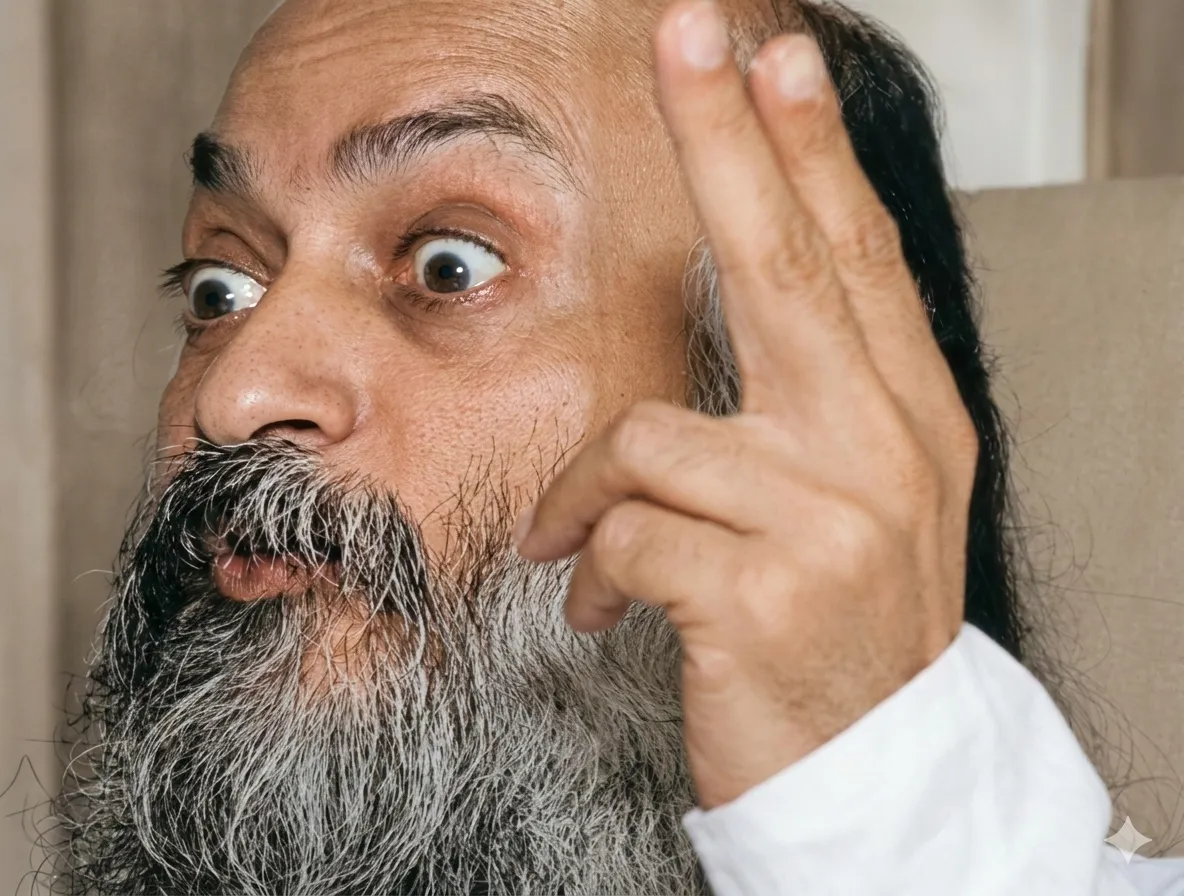
A mummy just gives birth and tries to control you; a real mother loves you into your own freedom; ‘Ma’ is Osho’s joking name for his women disciples.
From the Discourses
Passages where Osho speaks to this question — each links to the complete discourse.
What is the difference between waiting for godot and waiting for god?
It is as if the sun has risen in the morning and you are sitting in your room with closed doors and windows, in darkness. Open the doors, you become available to the sun. The sun was already available -- just the meeting happens. You cannot wait for God. All waiting is for Godot. Godot means the one who never comes, who CANNOT come, whose arrival is impossible. And the only impossible thing is that which has already happened -- how can it happen again? You are alive, and you are waiting for life, Now, this is ridiculous. The real man of religion does not think in terms of God. He thinks in terms of life or, even better, of living -- because life can again become an abstract idea. Living, moment-to-moment living. In that very living, one knows what God is, because one knows who one is. Your idea…
You have told many times why you call your male sannyasins "swami." can you explain why the women sannyasins are called "ma"?
The path of the masculine is that of awareness, and awareness brings you to a point where you become master of your own being. That is the meaning of SWAMI. The feminine path is that of love, and love brings you to an ultimate point where you can mother the whole existence. And that is the meaning of MA. A woman in her ultimate flowering becomes a mothering energy... she can mother the whole existence. She feels blessed, and she can bless the whole existence. When a man arrives at the ultimate point he does not become a father, he does not become a mother, he simply becomes a master: master of his own being. Love and awareness -- these are two paths. And when I say masculine I don't mean that all males are masculine, and when I say feminine I don't mean that all females are feminine. There…
Osho, when I went to Rajneeshpuram in July, in your discourses you said that in India no children should be born for many years. I repeated this to many people when I came back to Hindustan. Different people had different reactions, but most women said, “The maternal feeling in a woman—how is she to satisfy it?” Some said, “A woman does not attain fulfillment until she becomes a mother.” Please say something about this, Osho.
Second, it is true that a woman’s fulfillment is in her becoming a mother. That is why, when I began giving sannyas, the traditional name for a male renunciate was “Swami.” There was no name for a woman—because in India, for thousands of years, woman has been suppressed and erased so badly that she was never given the chance to be initiated into sannyas. There wasn’t even a name. After much search I accepted “Ma” as that name, because in “Ma” lies her fulfillment. But this fulfillment as mother is proof that your love has risen so high that the whole world becomes, for you, as if they are your children—even your husband. This is the blessing of the rishis of the Upanishads. Whenever a couple came to a rishi for a blessing, there was a very unique blessing, found in no other scripture in the world. The rishi would…
प्रश्न: ओशो, जुलाई में जब मैं रजनीशपुरम गई थी, तब आपने अपने प्रवचनों में कहा था, भारत में कई सालों तक बच्चा पैदा नहीं होना चाहिए। यही बातें हिंदुस्तान आकर मैंने कई लोगों से कहीं। अलग-अलग लोगों की अलग-अलग प्रतिक्रियाएं थीं, मगर ज्यादातर महिलाओं ने कहा, स्त्री में जो मातृत्व की भावना होती है, उसे वह कैसे सैटिस्फाई करे? कइयों ने कहा, नारी पूर्णता को प्राप्त नहीं करती, जब तक वह मां नहीं बनती। इस बारे में कुछ कहिए, ओशो।
दूसरी बात, स्त्री की पूर्णता उसके मां बनने में है, यह सच है। इसलिए मैंने जब संन्यास देना शुरू किया, तो पुरुषों के लिए तो परंपरागत नाम था संन्यासी का: स्वामी। स्त्री के लिए कोई नाम न था। क्योंकि भारत में हजारों साल से स्त्री को इस तरह दबाया है, इस बुरी तरह मिटाया है, उसे कभी मौका भी नहीं दिया है कि वह संन्यास में दीक्षित हो सके। उसके लिए कोई नाम भी नहीं है। बहुत खोज कर मैंने ‘मां’ का ही वह नाम स्वीकार किया, क्योंकि ‘मां’ में ही उसकी पूर्णता है। लेकिन यह मां की पूर्णता इस बात का सबूत है कि तुम्हारा प्रेम इतना ऊंचा उठ जाए कि ये सारे जगत में तुम्हारे लिए सभी यूं हो जाएं, जैसे तुम्हारे बच्चे हैं--तुम्हारा पति भी। …
WHY ARE THERE SO MANY FOREIGNERS IN YOUR MOVEMENT? IS IT BECAUSE OF THEIR BOREDOM WITH MATERIALISTIC ACHIEVEMENTS? There are many reasons. One is certainly their boredom. While the East is struggling for bread and butter, starving, the West has seen all that the world can give, and still the frustration remains. Now something more is needed. Just a good house, good food, good clothes, a good job, is not enough. But this becomes clear only when you have all these things, which may be necessary for living, but still they are not enough. Something more, of a higher value, is needed. Secondly, they are more educated, more intelligent. They have seen all the intellectual gymnastics from Aristotle to Bertrand Russell, and they have not got anything from them, because neither Aristotle nor Bertrand Russell is a meditator; they are just thinkers, and the people want something beyond the mind.
I have heard that at the time of giving sannyas to your mother, you had stepped off your chair and touched the feet of your mother. This unique situation has thrilled me. Please quench my desire for knowing some more. Who is greater -- mother or guru?
They are greater than each other. Asking that question is wrong. The very formulation: it is just like asking, "Which is greater -- the hen or the egg?" You don't understand. You divide hen and egg; they are indivisible. The hen is a state of the egg, the egg is a state of the hen. To ask: Who is greater -- mother or guru, mother or Master? is possible only if you don't understand what a mother is and what a Master is. Both are to be respected for a certain thing that is common to both: they both give birth. That's why they are respected. The mother gives birth to the physical being, the first birth is through the mother. The second birth is through the Master. The Master is a mother! Becoming a disciple means getting into the womb of the Master. A Buddhafield is a womb. To…