
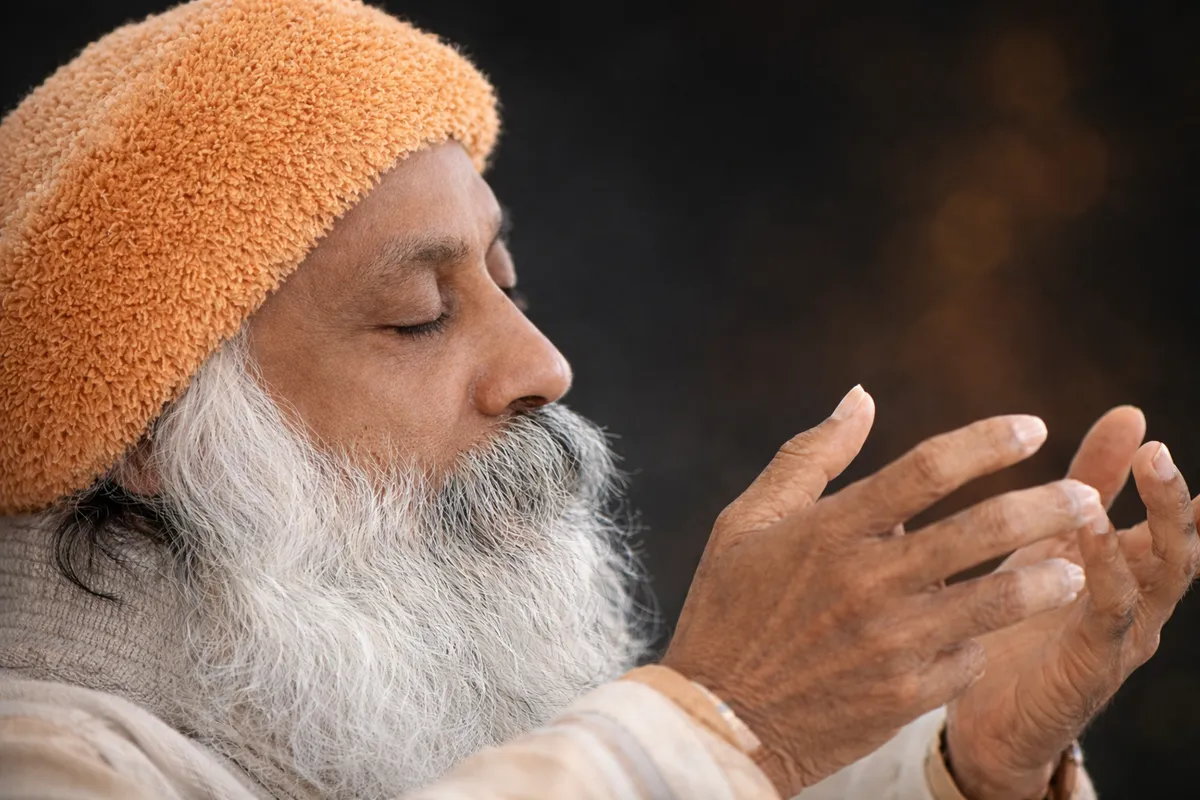
The same One is pretending to be both teacher and student; when you see it’s a hide-and-seek game, the distance vanishes and joy appears.
From the Discourses
Passages where Osho speaks to this question — each links to the complete discourse.
Osho, at this time and in this place, what does God make happen between you and us? What is the difference between you and us, and what is the connection?
I had long heard the sound of footsteps, but never met you face-to-face. In bewilderment the golden morning turned to dusky evening. The restlessness of each of my moments bowed down of its own accord. I had long heard the echo, but not the source of the sound. I had long heard the footfall, but never met you face-to-face. You too have heard the footfall; otherwise you would not have come here. You too have heard the echo; otherwise what would have brought you here? That very echo has brought you. But a direct meeting is not happening. I am standing facing him; you are standing with your back to him—this alone is the distance. It is not a great distance. About-turn—that is the distance. In the military they manage it. Turn around! “What is the difference between you and us?” Turn around! “And what is the connection?” From my…
What is the guru/disciple relationship?
Wittgenstein has said somewhere that what cannot be said can be shown. Saying needs no patience, but showing needs much patience. If I want to say something to you, I can say it this very moment. Your patience, your preparation is not needed. I can say it, and you will hear it. But if I want to show you something then you will have to make great preparations in order to see it. I cannot show it to you unless you have the capacity to see. The guru is basically not saying anything but trying to show something; and if the disciple is aware, then things become clear by not intervening. Things are always clear, but the mind is confused -- and a confused mind confuses things. As far as worldly things are concerned your mind cannot distort them too much because they are so objective that they do not…
The student returns satisfied with information; into the disciple’s life, knowing makes its entry. Knowing is that which transforms you; information is that which fills your memory. Information increases what you know; knowing increases you. Information may be useful in the market, but knowing is what avails in Paramatman. With the boat of information you may manage some convenience in the bazaar; but the boat of knowing can ferry you to the shore of the Beloved of Beloveds. Knowing and information seem alike, but they are not. A corpse, too, looks like the living from a distance. Come near and the odor arises. Examine closely and you will see the bird of life has flown. Information is such that its swan of life flew away long ago.
Beloved Osho, your relationship with your disciples seems to be unique among the religions. Would you say something about this?
The person who made it possible for you to have those few moments, the woman, the man -- be grateful, immensely grateful to the person. Yes, those moments are no more there. Nothing can be done about it. They cannot be pulled back, and even if there was some way to pull them back, they would not be the same. It would be a repetition. It wouldn't bring you the same joy, the same ecstasy. It is good that they cannot be pulled back, otherwise even the memory of those cherished moments would be spoiled. Respect the person, be grateful to the person that, for no reason at all -- she is a stranger, you are a stranger -- for no reason at all, for no bargain, there was no business... mysteriously the universe managed; something transpired between you. And it was nourishing to both of you. It has made…
Osho, according to the Paingala Upanishad there are four mahavakyas. First: tat tvam asi, That thou art; second: tvam tadasi, Thou art That; third: tvam brahmasmi, Thou art Brahman; and fourth: aham brahmasmi, I am Brahman. Osho, kindly explain the meanings and the subtle differences among these mahavakyas.
Kabir has said: the Master is a dyer. But before he dyes, he cleans; he washes, he brightens, he removes the grime from the cloth. Only when the cloth is clean can it be dyed; only then will the colors reveal their fullness. When these two points are complete—when it is clear that the disciple has understood: “I am not; Existence is”—then he is told the second point: do not fear, you too are that Existence. Yet the word “That” is still used. When it is understood that Existence, That, is all, the matter can be taken a little deeper, into the most subtle. “Tvam brahmasmi.” You are not only That; you are Brahman. Brahman means: now we have given “That” a face, personhood. We have endowed That with consciousness, with life. Now it is no longer an object, no longer a mere idol in a temple; now there is…