
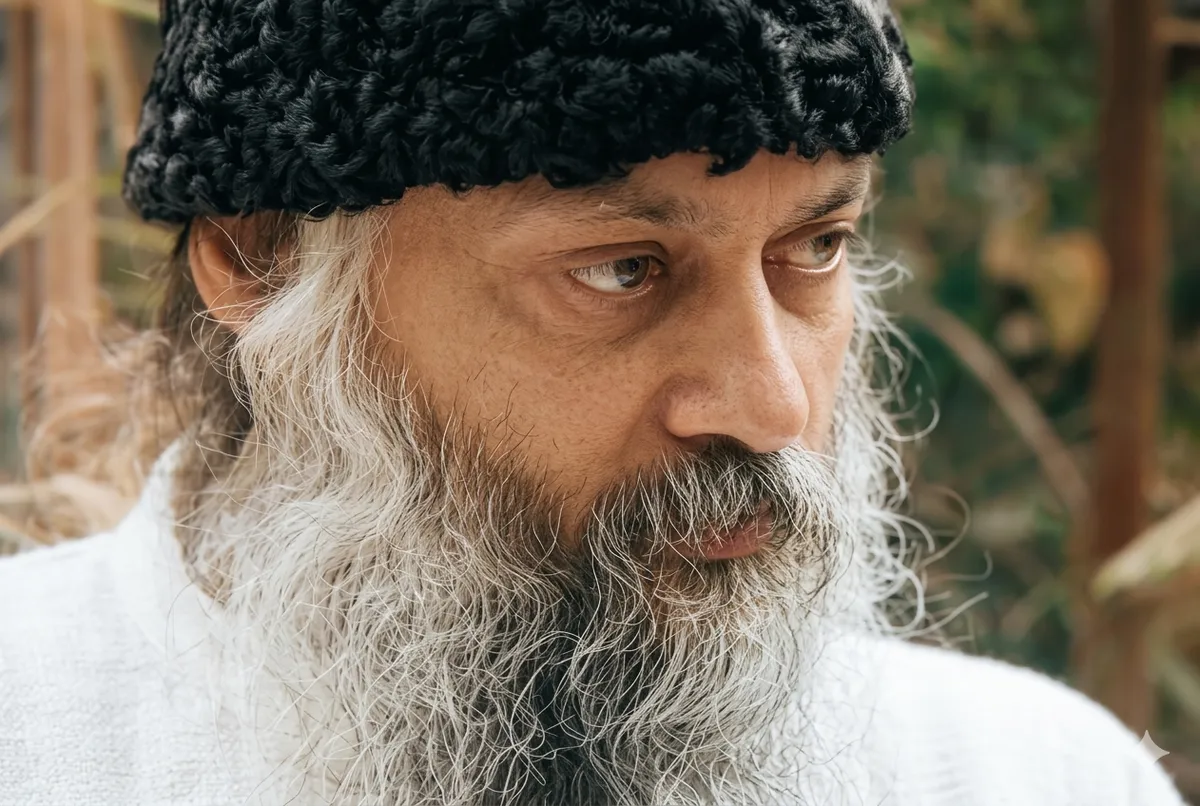
Reality never started and never ends, and you can feel it only when you stop thinking and are fully present.
From the Discourses
Passages where Osho speaks to this question — each links to the complete discourse.
My mind has difficulty understanding the existence of beginninglessness. Would you please talk about it?
Slowly slowly, learn the art of contacting reality without the mind interfering. Sometimes when the sun is setting, just sit there looking at the sun, not thinking about it -- watching, not evaluating, not even saying, "How beautiful it is!" The moment you say something, the mind has come in. The mind consists of language. Don't use language. Can't you just see the sunset and its beauty? Can't you be overwhelmed by its beauty? Can't you be possessed by its grandeur? What is the point of bringing language in? Nobody is asking you to say anything. The sun does not understand your language, the clouds that have become so beautiful and luminous in the setting sun are unable to understand your language. Why bring it in? Put it aside; be in direct contact, be thrilled. If tears come to your eyes, good. If you start dancing, good. Or if you…
To know? No, no. Not to know—about there being a beginning; the question of knowing does not even arise. If there is a beginning, it can be known. Whatever is, can be known. Now, what is not—what will you do about that? A beginning is impossible. The question of the limit of knowledge does not arise at all. That is, it is not that Mahavira says, “I don’t know whether there is a beginning or not.” I am also not saying that this is the limit of our knowledge—that we cannot find out when the beginning happened.
No, that is not the question. The question is that the very concept—the hypothesis—of a beginning is impossible; it is not possible. It is impossible because even for a beginning, something must already be there eternally; otherwise, even a beginning cannot occur. That is, for a beginning to be possible, existence must precede it; otherwise the beginning itself is not possible. And once there is a prior existence, it is no longer a beginning. And then you can keep pulling this back. Consider someone saying the world, existence, has a boundary. We might say: “We have no evidence of a boundary—of a point where the world ends, where existence comes to an end and beyond which there is nothing.” So we might say, “We don’t know. Perhaps one day man will reach that place where the world ends. Our knowledge is limited—we know very little. We have barely managed to…
प्रश्न: जानने की? नहीं, नहीं। जानने की नहीं, प्रारंभ के होने की, जानने का तो सवाल ही नहीं है। अगर प्रारंभ है तो जाना जा सकता है। जो है, वह जाना जा सकता है। अब जो नहीं है, उसके लिए क्या करिएगा? प्रारंभ असंभव है। ज्ञान की सीमा का सवाल ही नहीं है। यानी ऐसा नहीं है कि महावीर यह कहते हैं कि मुझे पता नहीं है कि प्रारंभ है कि नहीं। मैं भी ऐसा नहीं कह रहा हूं कि यह हमारे ज्ञान की सीमा है कि हमें पता नहीं चल सकता कि प्रारंभ कब हुआ।
नहीं, यह सवाल नहीं है। सवाल यह है कि प्रारंभ की अवधारणा, वह जो हाइपोथीसिस है प्रारंभ की, वह इंपासिबल है, वह पासिबल नहीं है। वह इसलिए असंभव है कि प्रारंभ के लिए भी पहले कुछ सदा से होना चाहिए, नहीं तो प्रारंभ भी नहीं हो सकता। यानी प्रारंभ के संभव होने के लिए भी प्रारंभ के पहले अस्तित्व चाहिए, नहीं तो प्रारंभ भी संभव नहीं हो सकता। और जब पहले अस्तित्व चाहिए तो वह प्रारंभ नहीं रह गया। और फिर इसको आप पीछे खींचते चले जाएं। जैसे समझ लें कि कोई आदमी कहे कि दुनिया की, जगत की एक सीमा है। और हम कहें, भई, हमें तो सीमा का कोई पता नहीं कि एक जगह जगत समाप्त हो जाता है, अस्तित्व एक जगह जाकर समाप्त हो जाता है जिसके आगे कुछ भी नहीं है। तो हम कहें, हमें पता नहीं है। हो सकता है एक दिन आदमी उस जगह पहुंच जाए, जहां जगत समाप्त हो जाता है। क्योंकि हमारा ज्ञान अभी सीमित है, हम बहुत थोड़ा सा ही तो जानते हैं। अभी चांद पर ही तो पहुंच पाए मुश्किल से और जगत तो, अस्तित्व तो बड़ा विस्तीर्ण है। …
Suppose you contemplate something beyond perception, beyond grasping, beyond not being. -- you.
I AM EXISTING. THIS IS MINE. THIS IS THIS. OH BELOVED, EVEN IN SUCH KNOW ILLIMITABLY. ... You can use any mantra: RAM, RAM, AUM, AUM -- anything. You can use Jesus Christ; you can use Ave Maria. You can use any word and monotonously chant it; it will give you deep sleep. You can even do this: Raman Maharshi used to give the technique WHO AM I? And people started using it as mantra. They would sit with closed eyes and they would go on repeating. ... `Who am I? ... Who am I? ... Who am I? ... It had become a mantra. That was not the purpose. So don't make it a mantra, and sitting, don't say, `I am existing. There is no need. Everyone knows, and you know already that you are existing; there is no need, it is futile. Feel it -- I AM EXISTING. Feeling is a different thing,
Osho, does living moment-to-moment begin the awareness of interdependence?
You have heard of Baital Pachisi (the Vetala tales). You would never suppose it could be a teaching for the wise—yet this land has made unique experiments. It has produced books that can be read on many levels, with layer upon layer of meaning—two, three, four, five meanings running parallel like five roads side by side. Thus whoever you are, there is a way. A small child enjoys it; the supreme knower enjoys it. The seeker finds the path; the arrived recognizes the destination. For one who is neither, it is a diversion—that too is something, a little entertainment. The first story goes like this. Emperor Vikramaditya was in court when a fakir arrived. As custom had it, people came in the morning to offer gifts. The fakir offered a wild-looking fruit. The emperor smiled—why come so far to offer a jungle fruit? But a fakir has nothing else, so…
पहला प्रश्न: ओशो, क्या क्षण-क्षण जीने से परस्पर-तंत्रता का बोध शुरू होता है?
तुमने बैताल पचीसी का नाम सुना होगा। तुम कभी सोच भी नहीं सकते कि वह भी कोई ज्ञानियों की बात हो सकती है, बैताल पचीसी। पर इस देश ने बड़े अनूठे प्रयोग किए हैं। इस देश ने ऐसी किताबें लिखी हैं, जिनको बहुत तलों पर पढ़ा जा सकता है, जिनमें पर्त दर पर्त अलग-अलग अर्थ हैं। जिनमें एक साथ दो, तीन, चार और पांच अर्थ दौड़ते रहते हैं। जैसे एक साथ पांच रास्ते चल रहे हों, पैरेलल, समानांतर। तो जिसकी जो सुविधा हो। एक छोटा बच्चा भी बैताल पचीसी पढ़कर प्रसन्न होगा और परम ज्ञानी भी पढ़कर प्रसन्न होगा। खोजी को मार्ग मिल जाएगा, पहुंचे हुए को मंजिल की प्रत्यभिज्ञा होगी। जो नहीं खोजी है, नहीं पहुंचा हुआ है, उसके लिए सिर्फ चित्त का मनोरंजन होगा। वह भी क्या कम है! थोड़ी देर को मन बहलाव हो जाएगा। बैताल पचीसी की पहली कथा है.। पच्चीसों ही कथाएं बड़ी अदभुत हैं, लेकिन पहली तुम से कहता हूं। पहली कथा है कि सम्राट विक्रमादित्य के दरबार में एक फकीर आया। सुबह का वक्त था। रिवाज के अनुसार लोग सम्राट को भेंट चढ़ाने सुबह-सुबह आते थे। …
Osho, the stream of the timeless is what Lord Buddha called a muhurta for a fleeting instant, and you call the same thing the present. This too makes sense to me, and yet it remains beyond my understanding. But even from this little understanding the joy that arises fills me with gratitude. Osho, I come to your refuge.
All those who have known, all who have awakened, have said one thing with certainty: truth is outside the stream of time—timeless, beyond time. The world is within time—or say, whatever is within time is the world; whatever is outside time is liberation. You can gather a few glimpses of this in your own life now and then. Consider: when you are unhappy, time seems long. When pain becomes intense and your very life writhes in suffering, time grows lengthy. The clock’s pace remains the same; the clock does not see your pleasure and pain, it knows nothing of them. It moves at its own rhythm, yet an hour passes as if centuries are passing. Whoever has known sorrow has known the long stretch of time; time becomes longer and longer. A loved one is dying, and you sit by their cot through the night; the night becomes so long…
दूसरा प्रश्न: ओशो, समयातीत की धारा को भगवान बुद्ध ने मुहूर्त भर कहा है और आपने उसी को वर्तमान कहा। यह मेरी समझ में भी आता है, फिर भी समझ के बाहर रह जाता है। लेकिन इस अल्प समझ से ही जो आनंद आता है, उससे मैं कृतज्ञता के भाव से भर जाता हूं। ओशो, मैं आपकी शरण आता हूं।
जिन्होंने भी जाना, जो भी जागे, उन सभी ने एक बात तो सुनिश्चित रूप से कही है कि सत्य समय की धारा के बाहर है, समयातीत है, कालातीत है। संसार है समय के भीतर--या यूं कहो कि जो समय के भीतर है वही संसार है; जो समय के बाहर है वही मोक्ष है। इसकी तुम अपने जीवन में थोड़ी-थोड़ी झलकें कभी-कभी जुटा सकते हो। सोचो: जब दुखी होते हो तो समय लंबा मालूम होता है। जब कोई पीड़ा सघन हो जाती है और प्राण किसी दुख में तड़पते हैं, समय लंबा हो जाता है। घड़ी की चाल तो वही होती है। घड़ी कोई तुम्हारे दुख-सुख को नहीं देखती। घड़ी को तुम्हारे दुख-सुख का कोई पता नहीं है। …