
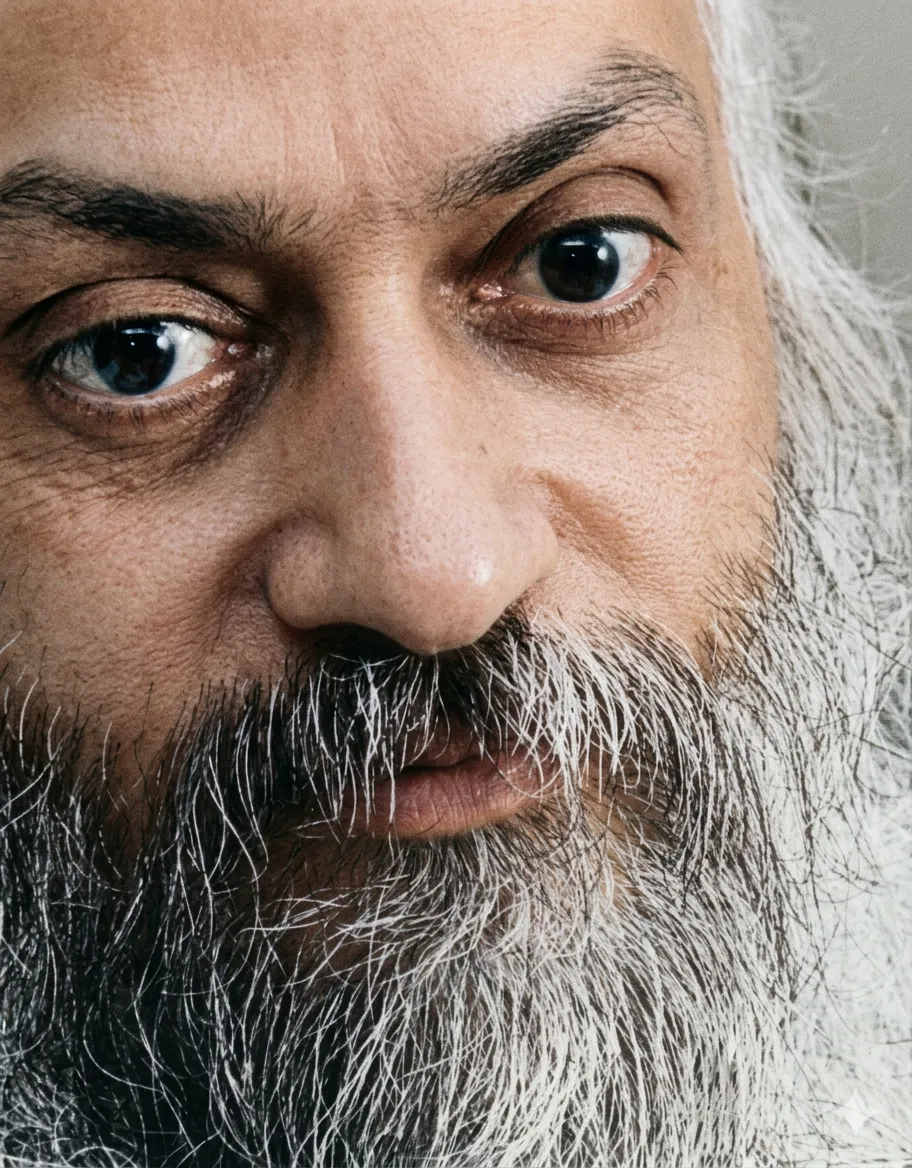
Awareness isn’t something to perfect—you already have it; just notice the one who is noticing, stay alert, and let the seeing be clear and simple.
From the Discourses
Passages where Osho speaks to this question — each links to the complete discourse.
Beloved Osho, I have no idea about what `right awareness' is. How to judge that I am going in the right direction?
There is no right awareness because there is no possibility of wrong awareness. Awareness is right. So first, drop the wrong question. Once you are asking a wrong question to yourself you cannot get the right answer. Don't ask what is right awareness. Simply ask what is awareness. Your question gives the fallacious impression that you know what awareness is, that the only thing that you don't know is, what is right awareness and what is not right awareness. Erase that fallacy completely from your mind. Awareness is simple, very innocent. Everyone has it, so it is not a question of achievement. One wrong question leads to another wrong question: first you ask what right awareness is, then you ask how to achieve it. You already have it. When you see the sunset, are you not aware? When you see a roseflower, are you not aware? You are aware of…
Beloved Osho, what is awareness? Why is it lost, and how can it be regained? Are there any steps for the same?
Awareness is never lost. It simply becomes entangled with the other, with objects. So the first thing to be remembered: it is never lost, it is your nature, but you can focus it on anything you want. When you get tired of focusing it on money, on power, on prestige, and that great moment comes in your life when you want to close your eyes and focus your awareness on its own source, on where it is coming from, on the roots -- in a split second your life is transformed. And don't ask what are the steps; there is only one step. The process is very simple. The step is only one: that is turning in. In Judaism there is a rebellious school of mystery called Hassidism. Its founder, Baal Shem, was a rare being. In the middle of the night he was coming from the river -- that…
Osho, is choiceless awareness also a kind of choice? It seems to come down to a paradox.
No, choiceless awareness is not a choice. Choiceless means we do not make any choice, we do not select any option; we simply awaken. In that awakening we do not decide, “This is right, that is wrong; this should be accepted, that should be dropped.” We make no decision. We simply look, awake. In this awakened seeing there is no choice at all. And as long as there is choice, we cannot see with awareness. “Awareness with choice”—there is no such thing. Awareness, as such, is without choice. Awareness by its very nature is choiceless. So awareness can never be together with choice, because choice means bias has begun; sleep has begun. There are so many people sitting here: if I say, “Bacchu-bhai is a fine man,” then I cannot be aware in relation to Bacchu-bhai either, because my attachment has begun. Nor can I be aware in relation to…
Osho, please say something about this news item: the indian express of 18th august reports that the rajneesh film won't reflect the real image of india. The union information minister, l.k. Advani said in the parliament, 'foreign television and film units have been refused permission to document the activities of the rajneesh ashram, as it is felt that a film on the activities of the ashram would not reflect favourably on india's image abroad.'
If this country is going to be destroyed one day, the reason will be these people who are in power today. India cannot have one language. And if it can have one language, that language has to be neutral; either it will be English or Esperanto, but not Hindi, not Gujarati, not Marathi, not Bengali, not Tamil. It will have to be a neutral language. English is neutral; it is nobody's mother tongue in India. And English is international too, so it is perfectly good. I support a two-language formula: English as the national language, because it is also international and as the second language, the mother tongue. Each child should be taught two languages. Forget all about Hindi, and forget all about creating one monolith in this country of variety, of multiplicity. And they are trying to do the same thing with religion too, in the same way. They…
Is there such a thing as right or wrong?
Akam, there is no such thing as right or wrong, because something may be right this moment and it may not be right the next moment. Something may be wrong today and may not be wrong tomorrow. Right and wrong are not fixed entities, they are not labels that you can put on things, "This is right" and "This is wrong." But this has been done up to now. Right and wrong have been decided by people. And because people have decided right and wrong, they have misguided the whole humanity. Manu decides in one way: what he thinks is right becomes right for millions and millions of Hindus for thousands of years. It is so stupid, it is unbelievable! How can people go on following Manu for five thousand years? Everything else has changed. If Manu comes back he will not be able to recognize the world at all;…