
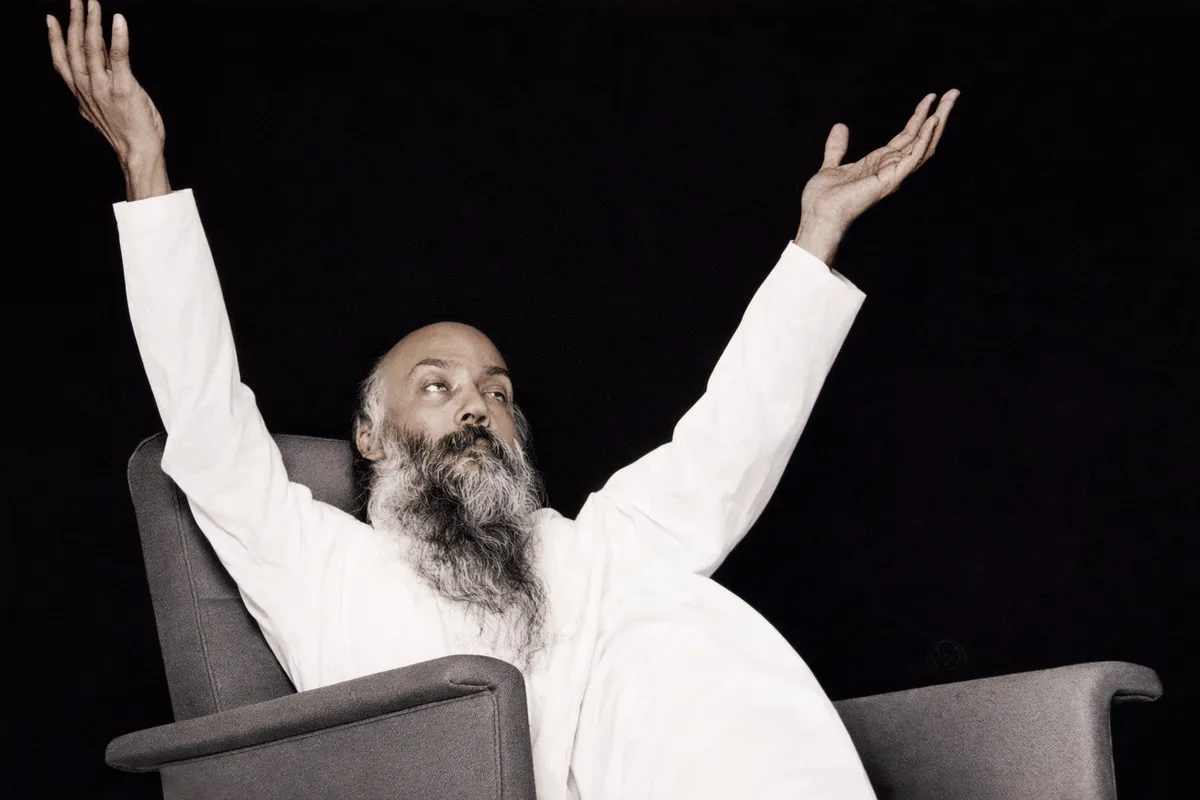
According to Osho, courage is choosing the unknown in spite of fear. It isn’t fearlessness; fearlessness is the fragrance that arises when courage matures. The courageous don’t obey fear; they risk the known for the unknown, accept life’s challenges, and discover vitality, intelligence, and joy. Repeatedly stepping into uncertainty transforms life from boredom into adventure.
Courage means you feel scared but still try new, unknown things, and the more you do, the less scary life feels.
From the Discourses
Passages where Osho speaks to this question — each links to the complete discourse.
Beloved Osho, what is courage?
Premo, courage means going into the unknown in spite of all the fears. Courage does not mean fearlessness. Fearlessness happens if you go on being courageous and more courageous. That is the ultimate experience of courage -- fearlessness; that is the fragrance when the courage has become absolute. But in the beginning there is not much difference between the coward and the courageous person. The only difference is, the coward listens to his fears and follows them, and the courageous person puts them aside and goes ahead. The courageous person goes into the unknown in spite of all the fears. He knows the fears, the fears are there. When you go into the uncharted sea, like Columbus did, there is fear, immense fear, because one never knows what is going to happen and you are leaving the shore of safety. You were perfectly okay, in a way; only one thing…
Osho, what is courage?
If soldiers are allowed to be intelligent, wars will disappear from the earth. Wars can exist only if soldiers are made in such a way, conditioned in such a way that they lose all intelligence. That's why unintelligent training has to be forced on them for years. Now the soldier goes on doing things which make no sense for years. Early in the morning he gets up, he has to line up and the parade begins. And "left turn," and "right turn," and "about turn," and "go forward," and "go backward." For what? And for hours together. In the Second World War a philosopher was recruited. When the commanding officer said, "Right turn!" everybody turned right except the philosopher. The commanding officer asked, "Why? Why are you not turning right?" He said, "Why should I turn? I have no business there; I don't see the need. And I think all…
Osho, you were more awake as an infant than I am now. How did this courage and awareness happen?
In India, in Punjab, if you are traveling in Punjab -- you can ask Neelam -- never ask anybody, "What is the time?" because if it happens to be twelve you will be beaten. And if you can escape alive it will be just a miracle. It is just for a very philosophical reason -- but when philosophy comes into the hands of fools, this is what happens. Nanak, the founder of Sikhism, has said that the moment of samadhi is just like two hands of the clock meeting on twelve, where they are no longer two. He was just taking an example -- that in the moment of samadhi the two-ness of your being dissolves and you arrive at oneness. The same happens in death too. He explained later on that the same happens in death. Again the two hands which have been separately moving come together and stop,…
Beloved Osho, I feel divided in two parts -- half going towards the unknown, and half towards all that is familiar from my past. When I get close to letting go of what I believe is mine, I panic -- even though I yearn to go to the place you talk about. Please give me courage to take the next step.
The real question is not of courage; the real question is that you don't understand that the known is the dead, and the unknown is the living. Clinging to the known is clinging to a corpse. It does not need courage to drop the clinging; in fact it needs courage to go on clinging to a corpse. You just have to see... That which is familiar to you, which you have lived -- what has it given? Where have you reached? Are you not still empty? Is there not immense discontent, a deep frustration and meaninglessness? Somehow you go on managing, hiding the truth and creating lies to remain engaged, involved. This is the question: to see with clarity that everything that you know is of the past, it is already gone. It is part of a graveyard. Do you want to be in a grave, or do you want…
So only those who are courageous enough can know life. Others only vegetate, they don't live. Courage can be of two types. The first type is the most prevalent one. The first type is cultivated. You repress your fear and you go on repressing your fear, so much so that it disappears from your consciousness and becomes part of your unconscious. You are no more aware of it and you start thinking that there is no fear in you. In ordinary situations it will work, but in any extraordinary situation in which real courage is needed you will have a breakdown. The fear will surface again. It was only on the surface that you were courageous. It had not become your soul. The second type, the second category of courage is spontaneous, natural, uncultivated. It does not come by repressing fear.