
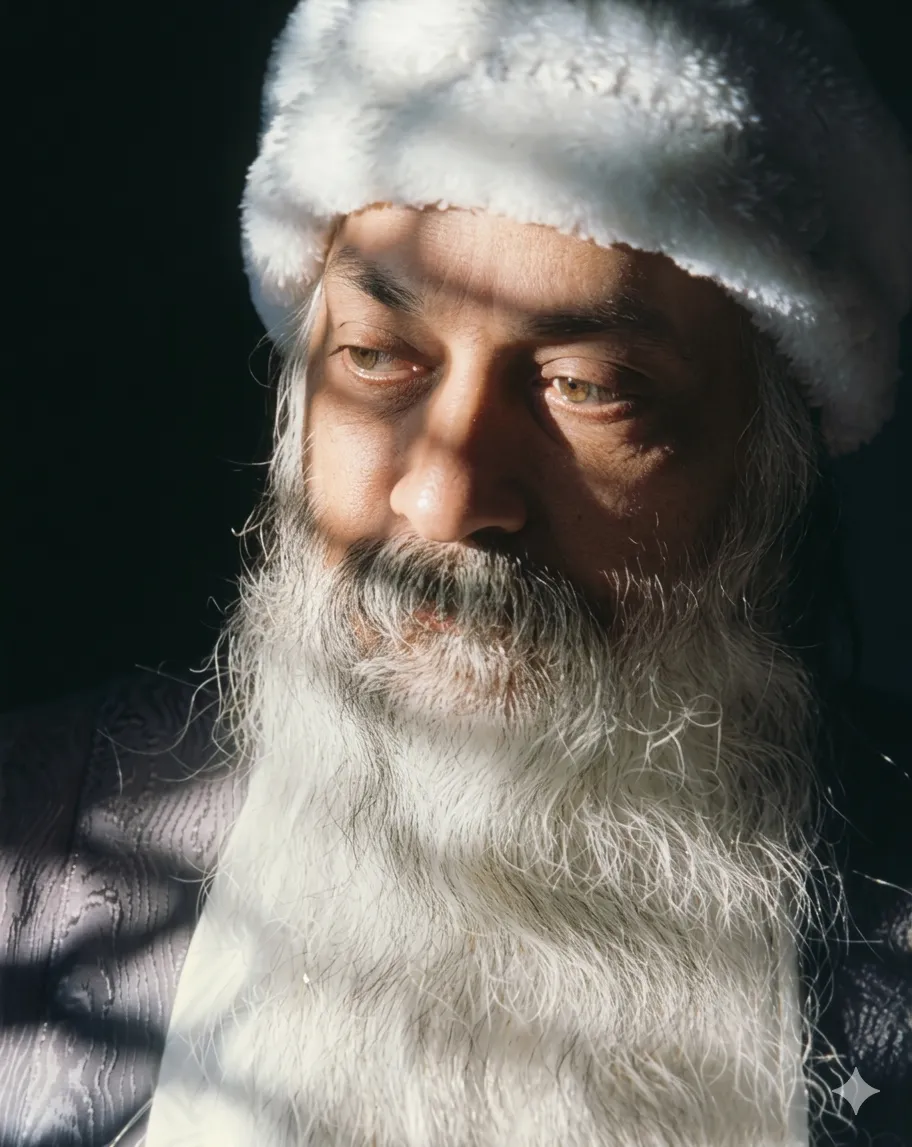
An oldie is someone in the last fourteen years of life; if people usually live to around 70, that starts at age 56.
From the Discourses
Passages where Osho speaks to this question — each links to the complete discourse.
I hear there is a room in the ashram called: the office of the grande seducer of the oldies. How olde is an oldie?
The question is from Astha. Now, it is a very technical thing, but I will try to give you a layman's conception. And I will give you the right address where you can find a more informed and expert opinion. Yes, there is a secret organization here in the ashram called SIN, s-i-n. "S" stands for seduction, seduction into neo-sannyas. That is the name of the organization, SIN. And there are three branches of the organization: for the babies, and for the oldies, and for those who are in-between. For the babies, up to the fourteenth year -- because by that time sexual maturity happens, and the baby is no more a baby. In fact, he is ready to create new babies, so he cannot be a baby. So you can demark the line -- fourteen years is the line for the babies; after birth, fourteen years. Before death, fourteen…
Beloved Osho, I am also getting old. Would you tell me a few laws for middle age also?
In India, the idea of evolution has never existed, but on the contrary just the opposite idea. The word is not even used in the West -- you may not have even heard of the word -- but in India they have been thinking about involution, not evolution: "We are shrinking, we are falling down." In the second stage of the fall one leg is lost; the table becomes a tripod. It is still balanced, but not as much as it was with four legs. In the third stage it loses another leg; now it is standing only on two legs, absolutely unbalanced. And this is the fourth stage: even two legs are not available; you are standing on one leg -- how long you can stand? The first stage is called satyuga, the age of truth; the second is simply named by the number; treta is the third, because…
Osho, I have heard that a seeker has to pass through four stages of sadhana: tariqat, shari’at, marifat, and haqiqat. The last is haqiqat, where the seeker meets his beloved and comes face to face with Truth. Osho, please explain the first three states.
These words are from the Sufis—very significant, and very straightforward. The first is tariqat. Tariqat means: the way, the method, the discipline, the means, the yoga. Tariqat means: something has to be done; only then will you attain—without doing, you will not receive. One has to walk a path; find the way; make a footpath. One has to bring some discipline into life, give it an order. Tariqat means learning the way to become worthy of it. When you go to have an audience with an emperor, you learn the etiquette of his court. You don’t just walk in. If you do, you will not be accepted. You learn how to sit there, how to stand there, how to bow there. If you are going to meet an emperor, you must taste something of the flavor of the emperor’s way of life. If you are going to meet the Divine,…
दूसरा प्रश्न: ओशो, मैंने सुना है कि साधक को साधना के चार चरणों से गुजरना पड़ता है: तरीकत, शरीअत, मारिफत और हकीकत। अंतिम है हकीकत, जहां साधक अपने सनम से मिलता है और सत्य के साथ उसका साक्षात्कार हो जाता है। ओशो, कृपया पहली तीन स्थितियों को समझायें।
… बहुत सीधे-साफ भी हैं। पहला है तरीकत। तरीकत का अर्थ होता है: तौर-तरीका, विधि-विधान, उपाय, योग। तरीकत का अर्थ होता है: कुछ करना है, तो उसे पा सकेंगे; बिना किये तो न मिलेगा। कुछ रास्ता चलना है; मार्ग खोजना है; पगडंडी बनानी है। कुछ जीवन में अनुशासन लाना है, व्यवस्था देनी है। तरीकत का अर्थ होता है, उसके योग्य हो सकें, इसका तौर-तरीका सीखना है। तुम किसी सम्राट के दर्शन करने जाते हो, तो तुम उसके दरबार का तौर-तरीका सीखते हो। ऐसे ही तो नहीं चले जाते। ऐसे ही तो स्वीकार न हो सकोगे। तुम सीखोगे कि कैसे वहां बैठेंगे, कैसे वहां उठेंगे, कैसे वहां झुकेंगे। सम्राट से मिलने जा रहे हो तो सम्राट के जीवन का जो ढंग है उस ढंग का कुछ स्वाद तुम्हें लेना होगा।
Osho! Death does not frighten me as much as the thought of old age, or old age itself. Why is that?
Therefore I say to you: drop worrying about yoga. Enjoy bhoga so totally that by the very enjoyment you become free of enjoyment. And then yoga will kindle of its own accord. The lamp will light by itself. Then there is no death. Then even death brings only one message—release from the body. Then death is not an end—only the beginning of a new journey; only release from the body. And the body is narrow. The body is as if one were shut in a prison, as if a bird were trapped in a cage. Death brings the news that the cage has broken. And now the hamsa can fly. Let the hamsa go alone! Now—to Manasarovar! Now—let us go home! What message of death has arrived? By whose jewel-like voice has the music of rhythm been sung? What message of death has arrived? The body grew tired and worn;…
चौथा प्रश्न: ओशो! मृत्यु से मुझे इतना भय नहीं लगता जितना वृद्धावस्था के विचार से या वृद्धावस्था से। ऐसा क्यों है?
इसलिये, मैं तुमसे कहता हूं: योग की फिक्र छोड़ो। तुम भोग को इतनी परिपूर्णता से भोगो कि तुम भोग से भोग के कारण ही मुक्त हो जाओ। और तब योग अपने-आप जलेगा। अपने-आप दीया जलेगा। फिर मौत नहीं। फिर तो मृत्यु भी सिर्फ एक ही संदेश लाती है--देह-मुक्ति का। फिर मृत्यु अंत नहीं है--सिर्फ एक नई यात्रा का प्रारंभ है; सिर्फ देह से छुटकारा है। और देह तो संकीर्ण है। देह तो ऐसी है जैसे कोई कारागृह में बंद है, कि पक्षी पिंजड़े में बंद है। मौत तो खबर लाती है कि पिंजड़ा टूट गया। और अब हंसा उड़ सकता है। हंसा जाये अकेला! अब चलो मानसरोवर! अब चलें अपने घर!
Osho, “na sā sabhā yatra na santi vṛddhāḥ; vṛddhāḥ na te ye na vadanti dharmam. nāso dharmo yatra na satyam asti; na tat satyaṁ yac chalelānuviddham.” “A gathering without elders is no assembly; those who do not expound dharma are not elders. That which has no truth is not dharma; that which is laced with deceit is not truth.” Osho, please say something on this subhāṣita from the Mahābhārata.
Sahajanand, growing old is very easy. Do nothing and you will grow old anyway. The irreligious grow old, the religious grow old; sinners and saints; virtuous and unvirtuous. Growing old is not an art. Animals grow old, birds grow old, trees grow old, mountains grow old. Vindhyachal is Earth’s oldest mountain—so old its back has bent. From that bent back came the story that when the sage Agastya went south, Vindhya bowed to salute him. Agastya said, “Stay bowed till I return,” and he never did. Ever since, poor Vindhyachal remains bent. The truth is: Vindhya is the oldest, and the Himalayas the youngest. Mountains grow old, trees grow old, birds and animals grow old, humans grow old. Old age in itself is not a virtue; it carries no intrinsic worth. So the aphorism says, “A gathering without elders is no assembly.” Taken at face value, it is simply wrong.…
पहला प्रश्न: ओशो,न सा सभा यत्र न सन्ति वृद्धाःवृद्धाः न ते ये न वदन्ति धर्मम्।नासो धर्मो यत्र न सत्यमस्तिन तत्सत्यं यच्छलेलानुविद्धम्।।‘जिसमें वृद्ध नहीं हैं वह सभा नहीं है; जो धर्म को नहीं बतलाते वे वृद्ध नहीं हैं।जिसमें सत्य नहीं है वह धर्म नहीं है; जिसमें छल मिला हुआ है वह सत्य नहीं है।'ओशो, महाभारत के इस सुभाषित पर कुछ कहने की कृपा करें।</cr></cr></cr></cr></cr></cr></cr>
सहजानंद, वृद्ध होना तो बहुत आसान है। कुछ न करो तो भी वृद्ध हो ही जाओगे। अधार्मिक भी वृद्ध हो जाता है, धार्मिक भी वृद्ध हो जाता है; पापी भी, पुण्यात्मा भी; साधु भी, असाधु भी। वृद्ध होना कोई कला नहीं है। पशु-पक्षी भी वृद्ध होते हैं, वृक्ष भी वृद्ध होते हैं, पहाड़-पर्वत भी वृद्ध होते हैं। जैसे विंध्याचल पर्वत पृथ्वी का सबसे ब़ूढा पर्वत है--इतना कि उसकी कमर झुक गई है। उसकी झुकी कमर के कारण ही यह कहानी बनी कि अगस्त्य ऋषि दक्षिण गए, तब विंध्याचल ने झुक कर उनको नमस्कार किया। और वे कह गए कि जब तक मैं लौट न आऊं, तब तक तू झुका रहना। फिर वे लौटे नहीं, वे समाप्त ही हो गए। तब से बेचारा विंध्याचल झुका ही है। असलियत यह है कि विंध्याचल पृथ्वी पर सबसे बूढ़ा पर्वत है और हिमालय सबसे युवा।