
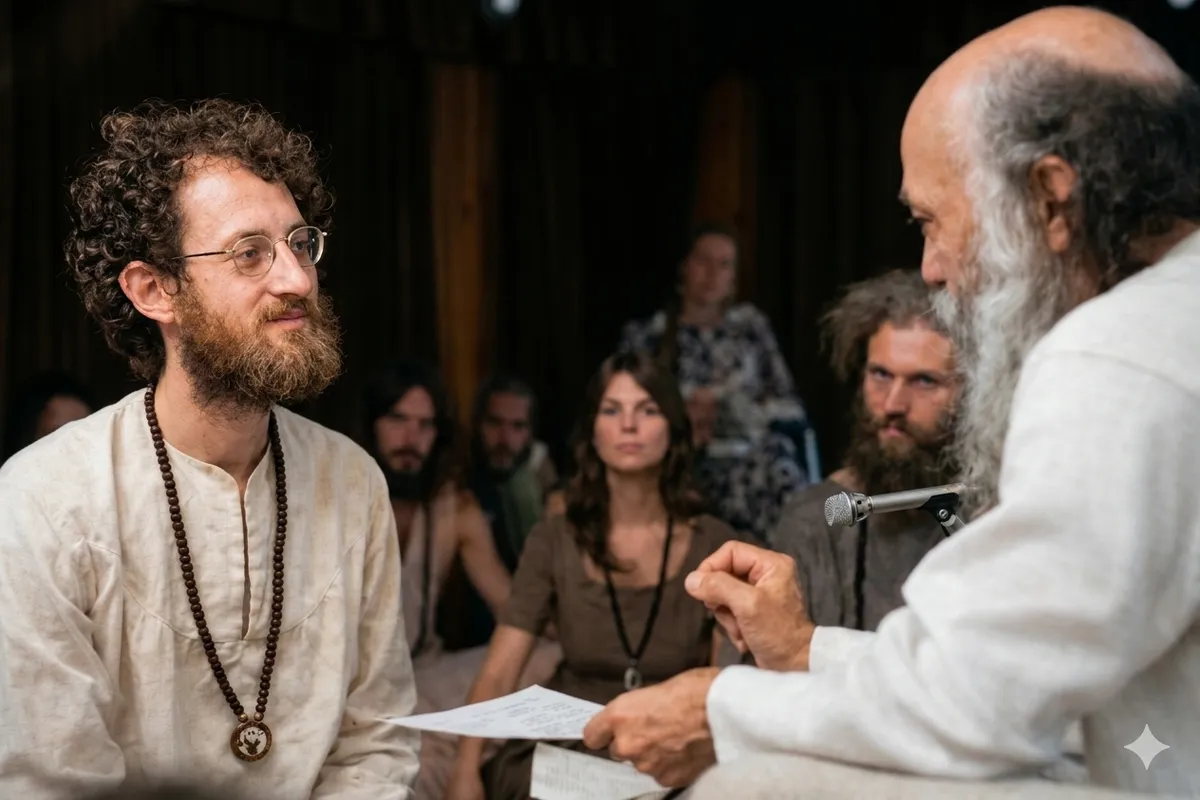
It’s when there’s no “you” looking at God; your whole self becomes one, and you simply are That.
From the Discourses
Passages where Osho speaks to this question — each links to the complete discourse.
What is a mystical experience?
And God laughed and said, "Because you all are together here. Touching each other, you have become total. And I can only be available to you when you are total. Now, you are not fragments. Up to now you have been fragments: one was working through the heart, another was working through the head, and the third was working through the body. You were fragmentary. And I am not available to the fragments: I,am available only when somebody becomes total. In this moment, your energies met and mingled with each other. "I have always followed you, but have remained invisible because the I can only see me when it is total. Now you can touch me! Now you can have me! You have been missing me for only one reason: you were adamant, stubborn; you were clinging to one fragment -- and God is a totality." This is my message…
Osho, what is mysticism?
Mysticism is the experience that life is not logic, that life is poetry; that life is not syllogism, that life is a song. Mysticism is the declaration that life can never really be known; it is essentially unknowable. Science divides existence into two categories: the known and the unknown. The known was unknown one day; it has become known. The unknown is unknown today; tomorrow, or the day after tomorrow, it will also become known. Science believes that sooner or later a point of understanding will arrive when there will be only one category: the known, all will have been known. The unknown is slowly being reduced to the known. Mysticism is the declaration that life consists of three categories: one, the known; another, the unknown; and the third, and the most important, is the unknowable -- which has not been known and which will never be known. And that…
Osho, is the experience of the Divine different for each person?
Think of it like this: you go home from this garden, and your children say, “Tell us—what was the garden like?” A painter might tell you by making a painting: “It was like this.” A poet will write a poem—of the trees, of the winds passing through them, of the sun filtering between their leaves. Now a poem and a painting differ greatly. Or perhaps someone is a musician; he will not even write a poem—he will lift his vina. Why write? The winds passed through the trees and there was sound and resonance—he will reproduce that resonance on the vina. The colors in the trees he will translate into tones. The sun and shade he will pour into music. He will play the garden on his vina. Another will write a poem; another will render it on paper. The three expressions will differ. And if you look only at…
तीसरा प्रश्न: ओशो, क्या परमात्मा का अनुभव भी प्रत्येक का अलग-अलग होता है?
ऐसा ही समझो कि इस बगीचे से तुम गए घर, और किसी ने तुमसे कहा--तुम्हारे बच्चों ने कहा कि हमें भी तो कुछ बताओ कि बगीचा कैसा था? जो चित्रकार होगा, वह शायद चित्र बना कर बता देगा कि ऐसा था। जो कवि होगा, वह एक कविता लिखेगा--वृक्षों की, वृक्षों के बीच से गुजरती हवाओं की, वृक्षों के बीच-बीच से छनती सूरज की किरणों की, वह कविता लिखेगा। अब एक कविता में और एक चित्र में बड़ा फर्क है। या हो सकता है कोई संगीतज्ञ हो, वह कविता भी नहीं लिखेगा, वह अपनी वीणा उठा लेगा। क्यों लिखे कविता? हवाएं गुजरती थीं वृक्षों से और आवाज होती थी और नाद पैदा होता था, वह वीणा पर वही नाद पैदा कर देगा। रंग थे वृक्षों में, रंगों को वह ध्वनियों में बदल देगा। धूप-छांव थी, वह धूप-छांव को संगीत में उतार देगा। वह अपनी वीणा पर बजाएगा बगीचे को। कोई कविता में लिखेगा, कोई कागज पर उतारेगा।
Question: BELOVED OSHO, WHAT IS THE MYSTIC CONCEPTION OF ULTIMATE REALITY? Maneesha, the mystic's conception of the ultimate reality is the only authentic, real experience. It is not a thought or a concept, but an existential experience. But the mystic does not deal with the mind. His whole effort is to get rid of the prison of the mind. The mystic is not a philosopher; his world is beyond all philosophies. Philosophies are simply by-products of mental processes. They do not reflect the reality, they only reflect you. That's why there are so many philosophies in the world, contradicting each other. The reality is one. How can there be so many philosophies? -- there are not so many mystical experiences. There is only one experience; neither time changes it, nor space. Since millennia, the mystic in every country, in every race, in every age has experienced the same reality.
What is a mystic?
I don't know, Purna, and nobody else knows either. That's why a mystic is called a mystic. Something indefinable, something very elusive, something that cannot be grasped, that cannot be comprehended. Not that it is something special -- it is very ordinary. That makes the mystery ten thousandfold. A mystic is in a state of natural being. He is the most ordinary man, he has renounced all extraordinary desires. All desires are basically to become extraordinary, to become somebody. A mystic is one who IS and who has no desire to become anybody else. A mystic is a state of utter contentment, a state of no movement. He is not going anywhere, he has no goals, not motives. He simply is. He has stopped all desires to know; rather, he has started living. There are people who go on searching for knowledge, They are anti-mystic; their whole effort is how…