
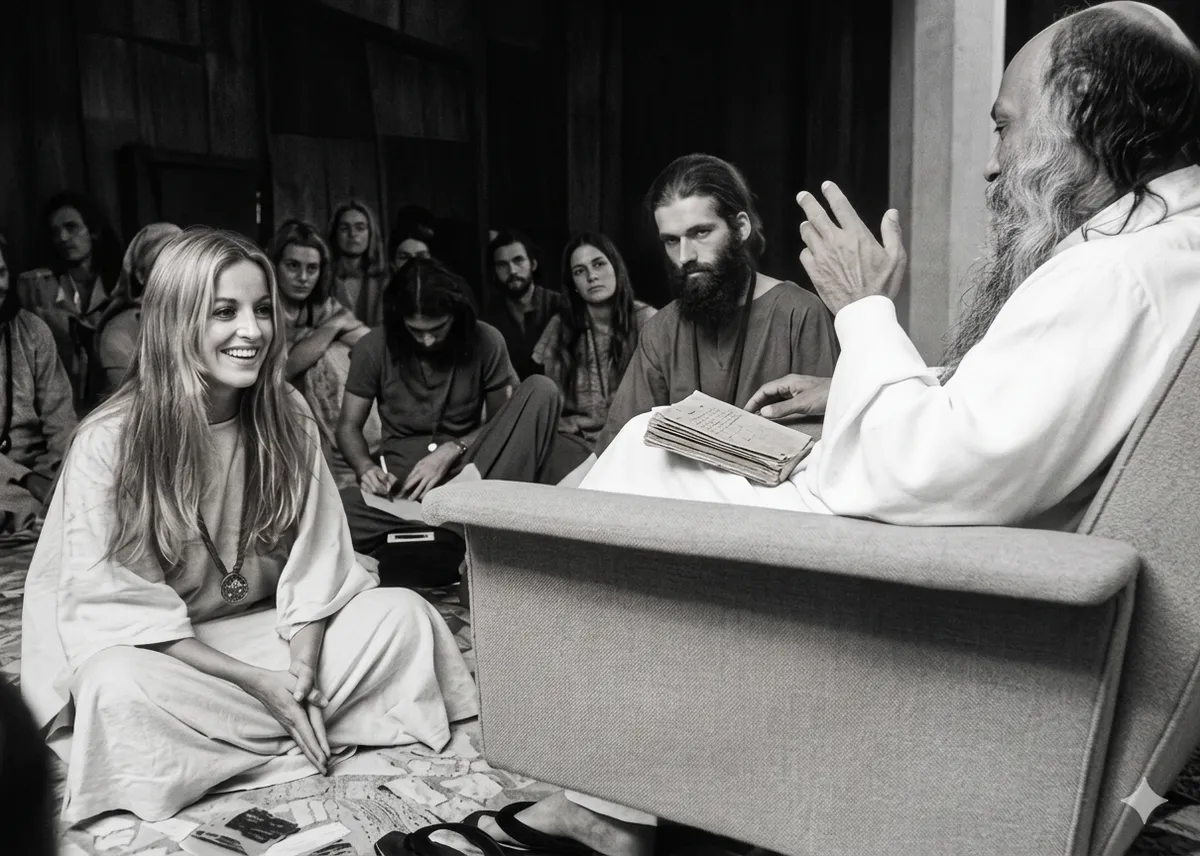
When people aren’t worried about survival, joyful Krishna-style celebration spreads—even thinkers may relax and join in.
From the Discourses
Passages where Osho speaks to this question — each links to the complete discourse.
Osho, in America, England, and other countries these days the Krishna Consciousness movement is spreading very rapidly, and they make much use of sankirtan and the like. So it seems as if it is some new variety item, some kind of entertainment, a new fad. Or can you say that some prelude is being prepared there for the birth of Krishna?
The West is now again becoming affluent by today’s standards. Perhaps in India we will still have to wait a long time for Krishna. For now, Krishna cannot sink very deep into the Indian mind. A poor, destitute society does not think of playing the flute; for it, Christ seems appropriate. For one who himself hangs on the cross every day, Christ will seem right. Therefore a very unlikely event is taking place: in India Christ’s influence is increasing daily, and in the West Christ’s influence is decreasing. To think that missionaries are simply deluding people and making them Christians is not enough. The symbol of Jesus comes very close to the poor, suffering mind of India. A missionary cannot seduce unless the symbol itself is drawing near. If he can seduce, it is only because the symbol is approaching. Now Krishna’s golden image and Rama’s statues standing in splendor…
Questioner: today a movement by the name of krishna consciousness is getting popular in america, england and other countries of the west where things like kirtan are becoming fashionable. Is it a new variety of entertainment or a fad? Or do you think that the ground is being prepared for krishna's birth in the west?
It is remarkable that when young men and young women of the West dance and do kirtan, they do it with an abandon and joy that cannot be found anywhere in India today. Go round this country where kirtan has been in vogue for centuries and you will nowhere come across that enthusiasm and joy among people who do kirtan here. For us it is a well-traveled road, a routine. For us the kirtan is now a worn out coin; we know it is worthless. For the westerners it is a new coin which is valuable. When a group passes through the streets of London singing and dancing, even the traffic police watch them in amazement. They think their youth are going crazy. No one in India will think like that; here it is an accepted ritual. But remember, real religion is run by mad people, it is not the…
Osho, what qualities in Krishna’s personality are relevant for today’s age, and what significance can his personality have today? Please shed some light.
Hence even those who worshipped Krishna have worshipped him in fragments. Surdas’s Krishna never grows beyond childhood. The adult Krishna is dangerous; Surdas could not endure him. If child Krishna teases the village women, we do not mind much; but if a young Krishna does so, we are troubled, because we can only understand on our own level. Lacking any other measure, we select a form we like and reject the rest. Those who love the Gita ignore the Bhagavata, because the Krishna of the Bhagavata is quite different; and those who love the Bhagavata avoid the Gita—where is music, color, rasa, and where the battlefield! Perhaps there is no personality greater than Krishna in swallowing such vast oppositions at once. So people have clung to one face of Krishna and denied the others. Gandhi called the Gita his mother, but he could not assimilate it. Where would Gandhi’s ahimsa…